
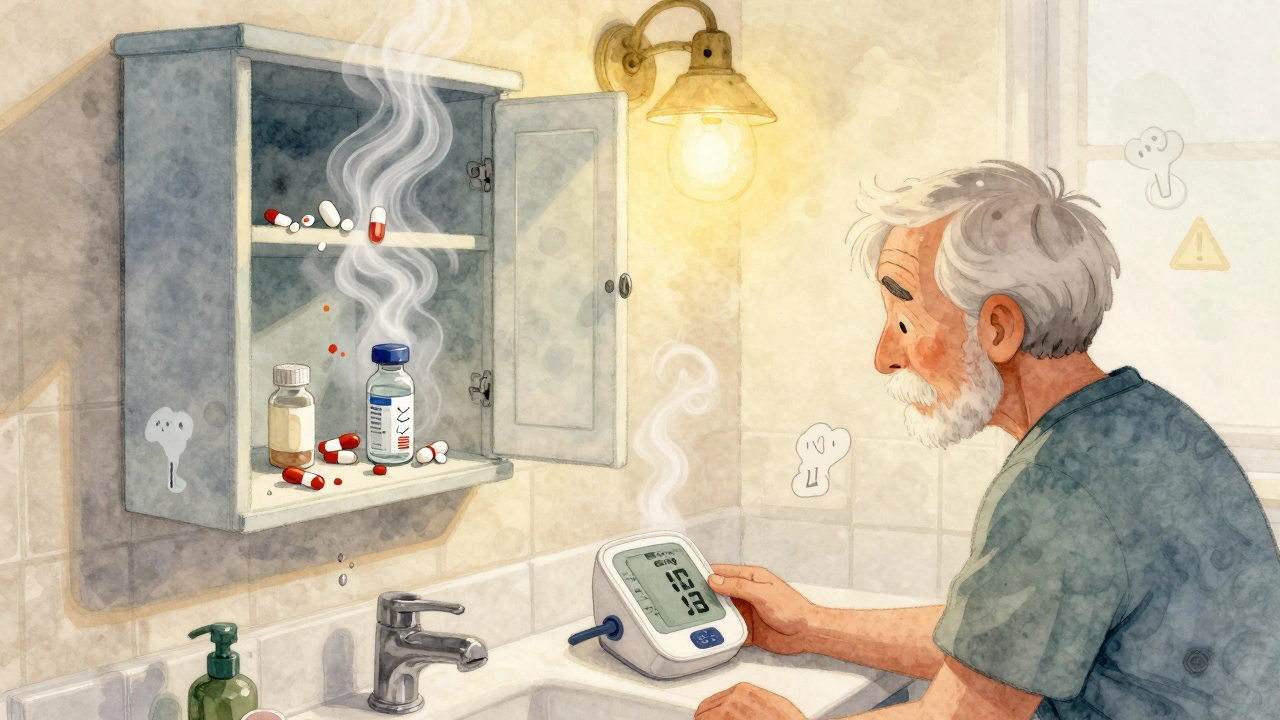
Most people keep their medications in the bathroom. It’s convenient-the medicine cabinet is right there, next to the toothbrush and shampoo. But here’s the truth: storing medications in the bathroom is one of the most common, and dangerous, mistakes people make with their prescriptions.
It’s not just about expired pills. It’s about whether your blood pressure medicine still works. Whether your insulin still lowers your glucose. Whether your antibiotic actually kills the infection. And if you’re keeping those pills in the bathroom, chances are, they’re not doing what they’re supposed to.
Why the Bathroom Is the Worst Place for Medicines
The bathroom is humid. It’s hot. It’s full of steam. Every time you take a shower, the temperature spikes by 20 to 30 degrees Fahrenheit. Humidity levels climb to 80-100%. That’s not just uncomfortable-it’s destructive to pharmaceuticals.
Medications are chemical compounds. They’re designed to stay stable under controlled conditions. Most are tested and approved for storage between 59°F and 77°F (15°C-25°C). The bathroom? It rarely stays in that range. Moisture causes tablets to break down through hydrolysis. Capsules get sticky or brittle. Powders clump. Insulin, a protein-based drug, becomes useless if it gets warmer than 86°F. Nitroglycerin, used for heart attacks, loses potency in just weeks when exposed to humidity.
A study in Circulation found that 30.2% of patients using beta-blockers stored in humid environments had inconsistent blood pressure control. That’s not a coincidence. That’s degradation. And when your medication doesn’t work, your condition doesn’t get better-it gets worse.
What Happens to Your Pills in the Bathroom?
It’s not just theory. Real people see the damage.
On Reddit’s r/pharmacy, a user shared how their blood pressure medication stopped working after being stored in the bathroom. Eighty-seven people responded with similar stories. One nurse reported that 42% of patients’ medications stored in bathrooms showed visible signs of degradation-discoloration, crumbling, odd smells. Only 8% of those stored elsewhere showed the same.
Blood glucose test strips aren’t pills, but they’re just as sensitive. A 2021 study found that 68% of test strips stored in bathrooms gave inaccurate readings. Imagine adjusting your insulin dose based on false numbers. That’s not just risky-it’s life-threatening.
Birth control pills? The FDA found humidity can reduce their effectiveness by up to 35%. That’s not a small risk. That’s a failed pregnancy waiting to happen.
And then there’s antibiotics. If they’ve degraded, they won’t kill the bacteria. Instead, they leave behind the toughest strains. That’s how antibiotic resistance grows. The World Health Organization calls this a global crisis. And storing your pills in the bathroom? It’s part of the problem.
It’s Not Just About Potency-It’s About Safety
There’s another reason to move your meds out of the bathroom: access.
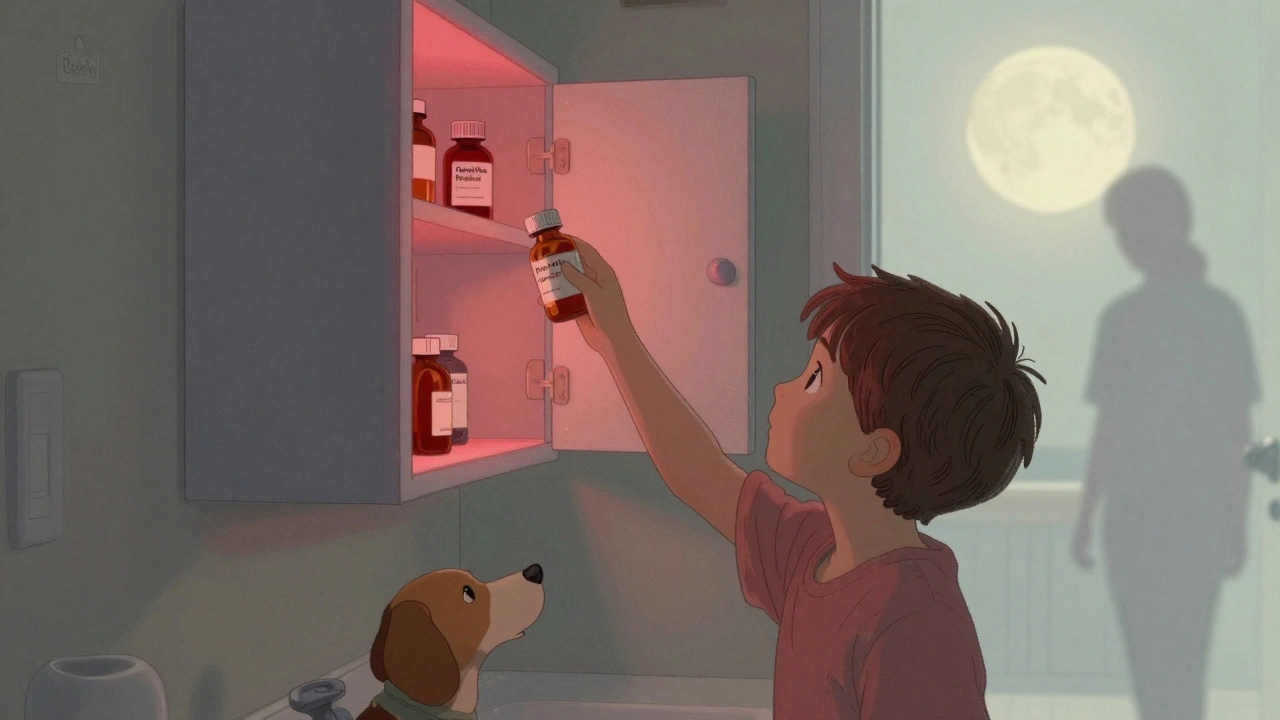
Most bathroom medicine cabinets are unlocked. Open. Easy to reach. That’s a problem if you have kids, teens, or pets in the house.
According to CDC data, 70% of misused prescription opioids come from home medicine cabinets. A 2022 NIH study found that 63% of households with children stored high-risk medications within reach. That includes painkillers, sedatives, and stimulants-all of which are commonly kept in bathrooms.
The American Academy of Pediatrics says all medications should be locked away. Not just out of sight. Not just on a high shelf. Locked. Because kids don’t understand expiration dates. They don’t know that a pill that looks the same might be broken down, dangerous, or deadly.
And it’s not just children. Teens, guests, even house cleaners can access those cabinets. One woman in WELLFOR’s 2023 report said her teenage nephew took her anxiety medication from the bathroom cabinet and ended up in the ER. She had no idea he’d even known it was there.
Where Should You Store Medications Instead?
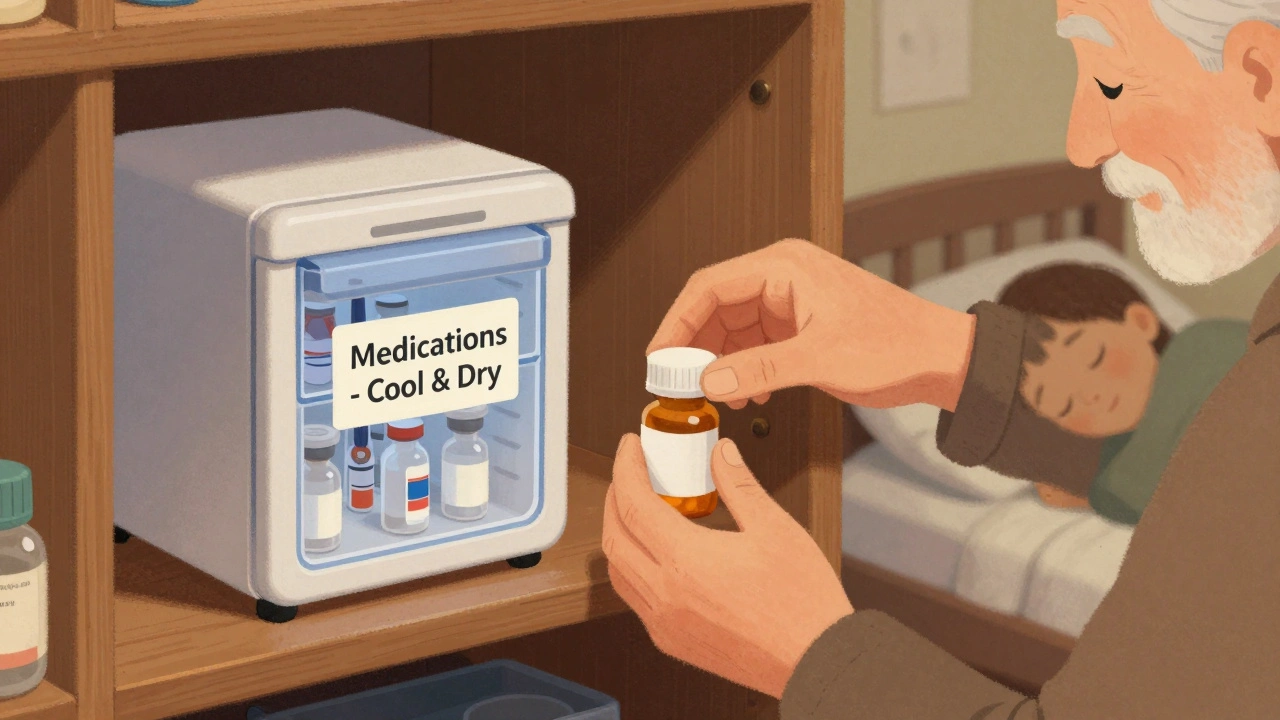
The answer is simple: a cool, dry, dark place. Away from windows. Away from heat sources. Away from moisture.
Best options:
- An interior closet in your bedroom
- A dresser drawer (not the top one-too close to heat from the ceiling)
- A dedicated storage box with a tight lid
These spots stay within 59°F-77°F year-round. Humidity stays below 50%. Temperature swings are minimal-usually just 2-3°F per day, not 20-30°F like in the bathroom.
Some medications need refrigeration-about 12% of prescriptions, including insulin, certain eye drops, and some antibiotics. These should go in a dedicated fridge, not the kitchen one. Kitchen fridges open and close constantly, causing temperature spikes that can ruin these sensitive drugs. A small, separate fridge set at 36°F-46°F is ideal.
Pro tip: Use airtight containers. Even if you store your pills in a closet, moisture can still creep in. A small plastic box with a rubber seal keeps them protected.
What About Those Little Desiccant Packets?
You’ve seen them-those little white packets that say "Do Not Eat" in your pill bottle. They’re desiccants. They absorb moisture.
But here’s the catch: they only work if the bottle stays sealed. Once you open it, the packet is only useful for a few days. If you’re storing the bottle in a humid bathroom, the packet is overwhelmed. It can’t keep up.
Some newer bottles now include humidity-indicating labels. They turn color if moisture levels get too high. As of 2023, 32 major pharmaceutical companies use these. But not all. So don’t rely on them. Move your meds anyway.
When to Throw Things Out
Expiration dates aren’t arbitrary. They’re based on stability testing under proper storage conditions. If your meds were stored in the bathroom, they may have degraded long before the date on the bottle.
Signs your medication is no longer good:
- Tablets are cracked, discolored, or sticky
- Capsules are swollen or leaking
- Liquids are cloudy or have particles
- Pills smell weird-rancid, chemical, or musty
If you see any of these, throw them out. Don’t take the risk.
And don’t flush them or toss them in the trash. That’s bad for the environment. The EPA says 46% of medications found in waterways come from improper disposal. Use a drug take-back program. Many pharmacies offer them. Or check with your local police station-they often have drop boxes.
It’s Not Too Late to Fix This
Even if you’ve kept your meds in the bathroom for years, you can still change. Start now.
Take five minutes this week:
- Clear out your bathroom medicine cabinet.
- Check each bottle for signs of damage.
- Move everything that’s still good to a cool, dry place.
- Dispose of anything that looks off-safely.
- Lock your new storage spot if you have kids or pets.
It’s not about being perfect. It’s about being safe. Your life-or someone else’s-could depend on it.
Medications are powerful tools. But they’re not magic. They need the right environment to work. And the bathroom? It’s the worst place you could choose.
Can I store my medications in the kitchen cabinet?
Only if it’s away from the stove, sink, or window. Kitchen cabinets near the stove or dishwasher get too hot and humid. A cabinet in a cool, interior part of the kitchen is okay-but a bedroom closet is still better. Avoid any spot that gets direct sunlight or heat from appliances.
What if my medicine says "store at room temperature"?
"Room temperature" means 59°F-77°F (15°C-25°C). The bathroom rarely stays in that range. Even if the label doesn’t say "avoid humidity," it’s implied. Manufacturers test drugs under controlled conditions-not in steamy bathrooms. When in doubt, store it elsewhere.
Is it safe to store pills in a pill organizer?
Yes-but only if you keep the organizer in a cool, dry place. Pill organizers expose pills to air and light, which can speed up degradation. Don’t leave one on the bathroom counter. Keep it in your bedroom drawer or on a nightstand away from windows. Use it for short-term use (a week or less), not long-term storage.
How do I know if my medication has lost potency?
You usually can’t tell just by how you feel. But physical signs include: pills that crumble, change color, or smell odd. Liquids that look cloudy or have particles. If your condition isn’t improving-even after taking your meds as directed-it could be because the drug degraded. Talk to your pharmacist. They can test some medications or advise on replacement.
Are there smart storage options for medications?
Yes. Some smart medicine cabinets now monitor temperature and humidity and send alerts to your phone if conditions get unsafe. These are still new and expensive, but they’re becoming more available. For most people, a simple airtight container in a closet is enough. If you’re managing multiple critical medications, though, a smart cabinet could be worth considering.
Marvin Gordon
December 4, 2025 AT 12:02Just moved all my meds to a locked drawer in my bedroom last week. Been using a small airtight container for the pills and it feels way better knowing they’re not getting steamed every morning. Simple fix, huge peace of mind.
Mark Ziegenbein
December 4, 2025 AT 13:47Let’s be real-the bathroom isn’t just bad for meds, it’s a biological hazard zone masquerading as hygiene. Humidity doesn’t just degrade tablets, it corrodes the very integrity of pharmaceutical chemistry. The FDA’s 59°F–77°F range isn’t a suggestion-it’s a thermodynamic contract between molecule and stability. Your insulin isn’t just ‘less effective’-it’s becoming a molecular ghost. And you wonder why your numbers are off? It’s not your body. It’s your cabinet. Stop romanticizing convenience. Science doesn’t care how pretty your towel rack is.
Jimmy Jude
December 6, 2025 AT 04:17Y’all are acting like this is news. My grandma died because her heart meds turned to mush in that steamy cabinet. She didn’t even know. I found the bottle, cracked and sticky, behind the toilet paper. Don’t be her. Move your pills. Now.
ashlie perry
December 6, 2025 AT 22:34Did you know the government puts trackers in pill bottles? That’s why they say not to store them in the bathroom-they’re monitoring your humidity levels to see if you’re sick enough to need surveillance. Also, the FDA is secretly run by Big Pharma and they want you to think your meds are breaking down so you buy new ones every month. Just sayin’.
Rupa DasGupta
December 8, 2025 AT 07:22OMG I just checked my bathroom cabinet and my birth control pills are kinda sticky 😱 I thought it was just old… but now I’m terrified. I’m moving them to my nightstand tonight and buying one of those lockboxes. Also, why does no one talk about how weird it is that we keep medicine next to toothpaste?? 🤢
Juliet Morgan
December 10, 2025 AT 00:41My mom has diabetes and she kept her insulin in the bathroom for years. She didn’t realize her readings were off because the meds were degrading. I cried when I found out. We moved everything to the back of her closet with a little humidity pack. Her A1C dropped. I’m not exaggerating-this saved her life. If you’re reading this, please just move your pills. It’s not hard. It’s not dramatic. It’s just… care.
Norene Fulwiler
December 11, 2025 AT 03:28In my village in India, we’ve always stored medicines in clay pots in the coolest corner of the house-never near water or heat. Our grandmothers didn’t have science degrees, but they knew humidity kills. Modern medicine has fancy labels, but the wisdom is the same. Don’t overthink it. Keep it cool. Keep it dry. Keep it safe.
William Chin
December 12, 2025 AT 02:32While I appreciate the general sentiment of this post, I must formally request that future public health advisories cite peer-reviewed studies with DOI identifiers, adhere to APA 7th edition formatting for all referenced materials, and include a formal risk-benefit analysis per the NIH Clinical Guidelines for Pharmaceutical Storage Integrity, dated 2021, Section 4.2. Without such rigor, this content, however well-intentioned, constitutes anecdotal advocacy and fails to meet the threshold for evidence-based public communication.