

Trimethoprim Hyperkalemia Risk Calculator
This calculator estimates your risk of hyperkalemia (high potassium levels) when taking trimethoprim based on the TMP-HyperK Score, which has 88.7% accuracy according to clinical research. Your results will show your risk level and recommend next steps for safer antibiotic use.
Most people think of antibiotics as simple fixes for infections-take a pill, feel better. But trimethoprim, a common ingredient in antibiotics like Bactrim and Septra, carries a silent, dangerous risk that many doctors still overlook: it can spike your potassium levels to deadly heights in just a few days. This isn’t a rare side effect. It’s a well-documented, life-threatening reaction that happens often enough to kill people-especially older adults and those already on blood pressure meds.
How Trimethoprim Turns Into a Potassium Trap
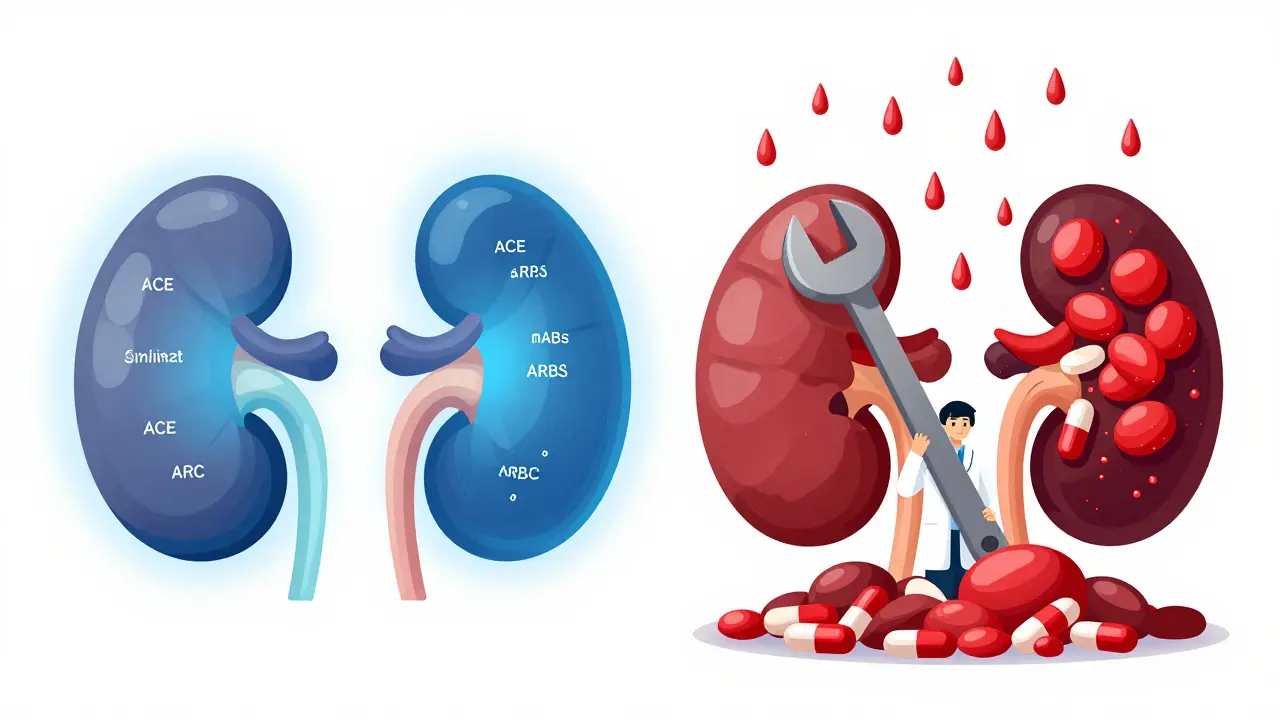
Trimethoprim doesn’t work like most antibiotics. While it kills bacteria by blocking folate synthesis, it also mimics a drug called amiloride-a potassium-sparing diuretic. That means in your kidneys, it blocks the tiny sodium channels in the distal tubules. When sodium can’t be reabsorbed, the electrical signal that pushes potassium out of your blood and into your urine gets weakened. Result? Potassium builds up.
This isn’t theoretical. Studies show that within 48 to 72 hours of starting trimethoprim, serum potassium can jump by 0.5 to 1.5 mmol/L. That might sound small, but normal potassium is 3.5-5.0 mmol/L. A rise to 6.0 or higher can trigger irregular heart rhythms, muscle weakness, or sudden cardiac arrest. One 80-year-old woman in Japan developed a potassium level of 7.8 mmol/L-nearly double the upper limit-just three days after starting a low-dose Bactrim prescription for UTI prevention. She had normal kidney function. She didn’t see it coming.
Who’s at the Highest Risk?
Not everyone gets hit. But certain groups are walking into a minefield without knowing it:
- People over 65
- Those taking ACE inhibitors (like lisinopril) or ARBs (like losartan)
- Patients with chronic kidney disease (eGFR below 60)
- Diabetics
- Anyone already on potassium-sparing diuretics (like spironolactone)
A 2014 study in JAMA Internal Medicine found that older adults on ACEIs or ARBs who took trimethoprim had a 6.7 times higher risk of being hospitalized for hyperkalemia than those taking amoxicillin. That’s not a small bump-it’s a cliff. Another study found that in patients with diabetes, kidney disease, and an ACEI/ARB, the hyperkalemia rate hit 32.1% with trimethoprim. Compare that to 4.3% with other antibiotics.
Even more alarming: many of these patients had normal kidney tests. Their creatinine was fine. Their eGFR looked okay. But trimethoprim concentrates in the kidneys at 10 to 50 times the level in the blood. So even a mildly impaired kidney can’t clear it fast enough, and potassium rises fast.
Trimethoprim vs. Other Antibiotics: The Numbers Don’t Lie
When you need an antibiotic, you have choices. Here’s how trimethoprim stacks up:
| Antibiotic | Hyperkalemia Risk (in high-risk patients) | Recommended Alternative? |
|---|---|---|
| Trimethoprim (TMP-SMX) | 8.4% (standard dose), up to 32% with risk factors | No |
| Nitrofurantoin | 1.1% (no significant increase) | Yes, for UTIs |
| Amoxicillin | 1.2% | Yes |
| Ciprofloxacin | 1.5% | Yes |
| Fosfomycin | 0.8% | Yes, for uncomplicated UTIs |
Nitrofurantoin is the go-to alternative for urinary tract infections in older patients on blood pressure meds. It doesn’t touch potassium. Ciprofloxacin and fosfomycin are also safe bets. But trimethoprim? It’s the outlier. A 2023 analysis of over 1,200 reported cases in the FDA database showed 43 deaths linked to trimethoprim-induced hyperkalemia-most in people over 65. That’s not a fluke. It’s a pattern.
Doctors Are Still Prescribing It-Without Checking Potassium
Here’s the scary part: most doctors don’t check potassium before prescribing trimethoprim. A 2023 survey found only 41.7% of primary care physicians routinely test potassium levels before giving Bactrim to patients on ACEIs or ARBs. Emergency room doctors? Only 32.4%. Nephrologists? Nearly 90%. That gap is deadly.
One Reddit thread from a doctor in Texas described a 72-year-old woman on lisinopril who developed a potassium level of 6.8 after three days of Bactrim. She needed emergency dialysis. She had no prior kidney issues. No warning signs. Just a standard UTI script.
Meanwhile, trimethoprim remains one of the top three most prescribed antibiotics in the U.S.-over 14 million prescriptions a year. About 4.2 million of those go to people over 65. That’s a lot of people being exposed to a known risk with little to no screening.
When Trimethoprim Is Still Worth the Risk
It’s not all black and white. For patients with Pneumocystis pneumonia-especially those with HIV or who’ve had organ transplants-trimethoprim is often the only effective treatment. The Infectious Diseases Society of America still lists it as first-line for this life-threatening infection. But even then, guidelines demand strict monitoring.
For these high-risk patients, the rules are clear:
- Check potassium before starting
- Test again at 48-72 hours
- Monitor weekly during long-term use
- Stop immediately if potassium exceeds 5.5 mmol/L
- Avoid entirely if baseline potassium is above 5.0 or eGFR is below 30
Hospitals that implemented mandatory electronic alerts before prescribing trimethoprim to patients on ACEIs/ARBs cut hyperkalemia events by over half. That’s not magic-it’s basic safety.

What You Can Do
If you’re on an ACE inhibitor, ARB, or have kidney disease, and your doctor prescribes Bactrim or Septra:
- Ask: "Is there a safer antibiotic for my situation?"
- Ask: "Will you check my potassium before and after I start this?"
- Ask: "What symptoms should I watch for?"
Symptoms of high potassium can be silent-or they can be sudden: muscle weakness, fatigue, irregular heartbeat, chest pain, nausea. If you feel any of these within the first week of starting trimethoprim, go to urgent care or the ER. Don’t wait. Don’t call your doctor tomorrow. This isn’t a slow problem. It’s a ticking clock.
Even if you’re young and healthy, don’t assume you’re safe. The 2023 case of the 80-year-old woman with normal kidney function proves that. Trimethoprim doesn’t care about your age or your lab numbers-it only cares about how your kidneys handle it.
What’s Changing
There’s progress. The American Heart Association now lists trimethoprim as a "high-risk medication" for heart failure patients. The FDA added hyperkalemia to its boxed warning in 2019. A new risk score called the TMP-HyperK Score, developed in 2022, can predict who’s most likely to crash with 88.7% accuracy using just four factors: age over 65, baseline potassium over 4.5, eGFR under 60, and use of ACEI/ARB.
Pharmacist-led interventions are working. One trial reduced inappropriate trimethoprim prescribing by 63% just by flagging high-risk patients in real time. The Institute for Healthcare Improvement has targeted this issue in its 2024-2026 patient safety roadmap, estimating that proper monitoring could prevent 12,000-15,000 hospitalizations a year in the U.S. alone.
But until every prescriber checks potassium before writing this script, the risk remains. And it’s not going away.
Cara C
December 21, 2025 AT 21:05Wow, I had no idea trimethoprim could do this. My grandma was on Bactrim for a UTI last year and ended up in the ER with weird muscle cramps. They thought it was dehydration. Now I’m going back through her records to check her potassium levels.
Thanks for laying this out so clearly. This needs to be common knowledge.
Michael Ochieng
December 22, 2025 AT 03:42As someone who works in pharmacy, I see this all the time. Docs grab Bactrim like it’s Advil. I’ve had to call back 3 prescriptions this month alone because the patient was on lisinopril. One guy said, ‘But my doctor said it was fine.’
Y’all need to push back. Ask for alternatives. Nitrofurantoin works just as well for UTIs and doesn’t turn your blood into a time bomb.
Cameron Hoover
December 23, 2025 AT 14:05I’m 71 and on lisinopril. My PCP prescribed Bactrim last week for a ‘possible’ UTI. I didn’t say anything because I didn’t want to be ‘that guy.’
Now I’m checking my potassium every day. I’ve got a home monitor. If it hits 5.2, I’m going straight to the ER. No waiting. No ‘let’s wait and see.’ This isn’t a drill.
Grace Rehman
December 24, 2025 AT 22:17so like... the system is designed to kill old people quietly
they give you a pill that quietly stops your heart
but only if you're over 65 and on blood pressure meds
and no one checks
and the doctor says 'it's fine' because they learned this in 1998
and the FDA added a warning in 2019 but still lets 14 million prescriptions go out
and we wonder why people are distrustful
its not a conspiracy its just capitalism with a stethoscope
Jerry Peterson
December 26, 2025 AT 07:27My dad had a potassium spike on trimethoprim. He was fine before. No kidney issues. Normal labs. Then boom-weakness, dizziness, ER. They didn’t even think to check K+ until his EKG looked like a seizure.
Now I print out that JAMA study and hand it to every doctor who tries to prescribe Bactrim to me or my parents. It’s not rude. It’s survival.
Meina Taiwo
December 27, 2025 AT 00:33This is why we need better antibiotic guidelines in primary care. Trimethoprim is cheap and easy. But it’s not safe for many. Nitrofurantoin, fosfomycin-better options exist. Doctors need training, not just prescriptions.
Adrian Thompson
December 28, 2025 AT 12:13THEY KNOW. THEY KNOW THIS KILLS PEOPLE. THEY STILL DO IT. WHY?
Big Pharma owns the AMA. The FDA is a revolving door. Bactrim is generic but the real profit is in the labs, the ER visits, the dialysis. They want you sick. They want you hooked.
Check your potassium. Or don’t. But don’t say I didn’t warn you when your heart stops.
Also: 5G causes hyperkalemia. Just saying.
Southern NH Pagan Pride
December 30, 2025 AT 08:41the fda warned in 2019 but the pharma lobby pushed back and now the algorithm on eprescribe still auto-populates bactrim for utis in patients on arbs
theyre using machine learning to kill us faster
my aunt died after 4 days of bactrim
her eGFR was 58
they said it was 'unexpected'
it wasnt
its a feature not a bug
Jackie Be
December 30, 2025 AT 19:14I just started Bactrim yesterday for a UTI and I’m 68 and on lisinopril and I just read this and now I’m sweating and my arm feels heavy and I think I’m gonna die
can someone tell me if this is real or am I having a panic attack
my potassium was 4.6 last month
HELP
John Hay
December 31, 2025 AT 10:05Jackie, don’t panic. Stop the antibiotic. Call your doctor or go to urgent care. Get a potassium test. Right now. Don’t wait. This is real. I’ve seen it. You’re not crazy. You’re smart for asking.
And if your doctor dismisses you, go to another one. Your life matters more than their schedule.
Stacey Smith
December 31, 2025 AT 19:20USA is falling apart. We let corporations run medicine. You think this is an accident? No. It’s profit. We need to ban this drug. No exceptions. Not even for HIV. Let them use something else. We’re not a third world country.
Jason Silva
January 2, 2026 AT 07:40bro this is wild 😳
i just got prescribed bactrim for my sinus infection and i’m on losartan
i’m gonna ask for cipro instead
if you’re on blood pressure meds and they give you bactrim… run. literally run to the pharmacy and ask for something else
your heart will thank you 💪❤️
mukesh matav
January 4, 2026 AT 04:48Interesting. In India, we rarely use trimethoprim for UTIs. Nitrofurantoin or cipro are first-line. Even in older patients. Maybe because we don’t have as many ACEIs prescribed? Or just better awareness?
Still, this is a global problem. Doctors everywhere need to wake up.