
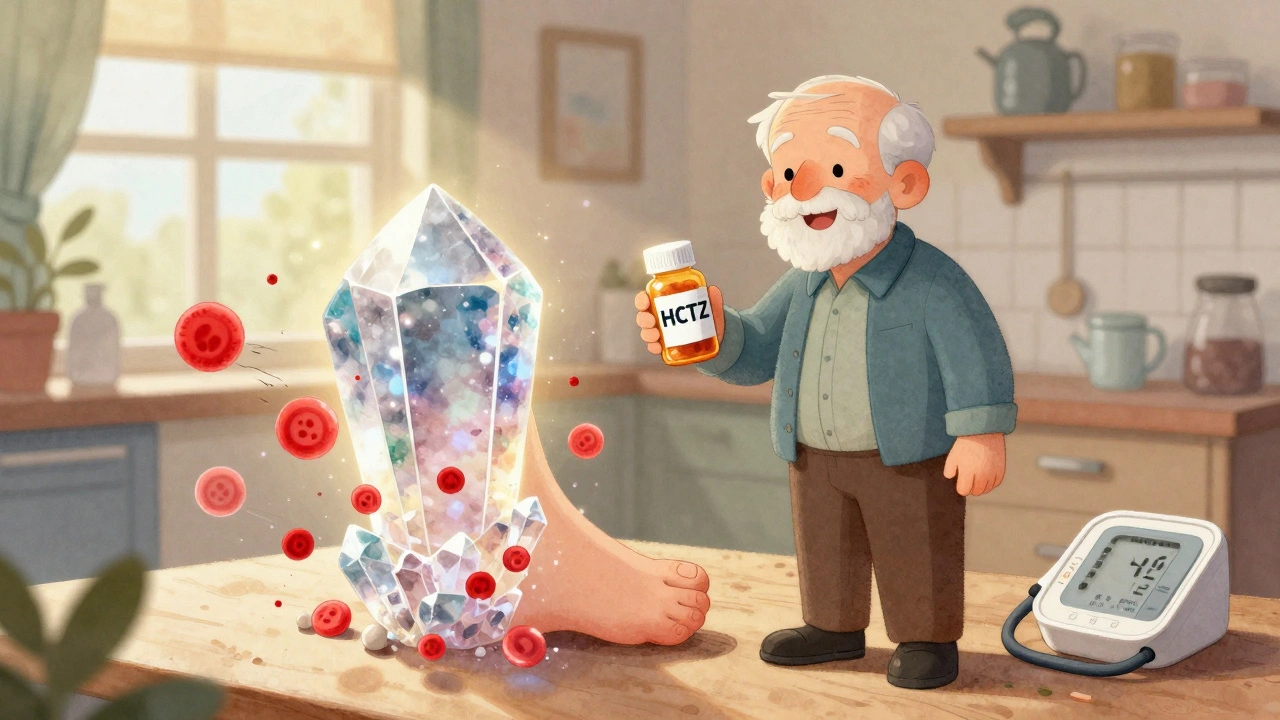
Many people take thiazide diuretics to control high blood pressure. One of the most common ones, hydrochlorothiazide (HCTZ), is cheap, effective, and prescribed over 35 million times a year in the U.S. But for some, it comes with a hidden cost: a sudden spike in uric acid that can trigger gout. If you’ve been told you have high uric acid or have had a gout flare-up before, this isn’t just a side effect-it’s a red flag you can’t ignore.
How Thiazide Diuretics Raise Uric Acid
Thiazide diuretics work by making your kidneys dump more sodium and water, which lowers blood pressure. But here’s the twist: they also interfere with how your body gets rid of uric acid. Uric acid is a natural waste product from breaking down purines in food. Normally, your kidneys filter it out and send it through urine. But thiazides block the same transporters-OAT1 and OAT4-that move uric acid out of your blood and into your urine.
Instead of being flushed out, uric acid builds up in your bloodstream. Studies show levels can rise by 6% to 21% within just 3 to 7 days of starting the drug. That’s not a slow creep-it’s a fast climb. And once it hits 6.8 mg/dL, the saturation point for uric acid in blood, crystals start forming in your joints. That’s when the pain hits.
The Gout Risk Isn’t Small
Not everyone who takes thiazides gets gout. But the risk is real. A 2024 study tracking nearly 250,000 people found that after 180 days on thiazides, the chance of needing gout medication jumped by 41% compared to those not taking them. The longer you’re on it, the higher the risk. After a year, it’s nearly 1.5 times more likely.
And it’s not just about the drug. If you already have high uric acid-above 7.0 mg/dL for men or 6.0 mg/dL for women-you’re already in the danger zone. Add thiazides on top, and you’re stacking the odds. About 12% to 15% of people on these drugs develop hyperuricemia. And while only 1% to 2% go on to have full-blown gout attacks, those numbers don’t matter much if it’s you.
Chlorthalidone vs. Hydrochlorothiazide: Is One Worse?
For years, doctors assumed chlorthalidone was riskier than hydrochlorothiazide because it’s stronger and lasts longer. But a 2019 study busted that myth. When given at similar doses, both drugs raise uric acid levels about the same. The difference isn’t in the drug-it’s in the dose. Higher doses mean higher risk. A 50 mg dose of HCTZ carries more risk than a 12.5 mg dose. But even low doses can push uric acid over the edge in sensitive people.
So if you’re switching from one to the other thinking you’re avoiding gout, you’re not. What matters is whether you’re taking any thiazide at all-and how long you’ve been on it.
Who’s Most at Risk?
Not everyone reacts the same. Some people can take thiazides for years without a problem. Others get their first gout flare within weeks. Why? Genetics play a big role. If your family has a history of gout, you’re more likely to have trouble clearing uric acid. Kidney function matters too. If your kidneys aren’t filtering well, even a small nudge from a diuretic can tip you over.
Other factors pile on: drinking beer or liquor, eating red meat or shellfish, being overweight, or having high blood pressure itself. Yes, hypertension is its own risk factor for gout. That’s why it’s so hard to tell if the diuretic is the real culprit or just the final straw.
What Does a Gout Attack Feel Like?
If you’ve never had gout, it’s hard to imagine. One minute, your big toe feels fine. The next, it’s swollen, red, hot, and so tender that even a bedsheet feels like sandpaper. The pain hits fast-often overnight-and peaks within 24 hours. Most attacks start in the big toe, but ankles, knees, and fingers can get hit too. It’s not just pain. It’s inflammation that can last days or weeks if untreated.
Doctors don’t need fancy tests to diagnose it. If your uric acid is above 6.8 mg/dL and you have that classic toe flare, it’s gout. Blood tests alone aren’t enough-some people have high uric acid but never get symptoms. Others have normal levels during an attack. The pain and swelling tell the real story.
What Should You Do If You’re on Thiazides?
If you’re taking a thiazide and have no history of gout, don’t panic. But do get your uric acid checked. The American College of Cardiology recommends testing before you start, especially if you’re over 50, overweight, or have high blood pressure. If your level is already above 7.0 mg/dL, your doctor should think twice before prescribing thiazides.
If you’ve had a gout attack before, thiazides aren’t the best choice. The European League Against Rheumatism says avoid them unless you’re also on urate-lowering therapy like allopurinol. Start with 100 mg daily and keep your uric acid below 6.0 mg/dL to prevent crystals from forming.
And if you’re already on thiazides and just had your first gout flare? Don’t stop cold turkey. Talk to your doctor. You might need to switch. But if your blood pressure is hard to control, you may need to keep the diuretic and add a gout medication. That’s not ideal, but it’s often necessary.
Alternatives That Don’t Raise Uric Acid
There are other blood pressure drugs that don’t mess with uric acid. Losartan, an ARB, actually helps your kidneys flush out more uric acid. Calcium channel blockers like amlodipine are neutral. And spironolactone, a potassium-sparing diuretic, doesn’t raise uric acid at all.
Here’s the catch: these aren’t always cheaper. Generic HCTZ costs about $4 for 90 tablets. Losartan? Around $10. Amlodipine? $8. Spironolactone? $6. For many people, the price difference matters. But if you’ve had gout, the cost of a flare-missed work, ER visits, pain meds-can be much higher.

What About Lifestyle?
Medication isn’t the whole story. Diet and habits shape your uric acid levels just as much as pills. Alcohol-especially beer and hard liquor-makes your body produce more uric acid and blocks its removal. Red meat, organ meats, and shellfish are packed with purines. Even sugary drinks with high-fructose corn syrup can spike levels.
Drinking more water helps your kidneys flush out uric acid. Losing weight reduces the burden on your joints and your liver’s purine production. And cutting back on alcohol? That alone can lower your risk of gout flares by up to 40%.
These changes aren’t optional if you’re on thiazides and have high uric acid. They’re part of your treatment plan.
When to Stop or Switch
There’s no one-size-fits-all answer. But here’s a practical guide:
- If you’re on thiazides and your uric acid is above 7.0 mg/dL-ask your doctor about switching.
- If you’ve had even one gout attack-thiazides should be avoided unless you’re on allopurinol.
- If you’re on a high dose (25 mg or more of HCTZ)-consider lowering it or switching.
- If you’re doing fine and your uric acid is normal-keep monitoring every 6 to 12 months.
Don’t assume your doctor knows your uric acid level. Many don’t check unless you bring it up. Ask for a simple blood test. It takes five minutes. It could save you months of pain.
The Bigger Picture
Thiazide diuretics saved lives. They lowered blood pressure, cut strokes, and reduced heart attacks in millions. But medicine isn’t about one-size-fits-all. It’s about matching the right tool to the right person.
If you’re healthy, young, with no family history of gout and normal kidney function-thiazides are still a solid choice. But if you’re older, overweight, have high uric acid, or have had even one gout flare, it’s time to rethink your options. The goal isn’t just to lower blood pressure. It’s to protect your joints, your kidneys, and your quality of life.
There’s no shame in switching meds. The real risk isn’t changing your prescription-it’s ignoring the warning signs until your toe swells up and you can’t walk.
Can thiazide diuretics cause gout even if I’ve never had it before?
Yes. Thiazide diuretics raise uric acid levels in the blood, which can trigger gout even in people who’ve never had it. About 1% to 2% of people on these drugs develop gout within a few months to a year. The risk is higher if you’re overweight, drink alcohol, eat purine-rich foods, or have a family history of gout.
How soon after starting thiazides does uric acid rise?
Uric acid levels can increase within 3 to 7 days of starting a thiazide diuretic. The rise is dose-dependent, meaning higher doses cause bigger spikes. Levels usually stabilize after a few weeks but remain elevated as long as you keep taking the medication.
Is chlorthalidone worse than hydrochlorothiazide for gout?
No. Recent studies show both drugs raise uric acid levels similarly when given at comparable doses. Earlier beliefs that chlorthalidone was riskier were based on higher typical doses, not the drug itself. The key factor is the dose, not the specific type of thiazide.
Should I stop taking thiazides if I develop gout?
Don’t stop on your own. Talk to your doctor. You may need to switch to a different blood pressure medication like losartan or a calcium channel blocker. If your blood pressure is hard to control, you might need to stay on the thiazide but start taking allopurinol to prevent future flares. Stopping abruptly can cause your blood pressure to rebound.
Are there blood pressure meds that help lower uric acid?
Yes. Losartan, an ARB, helps your kidneys excrete more uric acid by blocking the URAT1 transporter. It’s one of the few blood pressure drugs that can actually lower uric acid levels. Calcium channel blockers and potassium-sparing diuretics like spironolactone don’t raise uric acid and are safe alternatives.
How often should I get my uric acid checked if I’m on thiazides?
If you’re starting thiazides and have risk factors for gout (overweight, family history, high blood pressure), get your uric acid checked before you start and again at 3 months. If levels are normal and you have no symptoms, check every 6 to 12 months. If levels rise or you develop joint pain, see your doctor right away.
Audrey Crothers
December 13, 2025 AT 07:48OMG I just found out my HCTZ might be why my toe exploded last month 😭 I thought it was from beer, but now I get it. My doc never even mentioned uric acid! Going to ask for a test tomorrow. Thank you for posting this!!
Stacy Foster
December 15, 2025 AT 01:15Big Pharma knows this and hides it. Why? Because they make billions off gout meds AND blood pressure pills. You think they want you switching to cheap losartan? Nope. They want you stuck on HCTZ + allopurinol + NSAIDs forever. Wake up.
Lawrence Armstrong
December 16, 2025 AT 17:30Uric acid spikes fast - I saw it in my labs after 5 days on 25mg HCTZ. Went from 5.8 to 7.1. No gout yet, but I switched to amlodipine. Worth the extra $4/month. Your joints will thank you. 🙏
Nathan Fatal
December 18, 2025 AT 09:37Medicine is reductionist. We treat blood pressure like a number, not a system. But the body doesn’t care about targets - it cares about balance. Thiazides disrupt renal excretion pathways. That’s not a side effect - it’s a physiological cascade. If we treated patients as whole systems, not data points, we’d see this coming. The real failure isn’t the drug. It’s the model.
Rob Purvis
December 20, 2025 AT 08:22Just want to add - if you're on thiazides and you're over 50, or have a family history of gout, or even just drink a beer on weekends - get your uric acid checked. Seriously. It’s a $15 blood test. I ignored mine for a year. Then I got a flare so bad I couldn’t wear socks. Don’t be me.
Laura Weemering
December 21, 2025 AT 14:58It’s all about the URAT1 transporter… the epigenetic modulation of renal excretion pathways… the inflammatory cytokine cascade triggered by MSU crystals… and yet, we reduce it to ‘take a pill.’ We’ve lost the narrative. The body is not a machine. It’s a symphony. And thiazides? They’re the sour note.
Reshma Sinha
December 22, 2025 AT 16:56India has so many people on HCTZ - and so many with gout now. Doctors don’t check uric acid here. I told my uncle to switch to losartan. He did. No more pain. No more pills for gout. Just one med now. Simple. 💪
Donna Anderson
December 24, 2025 AT 02:13my dr said hctz is fine but i asked for a test anyway… turns out my uric acid was 7.4. i switched to spironolactone and my toe stopped screaming. also lost 15 lbs. best decision ever. 🙌
Levi Cooper
December 24, 2025 AT 05:43Why are we letting foreign drug companies dictate our health? HCTZ is American-made, cheap, and effective. Losartan? Made in China. Spironolactone? Mostly imported. We’re trading safety for patriotism. That’s not logic - that’s fear.
sandeep sanigarapu
December 25, 2025 AT 16:57Thiazides are not evil. But they are not neutral either. For patients with normal kidney function and no family history, they remain appropriate. For others, alternatives exist. The key is screening. Not suspicion. Not fear. Just testing.
Ashley Skipp
December 27, 2025 AT 11:21my doctor said dont worry about it i said but my toe hurt he said its just gout youll be fine
nikki yamashita
December 28, 2025 AT 23:00Switched to losartan and I feel like a new person. No more midnight toe pain. No more hiding my feet. And my BP is even better now. You’re not giving up - you’re upgrading. 💥
Adam Everitt
December 29, 2025 AT 05:30hctz is fine for me… uric acid 6.2… no gout… but i do drink a lot of beer… maybe thats the real problem… 🤔