
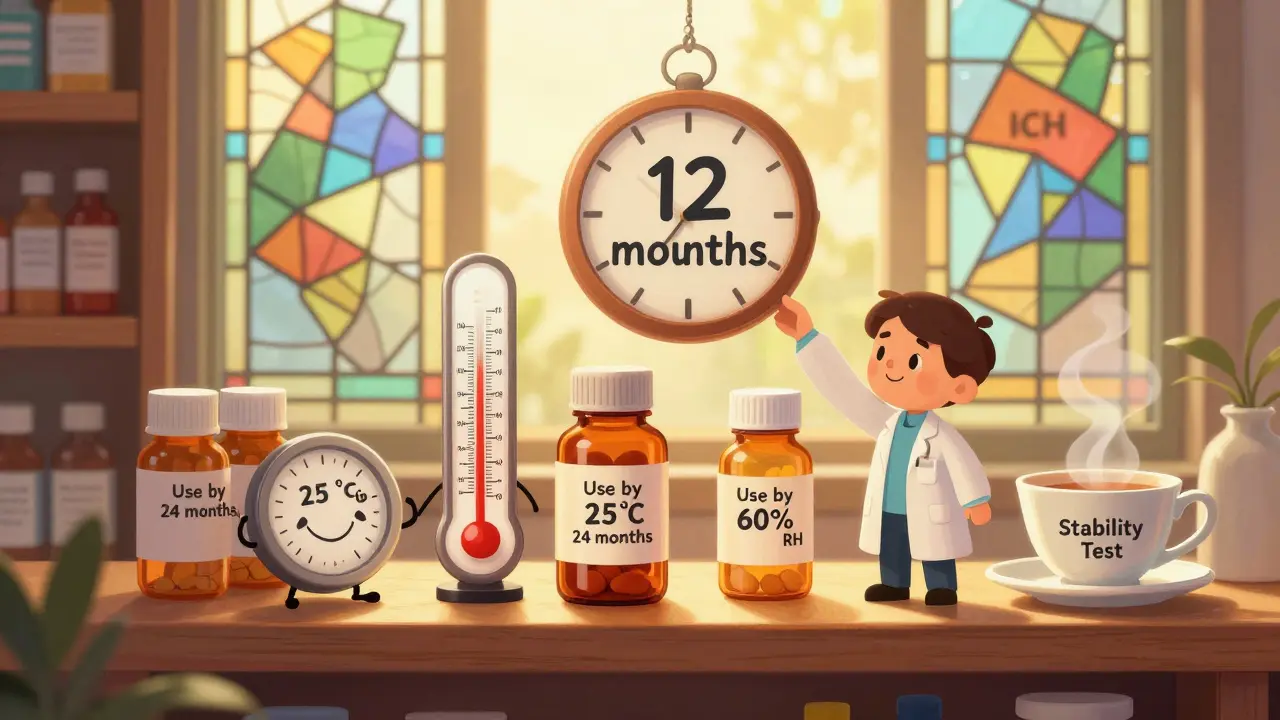
When a drug leaves the lab and enters the market, it has to last. Not just for weeks or months-but for years. Patients rely on it to work the same way on day one and day 730. That’s where stability testing comes in. It’s not optional. It’s not a suggestion. It’s a legal requirement enforced by global regulators like the FDA, EMA, and Health Canada. And at the heart of every stability study are two non-negotiable factors: temperature and time.
Why Temperature and Time Matter
Drugs aren’t static. They degrade. Heat, moisture, and light can break down active ingredients, change how they dissolve in your body, or create harmful byproducts. A pill that’s 98% potent when packaged might drop to 87% after a year in a hot warehouse. That’s not just a quality issue-it’s a safety risk. Stability testing simulates real-world conditions to catch these changes before patients ever see the product.
The goal? To prove that your drug stays within strict quality limits-potency, purity, dissolution, appearance-throughout its shelf life. That’s how regulators decide how long you can label it: "Use by 24 months." And that’s why temperature and time aren’t just numbers on a form. They’re the foundation of patient safety.
ICH Q1A(R2): The Global Standard
Since 2003, the International Council for Harmonisation (ICH) Q1A(R2) guideline has been the rulebook for stability testing worldwide. It doesn’t just apply in the U.S. or Europe. It’s used in Japan, Canada, Australia, Singapore, and more. That’s because the pharmaceutical industry can’t afford to run five different sets of tests for five different markets. Harmonization saves time, money, and lives.
ICH Q1A(R2) defines three main testing conditions, each with exact temperature and humidity targets:
- Accelerated testing: 40°C ± 2°C and 75% RH ± 5% RH for 6 months
- Long-term testing: Either 25°C ± 2°C / 60% RH ± 5% RH OR 30°C ± 2°C / 65% RH ± 5% RH
- Intermediate testing: 30°C ± 2°C / 65% RH ± 5% RH for 6 months (only if needed)
These aren’t guesses. They’re based on decades of data. The 40°C/75% RH condition was chosen because it’s harsh enough to accelerate degradation-but not so extreme that it creates artificial failure modes. Think of it like stress-testing a car engine. You don’t push it to 200 mph, but you run it hard enough to find weak points.
Long-Term Testing: The Real Clock
Accelerated testing gives you early warnings. But long-term testing is what actually defines your product’s shelf life. This is where you wait. And wait. And wait.
For most solid oral dosage forms-tablets and capsules-you run long-term studies at either 25°C/60% RH or 30°C/65% RH. Which one? It depends on where the product will be sold. The world isn’t one climate. ICH breaks it into five zones:
- Zone I (Temperate): 21°C / 45% RH
- Zone II (Mediterranean/Subtropical): 25°C / 60% RH
- Zone III (Hot-Dry): 30°C / 35% RH
- Zone IVa (Hot-Humid/Tropical): 30°C / 65% RH
- Zone IVb (Hot/Higher Humidity): 30°C / 75% RH
If you’re selling in India, Brazil, or Nigeria, you’re likely targeting Zone IVa. That means your long-term study must be run at 30°C/65% RH-not 25°C. And you need at least 12 months of data before you can submit for approval. The FDA requires this. The EMA allows 6 months under certain conditions, but if you want global approval, 12 months is the safe bet.
Testing doesn’t happen once. It happens at 0, 3, 6, 9, 12, 18, 24, and 36 months. Early time points catch fast-degrading products. Later ones confirm long-term stability. Chambers must hold temperature within ±0.5°C and humidity within ±2% RH. Even a 1.5°C spike for a week can invalidate months of data.
Refrigerated and Frozen Products
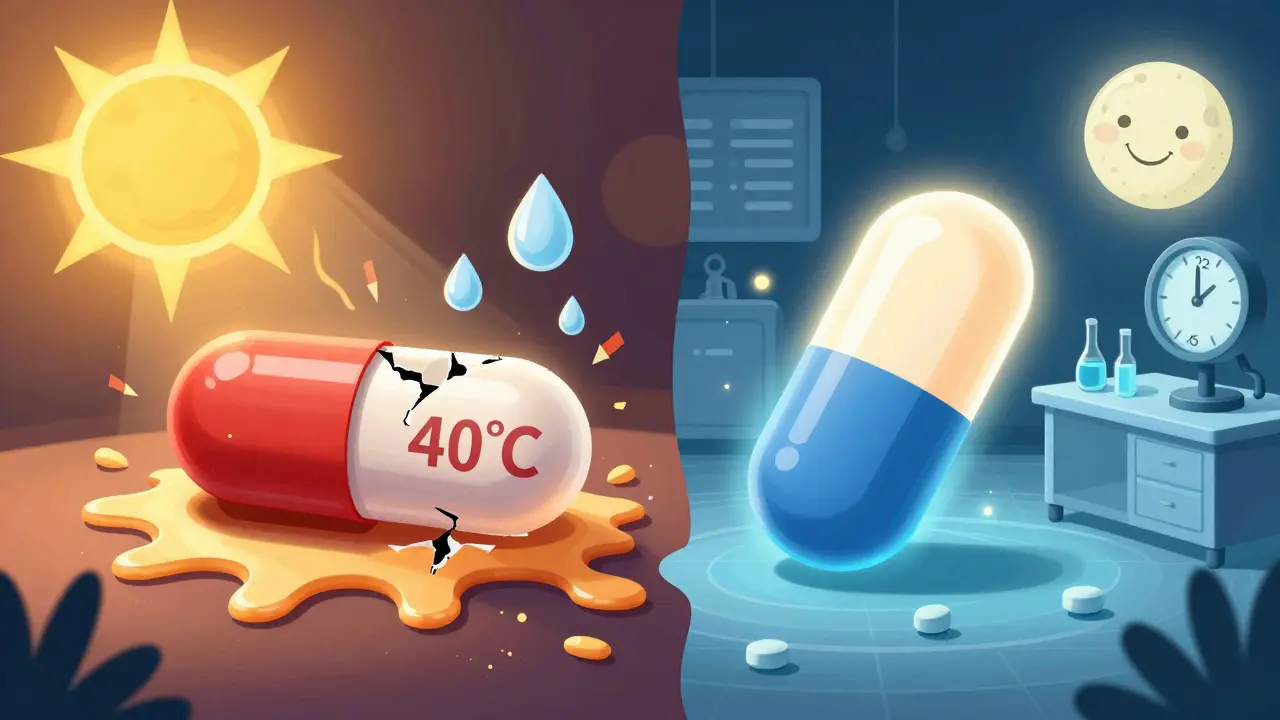
Not all drugs sit on a pharmacy shelf. Insulin, vaccines, monoclonal antibodies, and many biologics need refrigeration-or even freezing. Their stability rules are different.
- Refrigerated: Long-term at 5°C ± 3°C for 12 months. Accelerated? Not at 40°C. Instead, it’s 25°C ± 2°C / 60% RH for 6 months.
- Frozen: Typically stored at -20°C or colder. Testing focuses on freeze-thaw cycles, ice crystal formation, and protein denaturation. There’s no single ICH guideline yet for these, so companies develop their own protocols based on product behavior.
Here’s the catch: a biologic that’s stable at 5°C might degrade rapidly if it’s accidentally exposed to room temperature during shipping. That’s why real-time monitoring and transport studies are now part of the process. One FDA warning letter in 2022 cited a vaccine manufacturer for failing to test stability after a 10-hour exposure to 28°C during transit.
What Counts as a "Significant Change"?
ICH Q1A(R2) says stability testing fails if there’s a "significant change." But it doesn’t define what that means. That’s a problem.
Regulators expect:
- 5% loss in potency
- Any new impurity above identification threshold (usually 0.1%)
- Changes in physical properties-color, texture, dissolution rate
- Failure to meet microbial limits
But here’s where things get messy. One lab might reject a product that drops from 100% to 95.2% potency. Another might accept it. A Pfizer analyst shared on Reddit that a 4.8% drop in assay was flagged as a failure-even though statistical analysis showed it was within normal variation. The regulator didn’t care about the math. They cared about the number.
This lack of clarity causes delays, retests, and even recalls. Teva had to pull 150,000 vials of Copaxone® in 2021 because accelerated testing didn’t catch aggregation issues at 40°C. The problem? Their protocol didn’t include enough time points or sensitive enough assays.
Challenges in Real-World Testing
Even with perfect protocols, real life gets in the way.
Stability chambers are expensive, and they’re finicky. A 2023 survey of 142 pharma professionals found that 78% had experienced at least one temperature excursion-where the chamber went outside the ±2°C range. One incident can wipe out six months of data. That’s a $50,000 loss.
Humidity control is another headache. In dry climates like Arizona or Dubai, keeping 65% RH requires powerful humidifiers. In humid places like Singapore, dehumidifiers struggle to keep up. The best labs now use dual-loop systems that cut humidity swings from ±8% to ±3%.
And then there’s the waiting. A typical stability study takes 12 to 36 months. That’s longer than most startup funding rounds. Companies often delay product launches because they’re waiting for data. Merck’s Keytruda® team found a polymorphic transition in their drug by running intermediate testing at 30°C/65% RH-a change no one expected. That discovery prevented a potential bioavailability issue in tropical markets. But it also added six months to their timeline.
What’s Changing? The Future of Stability Testing
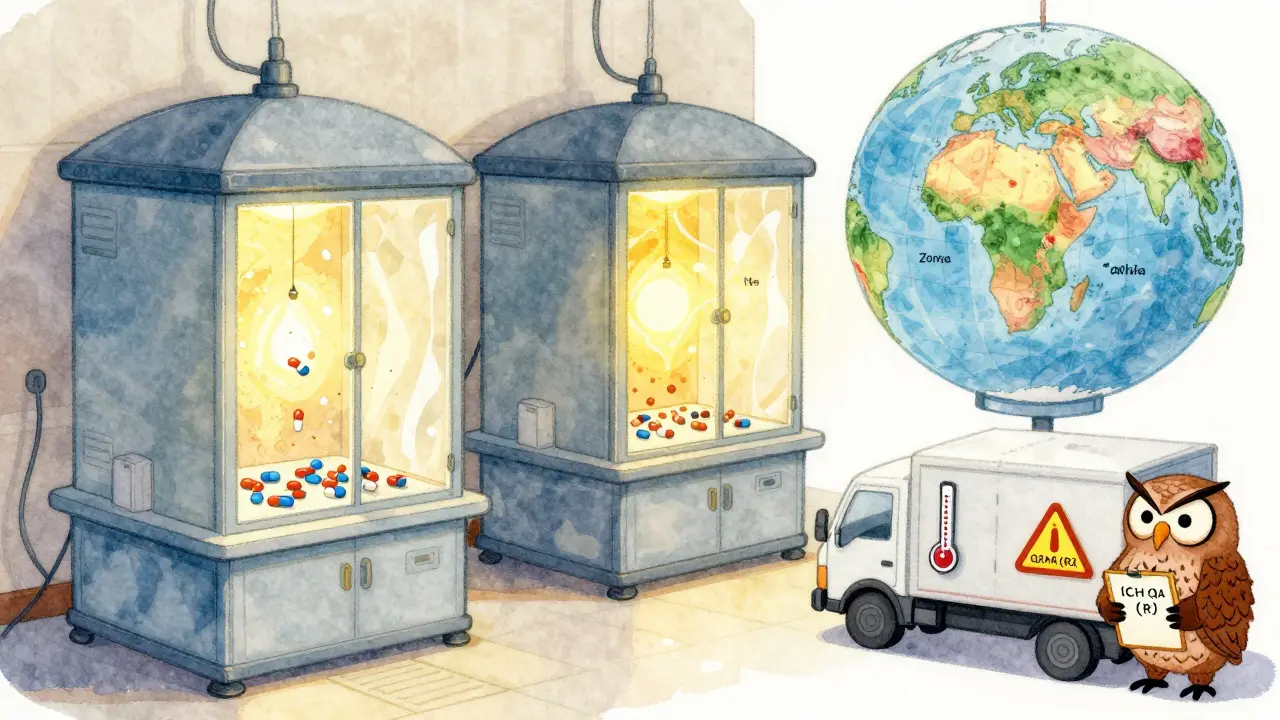
The ICH Q1A(R2) guideline is 20 years old. It was written for aspirin and amoxicillin. It wasn’t built for mRNA vaccines, antibody-drug conjugates, or lipid nanoparticles.
Experts agree: the rules need updating. The American Association of Pharmaceutical Scientists (AAPS) points out that 62% of stability failures in tablets come from humidity cycling-not constant conditions. But current tests assume humidity stays steady. In real life, it doesn’t. A drug shipped from Chicago to Miami goes through 30% RH to 85% RH in a single week.
Also, predictive modeling is gaining ground. Top pharma companies are now using accelerated tests at 50°C, 60°C, even 80°C to predict stability in months instead of years. One study showed this could cut time-to-market by 9 to 12 months. But regulators are skeptical. The EMA rejected eight model-based submissions in 2022 and 2023 because they couldn’t verify the math.
Meanwhile, the FDA is testing real-time stability monitoring using process analytical technology (PAT). If it works, future products might not need 12 months of physical testing. Instead, sensors in the manufacturing line could track degradation as the product is made.
What You Need to Do
If you’re developing a drug, here’s your checklist:
- Choose your target markets and match them to the correct ICH climatic zone.
- Run long-term testing at the zone’s required temperature and humidity for at least 12 months.
- Run accelerated testing at 40°C/75% RH for 6 months (unless it’s refrigerated).
- Test at 0, 3, 6, 9, 12, 18, 24, and 36 months. More often if degradation is expected.
- Calibrate chambers monthly. Document every temperature and humidity reading.
- Define "significant change" in your protocol-and stick to it.
- Include transport and abuse testing for products that move.
Don’t treat stability testing as a box to check. Treat it like your product’s insurance policy. Skip the details, and you risk recalls, regulatory action, or worse-harming patients.
Final Thoughts
Temperature and time aren’t just lab parameters. They’re the silent guardians of drug quality. The same pill that helps someone sleep tonight might be useless-or dangerous-next year if it wasn’t tested properly. The system isn’t perfect. It’s slow. It’s expensive. But it works. And until something better comes along, following ICH Q1A(R2) isn’t just compliance. It’s responsibility.
What are the standard temperature and humidity conditions for long-term stability testing?
The ICH Q1A(R2) guidelines define two primary conditions for long-term stability testing: 25°C ± 2°C with 60% RH ± 5% RH, or 30°C ± 2°C with 65% RH ± 5% RH. The choice depends on the target market’s climate zone. For example, products sold in tropical regions (Zone IVa) require testing at 30°C/65% RH. At least 12 months of data under these conditions must be available at the time of regulatory submission.
Why is accelerated testing done at 40°C and 75% RH?
The 40°C/75% RH condition was chosen because it’s harsh enough to accelerate degradation of most small-molecule drugs without causing unrealistic chemical changes. It simulates extreme but plausible environmental stress, such as a drug being stored in a hot warehouse or shipped during summer. Six months at this condition typically correlates to about two years of real-time storage at 25°C/60% RH for 85% of products, helping predict shelf life faster.
Do refrigerated drugs follow the same stability rules?
No. Refrigerated products like insulin or vaccines are tested at 5°C ± 3°C for long-term stability. Their accelerated condition is 25°C ± 2°C / 60% RH ± 5% RH-not 40°C. This is because freezing and thawing, not heat, are the main risks for biologics. Testing focuses on protein stability, aggregation, and freeze-thaw cycles, which standard protocols don’t capture.
What happens if a stability study fails?
A failed stability study means the product doesn’t meet its quality specifications over time. This can trigger regulatory actions like warning letters, product recalls, or denial of marketing approval. For example, Teva had to recall 150,000 vials of Copaxone® in 2021 after accelerated testing revealed aggregation issues that weren’t caught earlier. Companies must investigate the cause, update their protocols, and often retest the entire batch.
How long does a full stability study take?
A full long-term stability study typically runs for 24 to 36 months to cover the product’s full shelf life. However, at the time of regulatory submission, companies must have at least 12 months of data under long-term conditions. Accelerated testing provides early results after 6 months, helping identify potential issues before the full study completes.
Are there any new developments in stability testing?
Yes. The ICH is working on a new guideline (Q1F) to address complex products like antibody-drug conjugates and mRNA vaccines. The FDA is also piloting real-time stability monitoring using process analytical technology (PAT), which could reduce the need for physical testing. Predictive modeling using high-temperature data is becoming more common, but regulators still require physical validation. The trend is toward risk-based, data-driven approaches rather than one-size-fits-all protocols.
Gerald Tardif
December 27, 2025 AT 23:42Been in pharma QA for 18 years. Saw a lab in Ohio lose six months of data because someone forgot to calibrate the humidity sensor after a power surge. It’s not glamorous work, but this stuff? It’s what keeps people alive. Never take it for granted.
Monika Naumann
December 28, 2025 AT 20:27It is deeply troubling that Western regulatory standards continue to dominate global pharmaceutical protocols, despite the fact that the majority of patients live in tropical climates. India produces over 20% of the world’s generic medicines, yet we are forced to conform to 25°C standards designed for Europe. This is not science-it is colonialism in lab coats.
Elizabeth Ganak
December 30, 2025 AT 07:00Honestly? I just want to say thank you for writing this. My cousin is on insulin and I’ve seen how much stress the cold chain causes during monsoon season. This isn’t just paperwork-it’s real life. Keep talking about this.
Nicola George
December 31, 2025 AT 18:00So let me get this straight-we spend $50k on a chamber that can’t hold ±2°C… and we call that science? 😂
Meanwhile, in Cape Town, we’re still using a fridge with a broken thermostat and a sticky note that says ‘DO NOT OPEN’. Somehow, the meds still work. Maybe we need less tech and more common sense.
Kishor Raibole
January 2, 2026 AT 03:15It is an incontrovertible fact that the ICH Q1A(R2) guideline, while foundational, has become an anachronism in the age of biologics and mRNA therapeutics. The rigid adherence to fixed temperature-humidity matrices ignores the dynamic nature of modern pharmaceutical formulations. The regulatory apparatus, shackled by bureaucratic inertia, continues to demand archaic protocols that are ill-suited to the complexity of contemporary drug products. This is not merely inefficient-it is ethically indefensible.
John Barron
January 2, 2026 AT 19:00Did you know? There’s a patent pending for a stability chamber that uses AI to predict degradation in real time. 🤖💊
My cousin works at Roche and they’re already testing it. They call it ‘StabiliTrack’. It’s like a Fitbit for pills. 100% science. 0% guesswork. The future is now. 🚀
Liz MENDOZA
January 4, 2026 AT 15:10This is one of the clearest, most human explanations of stability testing I’ve ever read. Thank you.
For everyone who thinks this is just ‘bureaucracy’-imagine your grandma’s blood pressure med losing potency after sitting in a hot car for a week. That’s what’s at stake. Not paperwork. People.
Anna Weitz
January 5, 2026 AT 19:42They say temperature and time are the silent guardians
But who guards the guardians?
Chambers fail. People make mistakes. Regulators don’t understand math
And we still pretend this system is perfect
It’s not
It’s just slow enough that nobody notices until it’s too late
Will Neitzer
January 7, 2026 AT 05:23As a former regulatory affairs lead at a global CDMO, I can confirm that the most common cause of stability study failure is not equipment malfunction or formulation instability-it is inconsistent documentation. A single unlogged temperature deviation, even if within acceptable limits, can trigger a regulatory observation. The solution? Automated, blockchain-verified data logging. We implemented it in 2021. Zero deviations since. The technology exists. The will, however, remains the bottleneck.