

The reality is that while some seizure medications carry risks, uncontrolled seizures-especially tonic-clonic seizures-are often far more dangerous. They can lead to miscarriage or cause direct physical harm to both the mother and the fetus. The goal today isn't to avoid medication entirely, but to find the lowest effective dose of the safest possible drug before conception happens.
Key Takeaways for Planning and Pregnancy
- Not all antiepileptic drugs are created equal; some are significantly safer than others.
- Uncontrolled seizures pose a higher risk to a pregnancy than most medications.
- Certain seizure drugs can make your birth control pills fail, and vice versa.
- Preconception counseling is the best way to minimize risks to the baby.
- Newer-generation medications generally show better safety profiles for fetal development.
The Spectrum of Risk: Which Medications Matter Most?
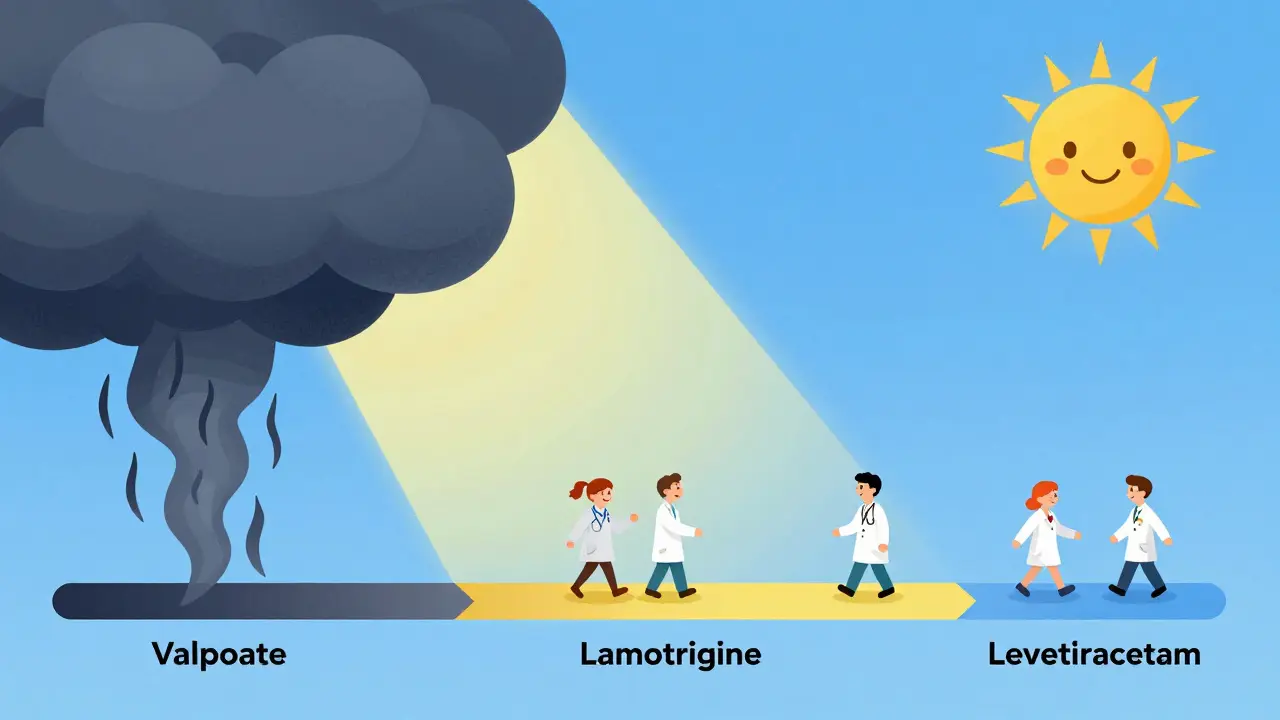
When talking about fetal development, doctors look at teratogenic effects-the way a drug can interfere with an embryo's growth. Not all medications carry the same weight. Valproate (also known as sodium valproate or valproic acid) is widely recognized as the highest-risk option. Research shows that about 10% of babies exposed to valproate in the womb develop physical birth defects. Beyond physical malformations, it's linked to more than double the risk of autism spectrum disorder (ASD) and nearly twice the risk of ADHD compared to other seizure drugs.
Other medications carry risks, but they are generally lower than valproate. A review by the MHRA (Medicines and Healthcare products Regulatory Agency) highlighted several drugs that increase the risk of physical abnormalities, including carbamazepine (Tegretol), phenobarbital, phenytoin (Epanutin), and topiramate (Topamax). While these are concerns, the risk levels are typically lower than those seen with valproate.
On the safer end of the spectrum, Lamotrigine (Lamictal) and Levetiracetam (Keppra) are often preferred for women planning a pregnancy. Recent data from Stanford researchers found that children whose mothers took newer-generation medications showed language development and verbal abilities at age two that were equivalent to children who weren't exposed to these drugs at all.
| Medication Entity | Risk Level | Primary Concerns | General Status |
|---|---|---|---|
| Valproate | High | Physical defects, ASD, ADHD | Avoid if possible |
| Carbamazepine | Moderate | Major congenital malformations | Use lowest effective dose |
| Topiramate | Moderate | Physical birth abnormalities | Case-by-case basis |
| Lamotrigine | Low | Generally safe | Preferred option |
| Levetiracetam | Low | Generally safe | Preferred option |
Common Birth Defects and Developmental Risks
It is important to keep things in perspective: more than 90% of babies born to women with epilepsy are perfectly healthy. However, when defects do occur, they often follow specific patterns based on the drug used. These are known as major congenital malformations (MCMs). Common issues include heart disease, which occurs in about 1-2% of exposures to high-risk drugs, and cleft lip or palate.
Other risks involve the development of the brain and spinal cord. Microcephaly-where a baby's head is smaller than expected-has been reported in 0.5-1% of valproate exposures. Urinary tract complications and general slow infant growth can also occur. The good news is that the prevalence of these major malformations dropped by 39% between 1997 and 2011, which tells us that doctors are getting much better at prescribing the right drugs for women of childbearing age.
The Hidden Danger: Drug-Drug Interactions
One of the most overlooked risks isn't the birth defect itself, but an unplanned pregnancy caused by medication interference. Antiseizure medications (ASMs) can interact with hormonal contraceptives in a way that makes them fail. For instance, if you are taking carbamazepine, phenytoin, phenobarbital, oxcarbazepine, or high doses of topiramate, your birth control pill, patch, or ring might not work as intended. This happens because these drugs can speed up how your liver processes the hormones in the contraceptive, effectively lowering the dose in your system.
The interaction also works the other way. Hormonal contraceptives can actually reduce the effectiveness of some seizure medications. Drugs like lamotrigine, valproate, zonisamide, and rufinamide may be less effective when paired with birth control, potentially leading to an increase in seizure frequency. This creates a tricky situation where the medicine keeping you safe from seizures is being weakened by the medicine preventing pregnancy.
Practical Steps for Preconception and Pregnancy
If you are planning to start a family, the best thing you can do is seek preconception counseling. This isn't just a check-up; it's a strategic plan to transition you to the safest possible medication. You should never stop taking your medication suddenly to "clear your system" before getting pregnant. Doing so could trigger a severe seizure that endangers both you and a potential embryo.
Here is a practical checklist for managing medication during this time:
- Audit your current meds: Identify if you are on a high-risk drug like valproate.
- Discuss alternatives: Talk to your neurologist about switching to lamotrigine or levetiracetam if they fit your seizure type.
- Optimize dosage: Aim for the lowest dose that still keeps you seizure-free. Higher doses generally correlate with higher risks of malformations.
- Review contraception: If you are using hormonal birth control, check if your ASM reduces its effectiveness. You may need a non-hormonal option, like a copper IUD.
- Supplement with Folic Acid: While not a cure-all, folic acid is standard for reducing neural tube defects in all pregnancies.

Addressing the Gap in Care
There is a concerning trend in how this care is delivered. Data shows that nearly 67% of people of childbearing potential are unable to correctly answer questions about ASM safety and birth control interactions. Even worse, only about a third of patients receive care that actually aligns with their reproductive goals. There is also a socioeconomic divide; people with fewer resources are disproportionately prescribed high-risk drugs like valproate, even when safer alternatives exist.
Advocating for yourself is key. If you are on a medication that you know is high-risk, ask your doctor why that specific drug was chosen over a safer alternative and if a transition is possible. The medical landscape has evolved-you no longer have to accept that pregnancy is an "all-or-nothing" risk.
Should I stop taking my seizure meds before I get pregnant?
No. You should never stop or change your medication without strict medical supervision. Uncontrolled seizures, particularly tonic-clonic ones, can cause miscarriages or cause physical trauma to both the mother and the fetus. The risk of a major seizure is often greater than the risk associated with the medication itself.
Which seizure medications are the safest for pregnancy?
Generally, Lamotrigine (Lamictal) and Levetiracetam (Keppra) are considered among the safest options. They are associated with lower rates of major congenital malformations compared to older drugs like valproate.
How does valproate affect a developing baby?
Valproate carries a significantly higher risk of both physical birth defects (about 10% of cases) and neurodevelopmental issues. It is linked to an increased risk of autism spectrum disorder (ASD) and ADHD in children exposed during pregnancy.
Can seizure meds make my birth control fail?
Yes. Medications such as carbamazepine, phenytoin, phenobarbital, and oxcarbazepine can increase the metabolism of hormones in birth control pills, patches, and rings, making them less effective and increasing the chance of an unplanned pregnancy.
What are the most common birth defects linked to these drugs?
The most common include heart disease, cleft lip or palate, and neural tube defects (problems with the brain and spinal cord). Some high-risk drugs are also associated with microcephaly, where the baby's head size is smaller than normal.
Does the dose of the medication matter for the baby?
Yes. Research indicates that for drugs like carbamazepine and valproate, the risk of major congenital malformations increases as the dose of the medication increases. This is why doctors recommend using the lowest effective dose possible.
Next Steps and Troubleshooting
If you have just discovered you are pregnant and are taking a high-risk ASM, don't panic, but do act quickly. Contact your neurologist and OB/GYN immediately. They will likely perform a risk-benefit analysis to decide if your medication should be adjusted. Because the most critical period for organ development happens in the first trimester, early intervention is vital.
For those who have had children while on ASMs and are worried about development, remember that language and cognitive development can vary. However, seeing a pediatric specialist for early screening can help identify any neurodevelopmental delays early, allowing for interventions that can significantly improve a child's outcome.