
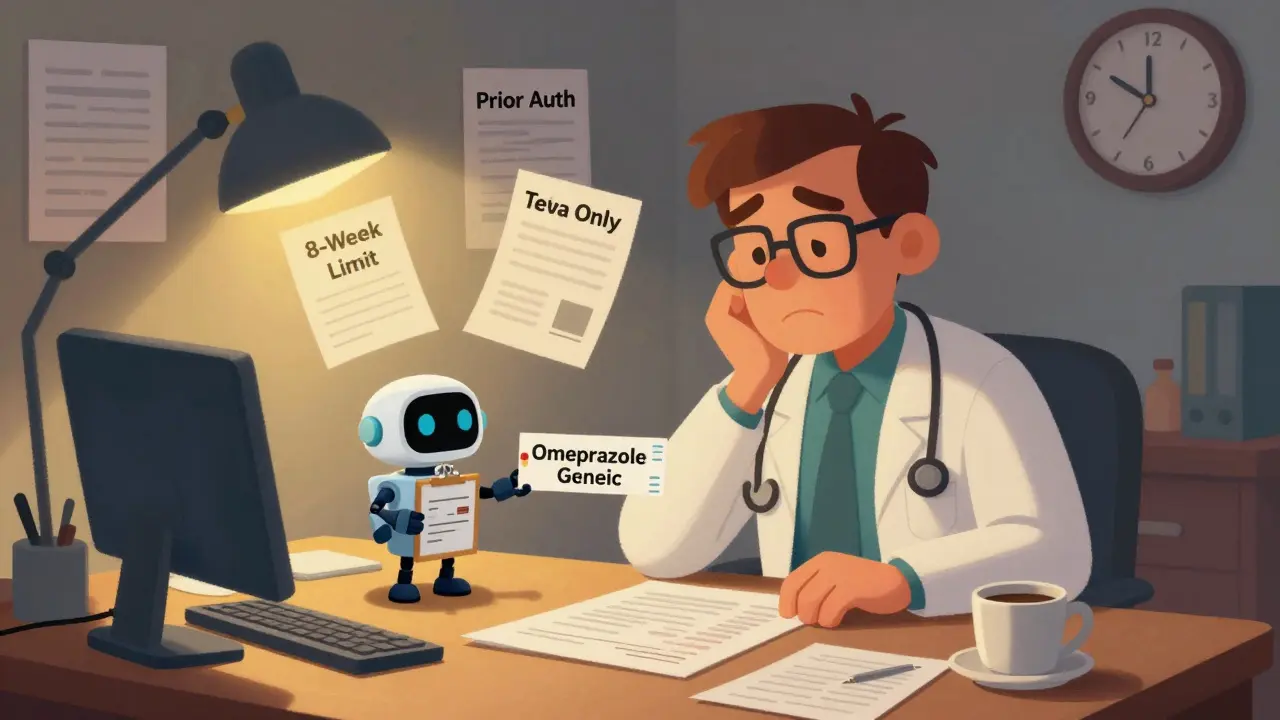
When a doctor prescribes a generic medication, many assume it’s a simple step-cheap, effective, and covered. But for providers across the U.S., that prescription often triggers a hidden hurdle: prior authorization. Even for generics-medications that have been on the market for years, are proven safe, and cost a fraction of brand names-providers must jump through bureaucratic hoops just to get approval. And it’s getting worse.
Why Generics Need Prior Authorization at All
You’d think generics wouldn’t need approval. After all, they’re chemically identical to brand-name drugs and have been FDA-approved for years. But insurance companies and pharmacy benefit managers (PBMs) treat them differently. They don’t block generics because they’re unsafe. They block them because they want to control which version you get. For example, if a patient needs omeprazole, there are dozens of generic versions made by different manufacturers. One payer might only cover the version made by Teva. Another might require you to try a cheaper version first-even if the patient has already had side effects from it. Or maybe the plan only allows a 30-day supply, and the doctor needs 90 days for better adherence. That’s when prior authorization kicks in. According to the American Medical Association, 92.7% of physicians say prior authorization requirements have increased over the last five years. And 28% of all prior authorization requests are for generic medications. The main reasons? Quantity limits, duration limits (like limiting proton pump inhibitors to 8 weeks), and therapeutic interchange rules that force providers to pick the payer’s preferred generic-even when it doesn’t match the patient’s history.The Step-by-Step Process for Getting Approval
Getting approval isn’t guesswork. It’s a system with rules, deadlines, and specific documentation requirements. Here’s how it actually works on the ground:- Identify the requirement. Check the payer’s formulary. Is the generic you want on the Preferred Drug List? Does it have quantity or duration limits? Many providers use tools like CoverMyMeds or Surescripts to pull real-time formulary data.
- Gather clinical evidence. You can’t just say, “My patient needs this.” You need proof. That means chart notes, lab results, diagnostic reports-anything showing why the formulary-preferred generic won’t work. If the patient had an allergic reaction to one generic, document it. If they failed on another, note the dates and symptoms.
- Submit electronically. Most insurers (78% of commercial plans, 63% of Medicare Part D) now require electronic submission. Fax is fading fast. The fastest submissions go through platforms like CoverMyMeds, which auto-populate forms and route them directly to the payer’s system.
- Wait for response. For urgent cases (like a patient running out of medication), Medicaid requires a decision within 24 hours. For standard requests, commercial payers typically take 5-10 business days. But if documentation is incomplete, the clock resets-and you’re back to square one.
- Appeal if denied. About 18.7% of generic prior authorization requests get denied. The top reasons? Missing documentation (42%), failure to prove medical necessity (38%), or not trying the payer’s preferred alternative first (20%).
What Makes Approval Faster for Generics
Here’s the surprising part: generics often get approved faster than brand-name drugs. Why? Because the clinical risk is lower. Insurers know these drugs work. They’re just trying to steer patients toward the cheapest version. If the requested generic is within quantity limits and the patient has no red flags, 41% of requests are auto-approved. Express Scripts reported a 40% increase in auto-approvals for generics in 2023. That’s because systems now check for simple rules: “Is the dose under 30 tablets?” “Has the patient had this drug before?” “Is this a maintenance medication?” If yes, the system approves without human review. Providers who use standardized templates for common scenarios-like GERD, hypertension, or diabetes-see approval times drop by 32%. One doctor in Ohio told me he keeps a folder of pre-written notes for each common generic: “I copy, paste, tweak the patient’s name, and hit submit. It cuts my time from 15 minutes to 3.”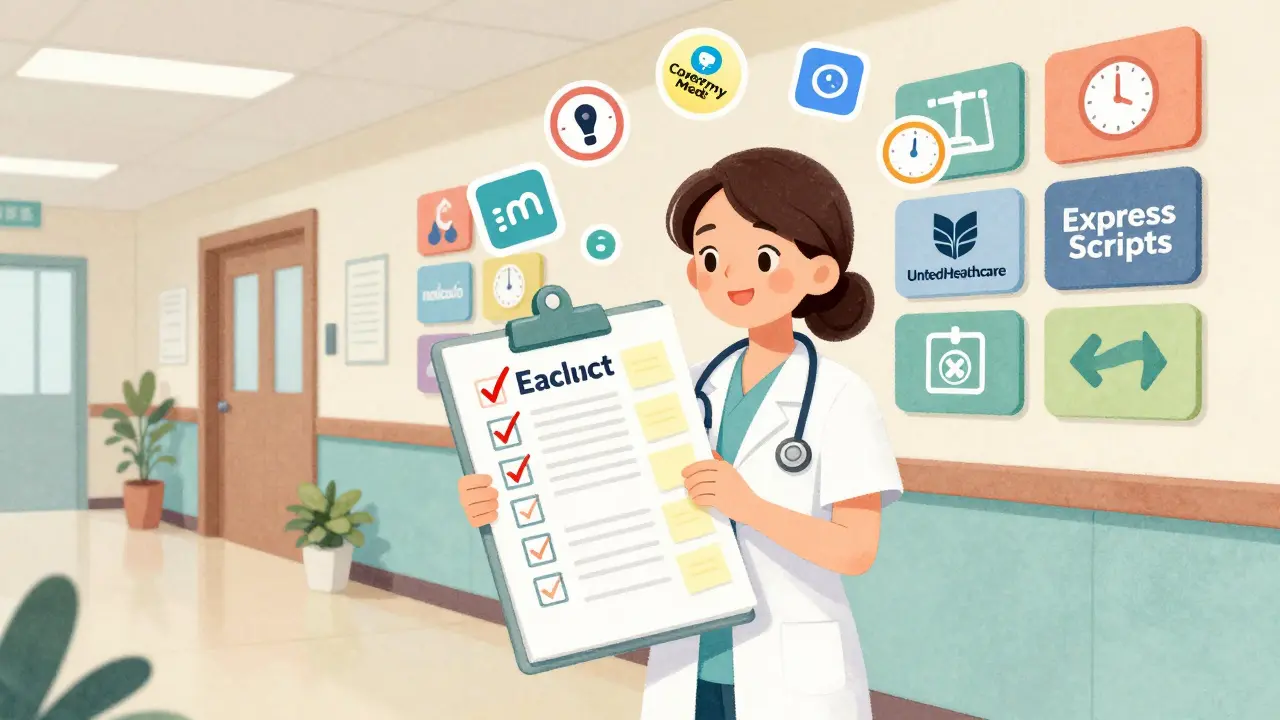
Where the System Breaks Down
The process works fine when everything’s clean. But real patients aren’t textbook cases. Take a patient with type 2 diabetes. Metformin caused severe diarrhea. The doctor switches them to sitagliptin-a generic. But the insurer denies it because their policy says you must try three other drugs first. Even though the American Diabetes Association says metformin intolerance is a valid reason to skip ahead. Or a patient on long-term omeprazole for Barrett’s esophagus. The plan says 8 weeks max. The doctor submits the endoscopy report showing intestinal metaplasia. Approved in two days. The inconsistency is the real problem. One payer might require a letter of medical necessity for a generic. Another might ask for a prior prescription history. A third might not require anything at all. Eighty-nine percent of providers say documentation rules vary too much between payers. And then there’s the human cost. Physicians spend an average of 16.1 hours per week on prior authorization. That’s nearly two full workdays. And 78% say that time could be better spent with patients.How Providers Are Fighting Back
Some practices have hired medical assistants专门 to handle prior authorization. These staff members learn each payer’s quirks, build checklists, and track deadlines. At one clinic in Ohio, the MA handles 78% of routine requests under physician supervision. Others are pushing for change. The American Medical Association is lobbying for laws that would eliminate prior authorization for generics that have been on the market for five years or more and have multiple manufacturers. It’s a reasonable ask: if a drug has been used safely by millions, why are we still making doctors prove it’s necessary? In 2024, CMS rolled out new rules requiring Medicaid managed care plans to use standardized electronic prior authorization transactions. That’s expected to cut processing times by 25%. And by 2026, McKinsey predicts 75% of generic prior authorization decisions will be made by AI systems-cutting approval times to under 24 hours.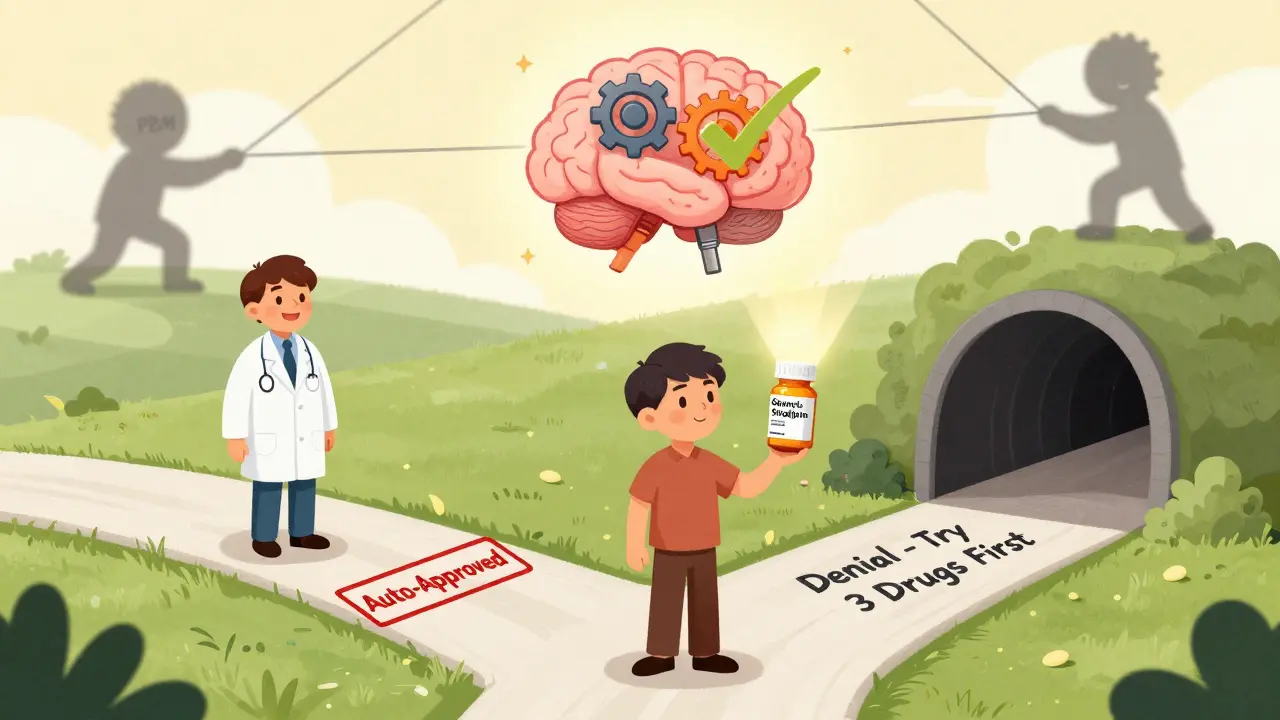
What You Can Do as a Provider
If you’re a provider drowning in paperwork, here’s what actually helps:- Build a payer-specific checklist. Know what each insurer wants before you write the script.
- Use electronic systems. Fax is slow. Phone calls are unreliable. Electronic submission cuts approval time by 35-50%.
- Document like a detective. Don’t just write “patient intolerant.” Write: “Patient experienced severe nausea and vomiting with generic A (Jan 2024), switched to generic B (Feb 2024), developed rash. Now requires generic C.”
- Keep a library of templates. Save successful prior authorization letters and reuse them with minor edits.
- Build relationships. Call the payer’s provider services line. Get a name. Ask for a direct line. One doctor told me his “go-to rep” at UnitedHealthcare approves 90% of his cases within hours.
The Bigger Picture
Prior authorization for generics isn’t about safety. It’s about cost-shifting. Insurers use it to control which version of a drug you get, not whether you get one at all. And while it saves $4.2 billion a year on generic misuse, it costs providers $1.2 billion in administrative burden by 2026, according to the Congressional Budget Office. The system isn’t broken-it was built this way. But it’s becoming unsustainable. Patients wait days for medication they’ve taken for years. Clinics burn out staff chasing approvals. And the irony? Many of these restrictions don’t even save money in the long run. A patient who can’t get their medication on time ends up in the ER. A delay in treatment leads to complications. That’s when real costs spike. The future isn’t about eliminating prior authorization. It’s about making it smarter. Auto-approvals for stable, well-known generics. Standardized rules across payers. AI that understands clinical context, not just formulary lists. Until then, providers will keep doing what they’ve always done: fighting bureaucracy to make sure their patients get the medicine they need.Do all insurance plans require prior authorization for generic medications?
No, but most do. As of 2024, 93% of commercial insurance plans, 89% of Medicare Part D plans, and 67% of Medicaid fee-for-service programs require prior authorization for at least some generic medications. The requirements vary by plan, drug, and state. Some plans only require it for quantity or duration limits, while others restrict which generic manufacturer is covered.
How long does prior authorization for generics usually take?
For standard requests, it typically takes 5-10 business days with commercial insurers. Medicaid requires decisions within 14 calendar days for non-urgent cases, and 24 hours for urgent ones. With electronic submission and complete documentation, many generic requests are auto-approved within 1-3 days. If additional info is requested, the process can stretch to 7-14 days.
Why are generics denied even when they’re cheaper than brand-name drugs?
Because insurers don’t just care about cost-they care about control. Many plans have preferred generic manufacturers and will only cover one or two brands. If you prescribe a different generic, even if it’s equally cheap, you need prior authorization. Sometimes, the preferred generic has a lower copay or the insurer has a rebate deal with that manufacturer. It’s not about price-it’s about steering.
Can patients get their generic medication while waiting for approval?
Sometimes, but not always. About 56% of physicians report having to write bridge prescriptions-short-term supplies of a different drug while waiting for approval. Some pharmacies offer 3-5 day samples from manufacturer programs. But many patients can’t afford to pay out-of-pocket, especially if they’re on fixed incomes. A 2023 survey found 83% of pharmacists have seen patients go without meds because they couldn’t pay for the generic upfront.
What’s the most common mistake providers make when submitting prior authorization for generics?
The biggest mistake is submitting incomplete or vague documentation. Saying “patient needs this generic” isn’t enough. You need specifics: why the formulary-preferred version failed, what side effects occurred, when they happened, and any supporting lab or diagnostic results. Missing documentation is the top reason for denial-accounting for 42% of rejections.
Miriam Piro
December 26, 2025 AT 18:03Let me tell you something they don’t want you to know… the pharmaceutical-industrial complex is using prior authorization as a backdoor to control your health. It’s not about cost-it’s about monopoly. Teva, Pfizer, CVS-they’re all in bed together. PBMs don’t care if you live or die, they care if their stock price goes up. They force you onto the cheapest generic, even if it’s made in a factory in Bangladesh with lead-contaminated binders. And when you complain? They say ‘it’s FDA-approved.’ Yeah, right. The FDA approves crayons as food additives these days. They’re turning doctors into clerks and patients into lab rats. 🤡💊 #HealthcareIsACorporateScam
Caitlin Foster
December 28, 2025 AT 06:43Okay but HAVE YOU SEEN the formularies??!? I swear, I’m about to start a side hustle as a prior auth ninja. I’ve got spreadsheets, templates, color-coded tabs, and a laminated flowchart taped to my monitor. I used to spend 3 hours a day on this nonsense-now I knock out 20 requests in 45 minutes. It’s not just work, it’s a sport. And I’m winning. 🏆✨ #PriorAuthQueen #DoctorsAreSuperheroes
Todd Scott
December 29, 2025 AT 06:14As someone who’s worked in both U.S. and Nigerian healthcare systems, I can tell you this isn’t just an American problem-it’s a global symptom of commodified medicine. In Lagos, we don’t have prior auth, but we have ‘cash upfront or no script’-which is just another form of gatekeeping. The U.S. system is more bureaucratic, but the outcome is the same: the patient suffers while middlemen profit. What’s worse is that we’ve normalized it. We’ve trained providers to accept paperwork as part of the job instead of fighting for systemic change. We need to treat administrative burden like a public health crisis-because it is.
Chris Garcia
December 29, 2025 AT 18:48There is a profound irony in the fact that we have spent decades perfecting the science of pharmacology-identifying molecular structures, conducting double-blind trials, mapping metabolic pathways-only to hand over clinical decisions to a spreadsheet algorithm that doesn’t know the difference between a patient’s chronic condition and a billing code. The system is not merely inefficient-it is philosophically bankrupt. We have replaced wisdom with workflow, compassion with compliance, and healing with hierarchy. When a machine decides whether a diabetic patient gets metformin because their last prescription was ‘too long,’ we have lost something essential. Not just money. Not just time. But our humanity.
James Bowers
December 30, 2025 AT 15:10It is imperative to acknowledge that the current prior authorization framework, while administratively cumbersome, serves a legitimate function in mitigating inappropriate utilization and ensuring fiscal responsibility within an overburdened healthcare system. The assertion that generics are being denied for non-clinical reasons is, in many instances, a mischaracterization. Payer policies are grounded in evidence-based formulary management and cost-containment strategies that are not inherently malevolent. That said, the lack of standardization across payers is indeed a systemic flaw requiring regulatory intervention.
Will Neitzer
December 31, 2025 AT 02:15I want to extend my deepest appreciation to every provider who has fought through this broken system-not just for their patients, but for the soul of medicine itself. The fact that you still show up, still document, still call reps, still rewrite letters, still fight for your patients… that is heroism in its purest form. And to the administrators, insurers, and policymakers reading this: you are not just blocking scripts-you are blocking trust. You are blocking healing. And you are blocking the very reason people became clinicians in the first place. Please, for the love of everything good, fix this. We are not cogs. We are healers.
Janice Holmes
December 31, 2025 AT 23:12Okay, so let me get this straight: we’ve got AI algorithms deciding if a patient gets their omeprazole based on whether they’ve had a ‘maintenance script’ in the last 90 days? But the same AI doesn’t know what Barrett’s esophagus is? And we’re calling this ‘innovation’? This isn’t progress-it’s a dystopian sitcom written by a bureaucrat who thinks ‘formulary’ is a personality trait. I’ve seen patients cry because they couldn’t get their generic because ‘the system doesn’t recognize their suffering.’ We’re not just failing medicine-we’re failing empathy. And I’m not okay with it.
Olivia Goolsby
January 2, 2026 AT 08:04They say it’s about cost control-but if that were true, why do PBMs get a 10% cut on every generic they steer you toward? Why do the same companies that run the PBMs also own the pharmacies that dispense the drugs? Why do they push the exact same generic that costs $2.50… but only if you pay $10 out of pocket? This isn’t about ‘preferred brands’-this is a multi-billion-dollar Ponzi scheme disguised as healthcare. And the doctors? They’re the pawns. The patients? The collateral. And the FDA? They’re asleep at the wheel. Wake up, people. This isn’t bureaucracy-it’s a rigged casino. And we’re all losing.