
Prescription errors happen more often than you think - and you can stop them before they hurt you.
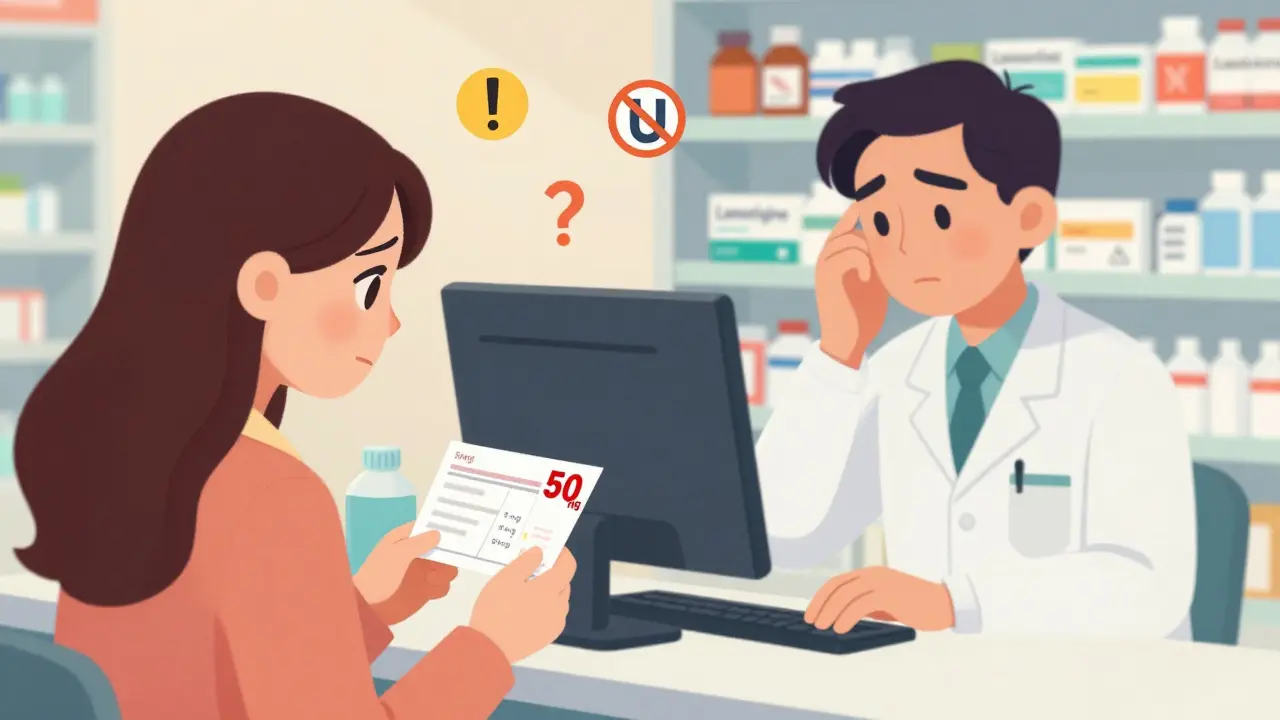
Imagine this: you walk out of your doctor’s office with a new prescription for pain relief. You pick it up at the pharmacy, take your first pill, and hours later, you’re dizzy, nauseous, and confused. Turns out, the doctor meant to write 5 mg - but wrote 50 mg. Or worse, they wrote "MS" for morphine sulfate, and the pharmacist read it as magnesium sulfate. These aren’t rare mistakes. They’re common. And you don’t have to just accept them.
Every year in the U.S. alone, over 1.5 million people are harmed by medication errors. About one in five of those come from the moment a doctor writes the prescription. Handwriting, abbreviations, dropdown menus, time pressure - all of it adds up. The good news? You don’t need to be a doctor to catch these mistakes. You just need to know what to look for.
What kinds of prescription errors actually happen?
Not all errors are the same. Some are simple typos. Others are deadly. According to analysis of over 12,500 malpractice claims, the most common types are:
- Wrong dosage or quantity - 19% of errors. This includes missing zeros (writing .5 mg instead of 0.5 mg) or adding them (5.0 mg instead of 5 mg). The FDA says these alone caused 128 deaths between 2010 and 2020.
- Unclear handwriting - 22% of errors. Even today, about 42% of handwritten prescriptions need clarification by pharmacists. That’s nearly half.
- Wrong drug name - 7% of errors, but often fatal. Drugs like Celebrex and Celexa, Zyprexa and Zyrtec, sound almost identical. One letter can mean the difference between treating arthritis and treating depression.
- Bad abbreviations - "U" for units, "QD" for daily, "MS" for morphine sulfate. These are banned in many hospitals, but still show up on paper prescriptions. "U" can be read as "0," turning a 10-unit dose into 100 units - a lethal mistake with insulin.
- Missing purpose - Doctors often don’t write why you’re taking the drug. If you’re on a blood thinner, you should know why. If you’re not told, you might not realize you’re on the wrong one.
High-alert drugs - like insulin, opioids, and blood thinners - are responsible for 72% of fatal errors, even though they make up only 8% of all prescriptions. That’s not luck. That’s a system failure. And you’re the last line of defense.
What you should check before leaving the pharmacy
Don’t just grab your pills and go. Take five seconds. Ask yourself these seven questions:
- Is the drug name spelled out fully? No abbreviations. "Lamotrigine," not "Lamictal." "Metformin," not "Glucophage." Brand names can be misleading - generic names are safer.
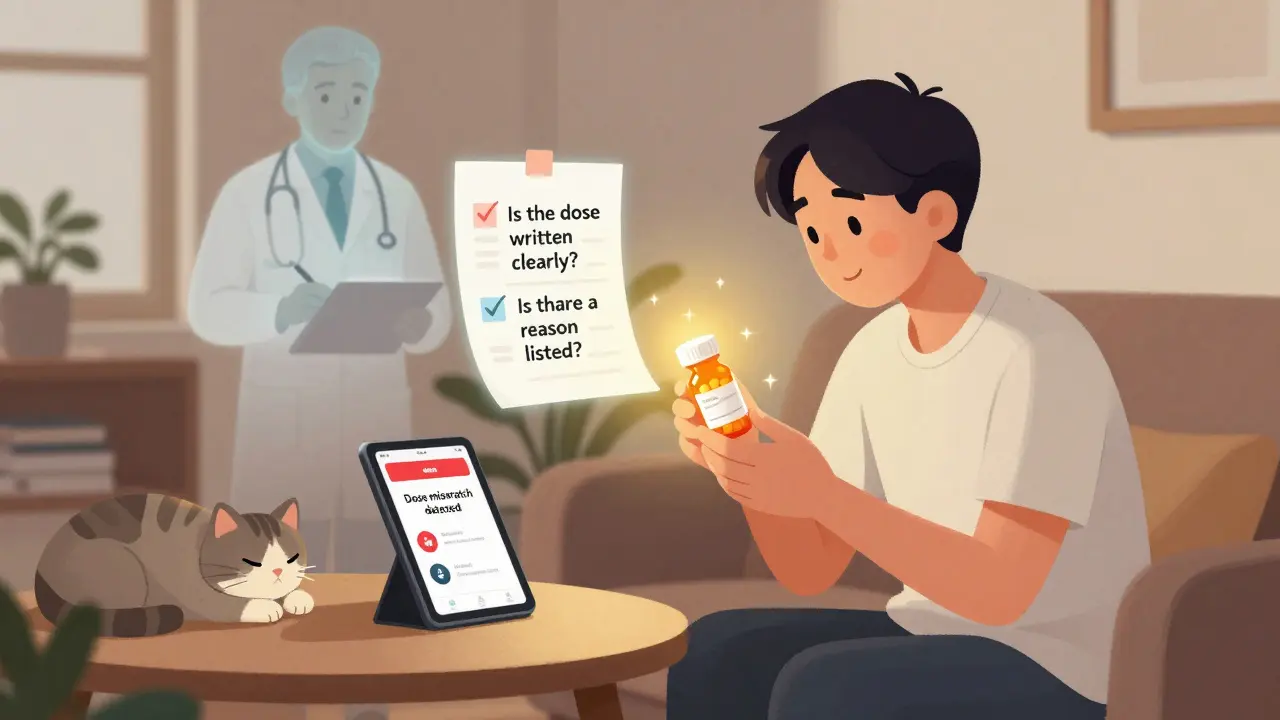
- Is the dose written clearly? Look for leading zeros: 0.5 mg, not .5 mg. No trailing zeros: 5 mg, not 5.0 mg. These tiny details prevent tenfold overdoses.
- Are the instructions clear? "Take one tablet by mouth twice a day" is good. "BID" or "QD"? Avoid those. They’re outdated and confusing. If you see them, ask for plain language.
- Does the quantity match what you expect? If you’re told to take it for 10 days, do you have 10 pills? If you’re on a 30-day supply, is it 30 pills? Mismatched quantities mean something’s off.
- Is there a reason listed? "For high blood pressure," "for nerve pain," "for diabetes." If it’s blank, ask. You have the right to know why you’re taking any drug.
- Is the prescriber’s info complete? Name, phone number, license number. If it’s missing, the prescription may not be valid.
- Is the expiration date reasonable? Prescriptions for chronic conditions usually last 6-12 months. If it expires in 30 days for a daily medication, something’s wrong.
Use this checklist every single time. A 2022 University of Michigan study found patients who used it caught 63% of errors - more than double the rate of those who didn’t check.
Use the teach-back method - it’s simple, and it works
When the pharmacist explains how to take your medicine, don’t just nod. Say it back.
"So, just to make sure I got this - I take one 5 mg tablet every morning with food, right? And this is for my arthritis?"
This is called the teach-back method. Johns Hopkins Medicine found it reduces misunderstandings by 81%. It’s not about testing you - it’s about making sure the pharmacist knows you understood. And if they hesitate? That’s your signal to pause.
Some people think this sounds rude. It’s not. It’s smart. You’re not questioning their expertise - you’re protecting your life.
Electronic prescriptions aren’t foolproof - here’s how to spot their traps
You might think switching to digital prescriptions solved the problem. It helped - but created new ones.
Electronic systems let doctors pick from dropdown menus. But if "5 mg" and "50 mg" are right next to each other, it’s easy to click the wrong one. A 2019 JAMA study found electronic prescribing caused 34% of new error types. One doctor told researchers they accidentally prescribed 10 times the right dose because they clicked too fast.
Also, many systems auto-fill previous prescriptions. If you switched from 5 mg to 10 mg last month, the system might still suggest 5 mg - and the doctor might not notice.
Here’s what to do: When you get your electronic prescription, ask the pharmacy to read you the exact details before they fill it. Or better yet - check your pharmacy’s app or patient portal. Most now let you see your prescriptions online before pickup. Compare what you see there with what your doctor told you. If they don’t match, call the office immediately.
Know the dangerous drug pairs
Some drugs look or sound so similar, even experts mix them up. The Institute for Safe Medication Practices keeps a list of these. Here are a few you should know:
- Lamotrigine (for seizures) vs. Lamictal (brand name - same drug, but if written as Lamictal without the generic, dosing errors spike)
- Hydrocortisone (skin cream) vs. Heparin (blood thinner) - both abbreviated as "HC"
- Insulin (for diabetes) vs. Isosorbide (for heart) - different uses, same first two letters
- Clonazepam (for seizures) vs. Clonidine (for blood pressure)
If you’re taking any of these, write down the generic name and keep it with your meds. Show it to the pharmacist. Say: "I’m on lamotrigine - not Lamictal. Double-check the label."
There’s also a free tool called ISMP’s Error-Prone Drug Pairs list. You can search it online. Print it out. Keep it in your wallet.
Ask the right questions - the "Ask Me 3" method
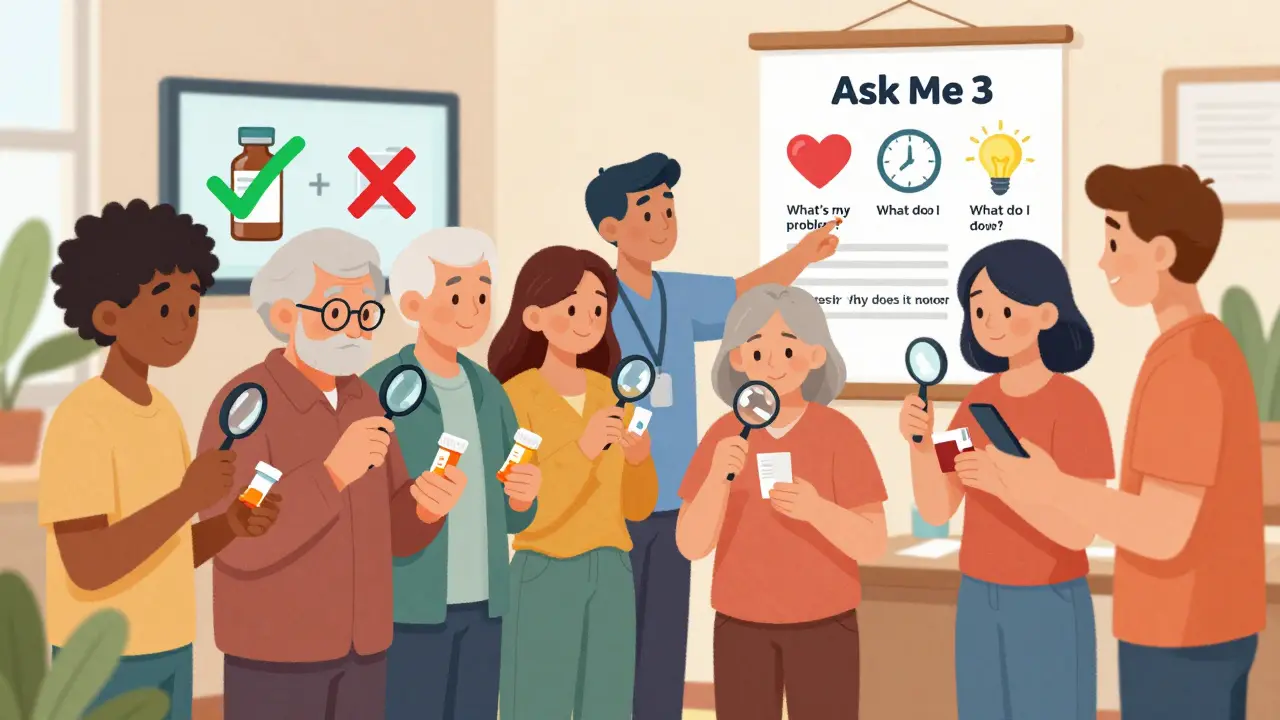
The National Patient Safety Foundation created a simple three-question rule:
- What is my main problem? Don’t settle for "it’s for pain." Ask: "Is this for my arthritis, my nerves, or my heart?"
- What do I need to do? Not just "take one pill." Say: "When? With food? Can I skip it if I feel fine?"
- Why is it important? "What happens if I don’t take it?" This question alone can reveal if the drug is even necessary.
A 2021 JAMA study showed patients who asked these three questions reduced medication errors by 44%. That’s not magic. That’s clarity.
What to do if you spot an error
If you catch a mistake - don’t second-guess yourself. Act.
- If you’re still at the pharmacy: Ask to speak to the pharmacist. Say: "I think there might be an error. Can we check the original prescription?"
- If you’re home and notice something’s off: Call your doctor’s office. Don’t wait. Say: "I received my prescription, but the dose doesn’t match what we discussed. Can you confirm?"
- If you’ve already taken the wrong dose: Call 999 or go to A&E immediately. Don’t wait for symptoms. Some errors cause damage within hours.
Pharmacists are trained to catch these. But they can’t read minds. If you don’t speak up, they assume you know what you’re getting.
Technology is helping - but you still need to be involved
New tools are emerging. Apps like MedSafety use AI to scan your prescription photo and flag errors. In a 2023 pilot, they reduced patient-identified errors by 68%. Some hospitals now send automated SMS alerts with your prescription details right after it’s written.
But here’s the catch: 36% of U.S. adults have low health literacy. They don’t use apps. They don’t read texts. They rely on others. That’s why programs like "Script Check" - where volunteers help elderly patients verify prescriptions - have found over 8,000 dangerous errors in one year.
Technology won’t replace your eyes. It can only support them.
You’re not just a patient - you’re a safety partner
Doctors are overworked. Pharmacies are rushed. Systems are flawed. But you? You have nothing to lose and everything to gain by paying attention.
Prescription errors aren’t accidents. They’re preventable. And the person who can stop them most often isn’t the doctor, the pharmacist, or the computer. It’s you.
Next time you get a prescription - don’t rush. Don’t assume. Check. Ask. Confirm. You’re not being difficult. You’re being smart.
Can handwriting on prescriptions still cause errors today?
Yes. Even with electronic systems, about 1 in 5 prescriptions are still handwritten, especially in urgent care or rural clinics. Handwriting errors account for 22% of all prescription mistakes. Dangerous abbreviations like "U" for units or "MS" for morphine sulfate are still common and can lead to fatal overdoses. Always ask for printed labels with clear, full drug names and dosages.
What should I do if the pharmacy gives me the wrong medicine?
Don’t take it. Don’t return it without asking. Ask the pharmacist to verify the prescription against the original order from your doctor. If they’re unsure, call your doctor’s office directly. If you’ve already taken it and feel unwell, call 999 or go to the nearest emergency department immediately. Keep the pill bottle and the original prescription - they’re evidence.
Are electronic prescriptions safer than handwritten ones?
They reduce handwriting errors by about 55%, but introduce new risks. Doctors can accidentally pick the wrong dose from a dropdown list, or the system may auto-fill an old prescription. Studies show electronic systems caused 34% of new error types. Always verify the name, dose, and instructions on the printed label - even if it came electronically.
What are high-alert medications, and why should I care?
High-alert medications include insulin, blood thinners like warfarin, opioids like oxycodone, and seizure drugs like lamotrigine. These drugs can cause serious harm or death if given in the wrong dose or to the wrong person. They make up only 8% of prescriptions but cause 72% of fatal errors. Always confirm the name and dose for these - and never assume the pharmacist already checked.
How can I protect myself if I have low health literacy?
You’re not alone. About 36% of U.S. adults struggle with health information. Ask a family member, friend, or community volunteer to help you check prescriptions. Look for local "Script Check" programs - they train volunteers to help elderly or low-literacy patients verify meds. You can also ask your pharmacist to use pictures or simple words to explain how to take your medicine. No question is too basic.
Is it okay to ask my doctor to write "for pain" or "for anxiety" on the prescription?
Yes, and you should. The American College of Physicians says every prescription should include the reason for use. If your doctor refuses, ask why. A clear indication helps the pharmacist catch mistakes - for example, if you’re given a blood pressure drug for anxiety. It also helps you remember why you’re taking it. Don’t let them skip this step.
What should I do if I think my prescription was meant for someone else?
Stop. Don’t take it. Call your doctor’s office immediately. Prescription mix-ups happen - especially in busy clinics where multiple patients have similar names. The pharmacist may also notice if the name or birth date doesn’t match. If you’re unsure, ask: "Is this prescription for me?" and confirm your full name and date of birth. Never assume.
Justin Fauth
February 4, 2026 AT 02:38Meenal Khurana
February 5, 2026 AT 11:39Joy Johnston
February 6, 2026 AT 02:00Shelby Price
February 7, 2026 AT 06:19Jesse Naidoo
February 8, 2026 AT 02:08Sherman Lee
February 9, 2026 AT 00:42Lorena Druetta
February 10, 2026 AT 12:30Zachary French
February 11, 2026 AT 23:48