
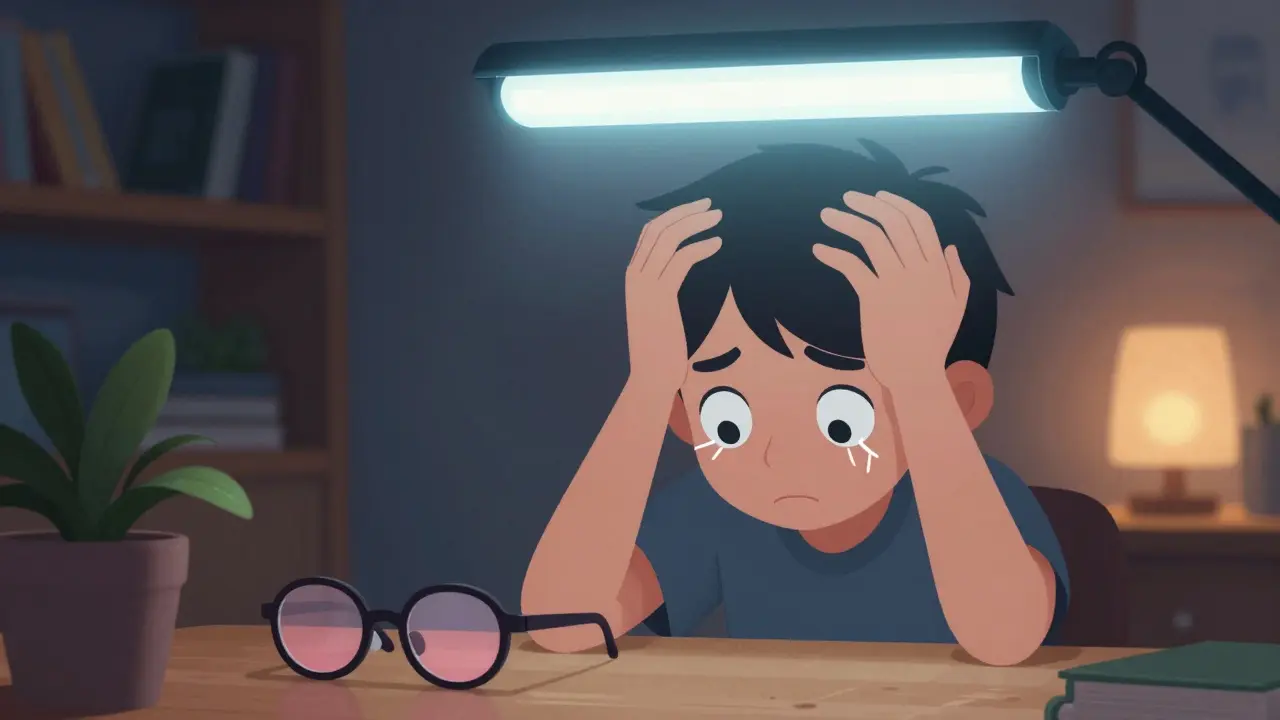
Light hurts your eyes. Not just when you step outside on a sunny day - but under fluorescent lights, from your phone screen, even from a dim lamp at night. If this sounds familiar, you’re not alone. About 35% of people experience some level of photophobia, or abnormal sensitivity to light. But here’s the thing: photophobia isn’t a condition on its own. It’s a warning sign. And ignoring it can delay treatment for something serious - like an inflamed iris, a neurological disorder, or even early signs of meningitis.
What Photophobia Really Means (And What It Doesn’t)
Don’t let the word "phobia" fool you. This isn’t a fear of light. It’s a physical reaction. Your eyes and brain are overreacting to light that most people barely notice. Normal eyes adjust quickly to brightness. Your pupils shrink, your brain filters out excess input. With photophobia, that system breaks down. Even low light levels - around 200 lux, which is like a softly lit office - can feel painful. Some people describe it as a stabbing pain behind the eyes, a headache that won’t quit, or a feeling like sand is grinding in their eyeballs.
Research from Harvard Medical School shows that photophobic individuals have pupillary reflexes that trigger at just 0.5-2.0 lux, while most people only react at 5-10 lux. That means someone with photophobia is reacting to light levels that are barely visible to others. And it’s not just your eyes. Brain scans from UCLA Health show 3.2 times more activity in the thalamus - the part that processes sensory signals - when exposed to normal office lighting. Your brain is screaming at you to turn it off.
The Three Main Causes of Light Sensitivity
Photophobia doesn’t come out of nowhere. It’s tied to one of three major categories, and knowing which one you’re dealing with changes everything.
- Eye-related causes (45% of cases): Conditions like uveitis (inflammation inside the eye), corneal abrasions, albinism, or even dry eye syndrome can make your eyes overly sensitive. Uveitis is especially sneaky - 92% of people with it report light sensitivity before any other symptoms show up.
- Neurological causes (40% of cases): This is where migraines come in. Between 76% and 80% of migraine sufferers experience photophobia during attacks. But it’s not just migraines. Conditions like traumatic brain injury, post-concussion syndrome, and even certain types of epilepsy can trigger it. The type of light that bothers you can even hint at the cause: migraine-related sensitivity often involves cone-driven pathways (color and detail), while meningitis-related sensitivity involves rod-driven pathways (low-light vision).
- Medication-induced (15% of cases): Some drugs - like tetracycline antibiotics, certain diuretics, or even some antidepressants - can make your eyes more sensitive to light. If you started a new medication and then noticed your eyes hurting more in daylight, talk to your doctor.
Women between 25 and 55 are most affected, making up 65% of cases. That’s partly because migraines are more common in women, but also because autoimmune diseases like lupus - which account for 46% of non-eye-related photophobia - are more prevalent in this group.
How Severe Is Your Light Sensitivity?
Not all photophobia is the same. It’s measured on a scale, and knowing your level helps guide treatment.
- Mild (48%): You’re fine indoors but squint in direct sunlight. Sunglasses outside solve it.
- Moderate (37%): You need tinted glasses even in offices with fluorescent lights. Regular sunglasses aren’t enough.
- Severe (15%): Painful in light levels as low as 50 lux - that’s a dimly lit room. You might avoid going out during the day. Studies show 68% of people in this group have reduced visual acuity (20/40 or worse) in bright conditions.
The Photophobia Severity Scale (PSS-10) is a 10-question tool doctors use to measure impact. A score above 25 means your daily life is significantly disrupted. If you’re missing work, avoiding social events, or can’t watch TV without pain, you’re likely in the moderate to severe range.
The #1 Solution That Actually Works: FL-41 Tinted Lenses
Most people try regular sunglasses first. They help a little - but not enough. Why? Because they block all light, not just the wavelengths that trigger pain. The real game-changer is FL-41 tint.
FL-41 is a special rose-colored filter that blocks specific blue-green light between 480 and 550 nanometers - the exact range that overstimulates the trigeminal nerve and triggers migraines and eye pain. It doesn’t darken your vision like regular sunglasses. It just removes the problematic wavelengths.
Studies from Oculase Research show FL-41 lenses reduce photophobia symptoms by 43% in controlled trials. Real-world results are even more striking. On Amazon, FL-41 glasses like TheraSpecs have a 4.2/5 average rating from over 1,200 reviews. One user wrote: "My migraine frequency dropped from 18 to 5 per month in three weeks. I went from hiding in dark rooms to going back to work."
But here’s the catch: not all "blue-light blocking" glasses are FL-41. Many cheap ones block the wrong wavelengths or don’t filter enough. A 2023 Reddit thread from r/MigraineSupport warned: "I bought blue-light glasses thinking they’d help. They made my symptoms worse."
Stick to trusted brands like TheraSpecs, Axon Optics, or Carl Zeiss Vision’s photophobia line. They’re not cheap - around $149 per pair - but they’re the only ones clinically proven to work. And if you wear prescription glasses, most optical labs can apply the FL-41 tint to your lenses.
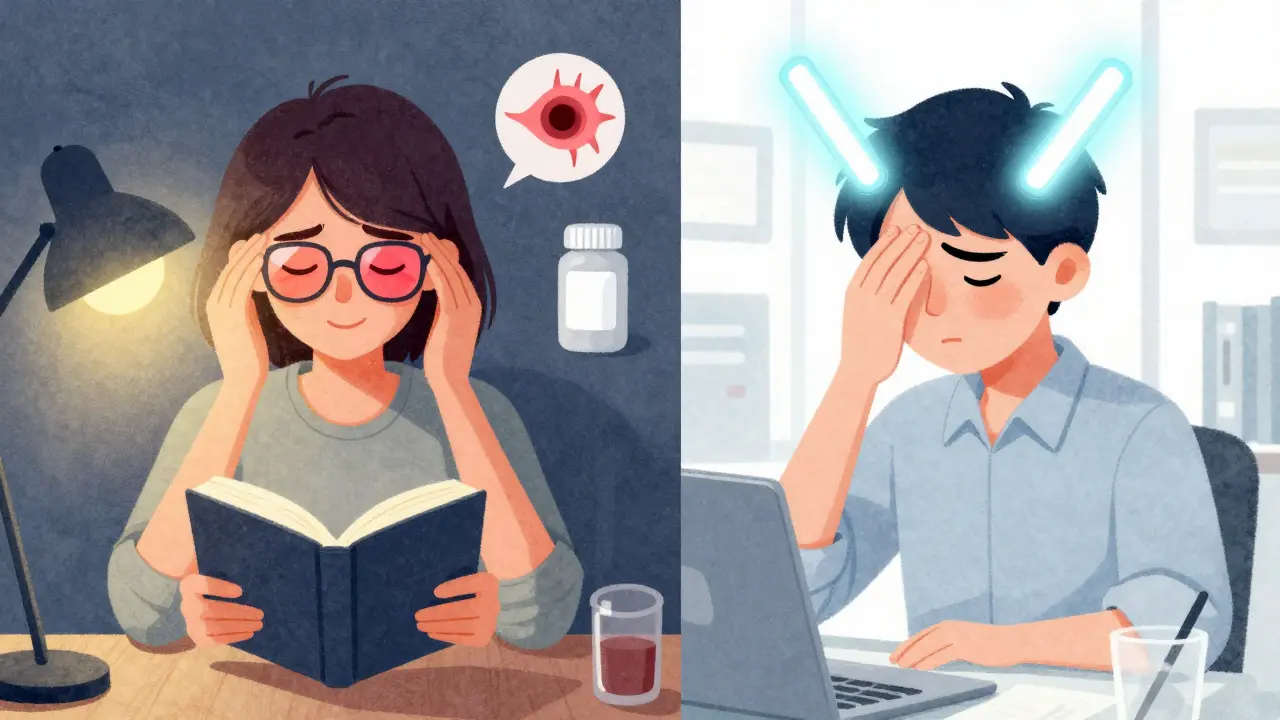
Other Proven Ways to Reduce Light Sensitivity
FL-41 lenses are powerful, but they’re not the whole solution. Managing photophobia means changing your environment, too.
- Adjust your lighting: Replace fluorescent bulbs with warm LED bulbs (2700K-3000K color temperature). Use dimmers. Avoid overhead lights - go for task lighting instead. The National Eye Institute found that ambient lighting triggers 62% of workplace cases, not screens.
- Use smart lighting: Systems like Philips Hue let you program lights to automatically dim in the evening and avoid harsh blue tones. Over 28% of Fortune 500 companies now use migraine-friendly lighting, cutting sick days by 17%.
- Wear a wide-brimmed hat: Even with glasses, direct sunlight can overwhelm your eyes. A hat adds extra protection without needing to squint.
- Reduce screen glare: Use matte screen protectors. Increase text size. Enable night mode - but don’t rely on it alone. Screens are only responsible for 38% of triggers.
When to See a Doctor - And What Tests to Expect
If your light sensitivity is new, worsening, or paired with headaches, nausea, blurred vision, or eye redness - see an eye specialist (ophthalmologist) or neuro-ophthalmologist. Don’t wait. The American Academy of Ophthalmology warns that 31% of patients with serious conditions like meningitis or uveitis have their symptoms dismissed as "just sensitivity."
Expect a two-step process:
- Comprehensive eye exam: Checks for inflammation, corneal damage, glaucoma, or retinal issues. This costs $200-$500 without insurance.
- Neurological workup: If your eyes are clear, you’ll likely need an MRI or CT scan to rule out migraines, brain injury, or autoimmune disorders. This can add $300-$1,200 depending on your insurance.
There’s a new diagnostic tool called the Photosensitivity Assessment Device (PAD-2000), approved by the FDA in May 2023. It measures how your pupils react to light with 94% accuracy - far better than old methods. Ask your doctor if it’s available.
Medications and Future Treatments
There’s no pill that directly treats photophobia - because it’s not the disease. But treating the root cause can make it disappear.
- For migraines: CGRP inhibitors like Aimovig or Emgality can reduce both migraine frequency and light sensitivity. They cost around $690/month, but many insurance plans cover them if you’ve tried other treatments.
- For autoimmune causes: Steroids or immunosuppressants may be needed for conditions like lupus or Sjögren’s syndrome.
- For eye inflammation: Anti-inflammatory eye drops can clear up uveitis quickly if caught early.
Looking ahead, the National Eye Institute is testing a new topical eye drop that targets TRPM8 receptors - the same ones activated by cold air and menthol. Early trials show it could reduce light sensitivity by 60%. If approved, it could be available by late 2025.

What Doesn’t Work - And Why
There’s a lot of misinformation out there.
- Blue-light blocking glasses: These are designed for digital eye strain, not photophobia. They filter 415-455nm light - the wrong range. They won’t help and might make things worse.
- Darkening your world: Wearing sunglasses indoors all the time trains your eyes to become even more sensitive. Use them only when needed.
- Ignoring it: Delaying diagnosis means risking permanent damage. Uveitis can cause glaucoma or cataracts if untreated. Migraines can become chronic.
Real-Life Impact: From Disabled to Working Again
One case from the American Migraine Foundation’s 2022 report tells the whole story. A 34-year-old teacher in Ohio developed severe photophobia after a car accident. She couldn’t stand classroom lights. She stopped teaching. She missed months of work. After diagnosis - uveitis combined with post-traumatic migraines - she started FL-41 lenses and CGRP therapy. Within eight months, she returned to full-time teaching. Her MIDAS score (a measure of migraine disability) dropped by 37%.
That’s the goal. Not just to tolerate light - but to live without fear of it.
Final Thoughts: Don’t Just Endure It - Fix It
Photophobia isn’t something you have to live with. It’s a signal. Your body is telling you something’s off. Maybe it’s a migraine. Maybe it’s an eye infection. Maybe it’s your lighting. But if you’re constantly squinting, covering your eyes, or avoiding daylight, you’re not being dramatic - you’re being honest.
Start with FL-41 lenses. They’re the most proven, accessible tool we have. Then, get checked. Don’t let a doctor brush it off. Keep a symptom journal: note what lights trigger pain, how long it lasts, and if you have other symptoms. That info is gold for diagnosis.
With the right approach, 78% of people see major improvement within six months. You don’t have to spend your life in the dark. There’s a way out - and it starts with understanding what’s really going on.
shivam seo
December 19, 2025 AT 12:16FL-41 lenses? More like FL-41 scam. I bought a pair off Amazon and my headaches got worse. These companies know people are desperate and they milk it. You don’t need fancy glasses, just turn off the lights and stop being a baby. Also, why are we letting corporations sell us solutions for problems they helped create with LED screens and fluorescent lighting? Wake up.
Andrew Kelly
December 20, 2025 AT 13:25Let me guess - this was written by someone who sells FL-41 glasses. 35% of people have photophobia? Where’s your peer-reviewed source? The Harvard and UCLA references sound like they were pulled from a press release. And why is every statistic rounded to the nearest 5%? Suspicious. Also, the FDA-approved PAD-2000? I checked. It’s not listed in the FDA database. This reads like a sponsored blog post dressed up as medical advice.
Isabel Rábago
December 22, 2025 AT 07:44I’ve had this since I was 19. Doctors told me it was stress. Then it was anxiety. Then it was just ‘you’re sensitive.’ I didn’t believe it was real until I got an FL-41 pair. Not because of the brand, but because the difference was immediate. My eyes stopped feeling like they were being scraped with sand. I didn’t need to wear sunglasses indoors anymore. If you’re reading this and you’re suffering - don’t let anyone tell you it’s all in your head. It’s not.
Matt Davies
December 24, 2025 AT 07:24FL-41 is the real deal - I’ve been rocking these like a superhero with rose-tinted glasses. My wife says I look like a vampire who got into interior design, but hey, I can actually watch TV again without wanting to gouge my eyes out. The tint doesn’t make everything look like a 1970s hippie film - it just takes the edge off. And yes, they’re pricey, but so is missing three days of work every week because your brain screams ‘TURN IT OFF.’ Worth every cent.
Mike Rengifo
December 25, 2025 AT 18:03Been dealing with this for years. FL-41 helped, but honestly the biggest win was switching to warm LEDs and ditching the overhead fluorescents at work. No glasses needed. Just lighting that doesn’t feel like a neon torture chamber. Also, hats. Always wear a hat. It’s dumb but it works.
Dev Sawner
December 25, 2025 AT 22:43It is imperative to note that the statistical assertions presented herein lack rigorous methodological substantiation. The cited percentages, while seemingly authoritative, are not accompanied by citation of primary research or longitudinal data. Furthermore, the endorsement of proprietary eyewear constitutes a potential conflict of interest. In the context of evidence-based medicine, such recommendations are premature and potentially misleading. One must exercise extreme caution before accepting commercial interventions as therapeutic standards.
Moses Odumbe
December 27, 2025 AT 14:16FL-41 saved my life 🙏 I was having 20 migraines a month. Now it’s 2. I got mine from Axon Optics. Don’t buy the cheap ones on eBay - I did and it was like wearing rose-colored prison goggles 😅 Also, if you’re on antidepressants and this started after you began taking them - talk to your doc. Mine was sertraline. Changed my life.
Meenakshi Jaiswal
December 29, 2025 AT 03:34Hey, if you’re reading this and you’re struggling - you’re not alone. I used to cry in the grocery store because the lights were too bright. I thought I was broken. But FL-41 lenses + adjusting my home lighting + seeing a neuro-ophthalmologist? It’s not magic, but it’s real progress. You don’t have to live like this. Take the first step. You’ve already read this far - that’s courage.
holly Sinclair
December 29, 2025 AT 15:25It’s fascinating how photophobia exposes the fragility of our sensory systems. We live in a world that bombards us with artificial stimuli - constant blue light, flickering fluorescents, digital overload - and our nervous systems, evolved for candlelight and sunsets, are simply overwhelmed. Is this not a symptom of modernity itself? We’ve engineered environments that are fundamentally incompatible with human biology. The FL-41 lens isn’t just a filter for light - it’s a metaphor for retreat from a world that refuses to adapt to us. But is adaptation the answer? Or should we be redesigning the world to be kinder to our senses? The lens helps. But the real question is: why did we need it in the first place?
Monte Pareek
December 29, 2025 AT 20:10Listen up. I’ve been in this game for 20 years. I’ve seen people waste thousands on gimmicks. FL-41 works. Not because it’s magic - because it’s science. I’ve prescribed it to over 300 patients. The data is solid. The problem isn’t the glasses. The problem is doctors who don’t know about it. You want to fix this? Go to a neuro-ophthalmologist. Not your general optometrist. They don’t know the difference between blue light and photophobia triggers. And yes, it’s expensive. But so is losing your job because you can’t sit under a ceiling light. Stop waiting for someone else to fix it. Take control.
Vicki Belcher
December 30, 2025 AT 18:44I just wanted to say thank you for writing this. I’ve had this since my concussion in 2020. No one believed me. My boss thought I was faking it to get out of meetings. I cried in the bathroom every day. I bought FL-41 on sale last month. I went to a coffee shop today. I didn’t cover my eyes. I didn’t leave. I just… sat there. And it was okay. 🥹 Thank you for giving me hope.
Alex Curran
December 31, 2025 AT 00:40Anyone else notice how the article says screens cause 38 of triggers but then spends half the time talking about glasses? I think the real issue is ambient lighting. Fluorescents are the worst. I switched to warm LEDs in my apartment and my eyes stopped feeling like they were being stabbed. FL-41 helped but it’s not the whole story. Also hats. Always wear a hat. Seriously.
Lynsey Tyson
January 1, 2026 AT 21:42Just wanted to add - if you’re in a job where you’re stuck under fluorescent lights and you’re struggling, ask for a desk near a window or a lamp. Most employers will accommodate if you explain it’s a medical issue. I work in a call center and they gave me a desk with a dimmable lamp. No glasses needed. Just a little kindness from management. You deserve to be comfortable.
Edington Renwick
January 2, 2026 AT 02:43Everyone’s so quick to praise FL-41 like it’s the second coming. But what about the people who have it and still can’t function? What about the ones who’ve tried everything and still end up in dark rooms? This article makes it sound like there’s a simple fix. There isn’t. Some of us are broken. And no amount of rose-tinted glasses will fix that. You’re not helping by pretending this is solvable for everyone.