
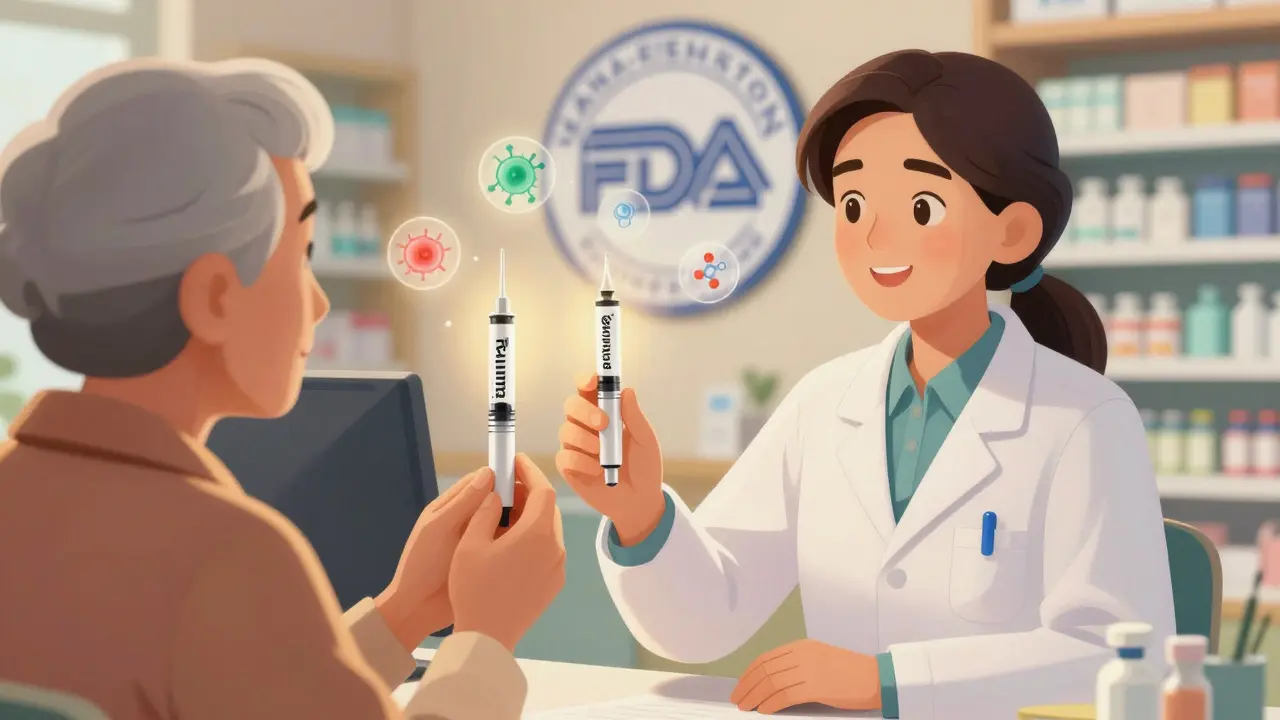
When a patient walks into the pharmacy with a prescription for a biologic drug like Neulasta or Humira, they’re not just getting a pill-they’re getting a complex therapy that can cost thousands per dose. That’s where the pharmacist steps in. Not as a silent filler of prescriptions, but as a key player in deciding whether a biosimilar can safely replace the original. This isn’t like swapping one generic pill for another. Biosimilars are different. And pharmacists are the ones who must explain why.
What Makes a Biosimilar Different from a Generic?
Most people think all cheaper versions of brand-name drugs are the same. They’re not. A generic drug, like simvastatin instead of Zocor, is chemically identical to the original. Same molecules. Same structure. Same everything. That’s why pharmacists can swap them automatically under state laws-97% of the time, they do.
Biosimilars? They’re not identical. They’re made from living cells, not chemicals. Think insulin, not aspirin. Because of this, even tiny differences in manufacturing-like temperature changes during production-can lead to minor structural variations. The FDA doesn’t require them to be exact copies. Instead, they must show no clinically meaningful differences in safety, purity, or how well they work. That’s a big deal. It means the patient won’t get worse outcomes. But it also means the pharmacist can’t just assume it’s a drop-in replacement.
Interchangeable vs. Non-Interchangeable: The Legal Line
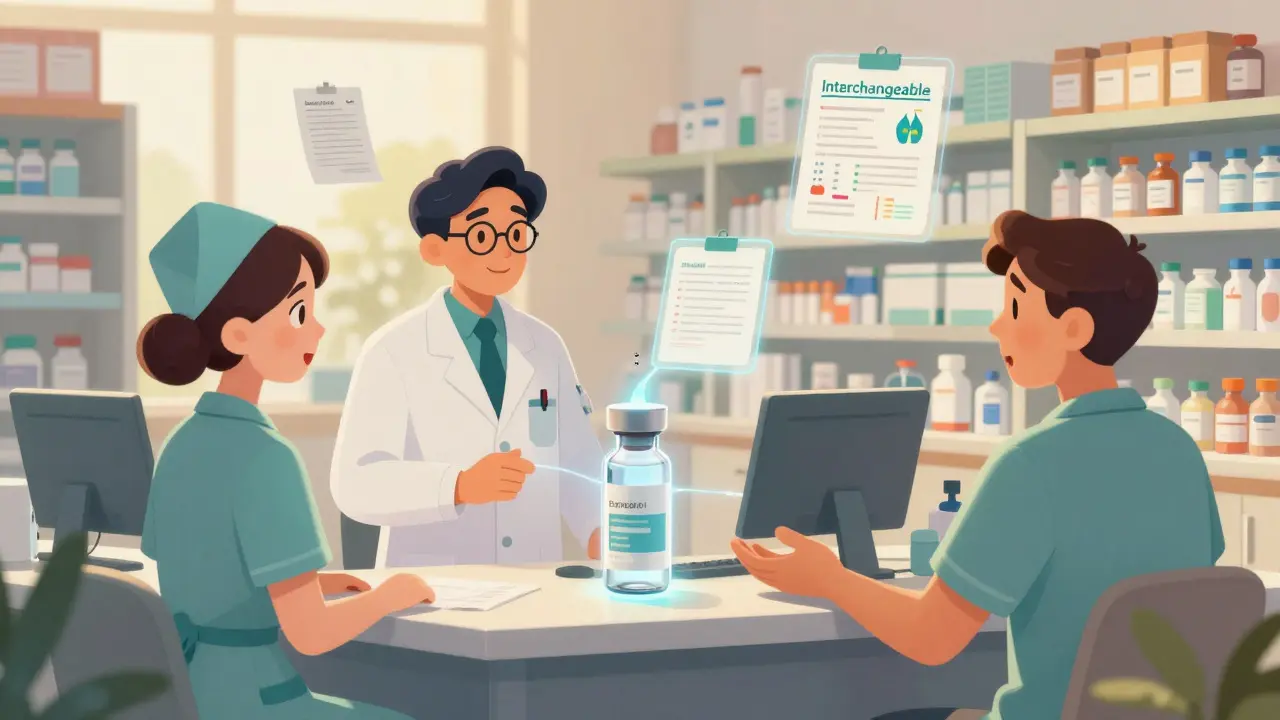
Not all biosimilars are created equal under the law. Some are labeled “interchangeable.” That’s a special FDA designation. It means the pharmacist can swap it for the brand-name drug without checking with the doctor first. Think of it like a green light. As of late 2023, only a handful of biosimilars have this status. Most don’t. And that changes everything.
If a biosimilar isn’t interchangeable, the pharmacist can’t substitute it unless the prescriber allows it. That means either the doctor wrote “dispense as written” on the prescription-or the pharmacy has to call them for permission. That slows things down. It adds work. It costs time. And in busy clinics, that’s a problem.
But here’s the twist: even when substitution isn’t automatic, pharmacists still play a huge role. They’re often the first to spot that a biosimilar is cheaper, more available, or better suited for the patient. They can suggest it. They can explain it. And in many cases, they’re the ones who convince the doctor to allow the switch.
Why Pharmacists Are Leading the Charge
Studies show pharmacists are far more likely than doctors to recommend biosimilars. One 2022 survey found that 87% of pharmacists said they’d recommend a biosimilar to a patient, compared to just 62% of physicians. Why? Because pharmacists spend more time learning about them. Nearly 80% of pharmacists have taken continuing education on biosimilars. Only 43% of doctors have.
At the US Oncology Network, they didn’t wait for doctors to catch up. They trained everyone-pharmacists, nurses, financial navigators, even the prior authorization team. They made it mandatory. They used e-learning modules. They had every provider sign an acknowledgment form agreeing to automatic substitution policies. Within a year, biosimilar adoption for pegfilgrastim jumped dramatically. Why? Because the pharmacy team took over the substitution process. Doctors didn’t have to stop what they were doing to approve each switch. Patients got the right drug faster. And the system saved money.
How Pharmacists Counsel Patients-Without Scaring Them
Patients hear “biosimilar” and think “cheap knockoff.” That’s natural. But it’s wrong. One pharmacist in Manchester shared a story: a patient with rheumatoid arthritis refused to switch from Humira to its biosimilar. She was terrified. “It’s not the real thing,” she said. The pharmacist didn’t argue. He didn’t lecture. He showed her the FDA’s website. He explained the 10-year clinical trial data. He said, “The FDA says it works just like the original. No meaningful difference. And it’s been used safely by thousands.” She switched. And she’s been stable for 18 months now.
That’s the power of good counseling. It’s not about pushing a cheaper drug. It’s about correcting myths. Patients think switching biologics is risky. But research shows that repeated switching between a biosimilar and its reference product doesn’t increase side effects. The FDA, the EMA, and major medical societies all agree. The fear is real. The risk? Not so much.
But there’s a catch. Appearance matters. If a patient has been on a brand-name biologic for years, and suddenly the pill or injection device looks different-different color, different size, different label-they’re 21% more likely to stop taking it altogether. That’s why pharmacists need to prepare patients ahead of time. Not just say, “Here’s your new drug.” But say, “This is the same treatment, just made by a different company. The device might feel a little different, but it works exactly the same.”
Traceability and Tracking: The Silent Backbone
When a biosimilar is dispensed, the pharmacist must record the exact batch number. Not just the drug name. The batch. Why? Because if something goes wrong-like an unexpected side effect-the system needs to trace it back. Was it this batch? Or that one? This isn’t bureaucracy. It’s safety.
That’s why the IFPMA says traceability is non-negotiable. And pharmacists are on the front lines. They’re the ones handing the patient the vial with the batch code printed on it. They’re the ones logging it into the electronic record. They’re the ones who alert the doctor if a patient has a reaction and the source needs to be tracked.
This level of detail isn’t needed for generics. But for biosimilars? It’s critical. And it’s one more reason why pharmacists can’t just treat them like any other drug.

Why Adoption Is Still Slow-And How to Fix It
Biologics make up just 2% of all prescriptions in the U.S. But they account for nearly half of all drug spending. That’s a massive opportunity. A single biosimilar can cut costs by 15% to 35%. Multiply that across thousands of patients, and you’re talking about billions saved.
So why isn’t everyone switching? Three big reasons:
- State laws vary. Some states allow automatic substitution. Others require prescriber approval every time. That creates confusion. A pharmacist in New York can swap a biosimilar. One in Texas might not be able to.
- Payers and PBMs block it. Some insurance companies still pay more for the brand-name drug because of rebate deals. That means the patient pays more out-of-pocket-even if the biosimilar is cheaper for the system.
- Doctors are hesitant. Many haven’t been trained. They worry about liability. They don’t know the data. And they’re not used to pharmacists making these decisions.
The fix? Three things: First, update state laws to allow pharmacist substitution where safe. Second, eliminate rebate structures that discourage biosimilar use. Third, educate. Not just doctors. Patients too. And pharmacists? They need to be the ones doing the educating.
The Future: Pharmacists as Biotherapeutics Specialists
Biosimilars aren’t going away. More are coming every year. By 2030, over 50 new biosimilars could hit the market. And with them, a growing need for experts who understand how they work, how they’re made, and how to use them safely.
That’s why experts are calling for a new pharmacy specialty: biotherapeutics. Imagine pharmacists who specialize in biologics, not just pills. Who know the manufacturing nuances. Who track batch data like detectives. Who train doctors, counsel patients, and advocate for policy changes. That’s not science fiction. It’s already happening in clinics that got ahead of the curve.
For the pharmacist, this isn’t just another task. It’s a chance to lead. To take control of a process that’s too complex for anyone else to manage. To turn confusion into confidence. And to help patients get the care they need-without paying more than they have to.
Virginia Kimball
February 15, 2026 AT 01:36Pharmacists are the real MVPs in this whole biosimilar mess. I’ve seen it firsthand-patients come in scared, thinking they’re getting some sketchy knockoff. Then you sit down, show them the FDA data, explain the manufacturing process like it’s a recipe they can understand, and suddenly they’re like, ‘Oh, so it’s just a different brand?’ No drama. No panic. Just better care and way less cash out the door. We need more of this, not less.
Chiruvella Pardha Krishna
February 16, 2026 AT 02:16It’s not about substitution. It’s about epistemology. The biosimilar is not the same as the original because it is not produced by the same ontological conditions. Living cells do not obey the logic of chemical synthesis. We are not dealing with commodities. We are dealing with emergent biological phenomena. To equate this with generic aspirin is to misunderstand life itself.
Joe Grushkin
February 16, 2026 AT 16:06Let’s be real. The whole ‘interchangeable’ label is a marketing ploy. FDA doesn’t require identical. So what? That means every biosimilar is a gamble. And pharmacists? They’re the ones stuck explaining why the patient’s insurance won’t cover the brand even though the doctor wrote ‘do not substitute.’ It’s a mess. And nobody’s fixing it.
Charlotte Dacre
February 16, 2026 AT 22:42So let me get this straight. We’ve got a $2000 drug, a $1200 biosimilar, and a pharmacist who’s the only one who actually knows what’s going on… while the doctor is Googling ‘what is a biosimilar’ during lunch? Sounds like a sitcom. Or a tragedy. Depends on whether you’re the patient or the CEO.
Mike Hammer
February 17, 2026 AT 10:25man i had a friend who switched from humira to the biosimilar and his skin broke out for like 3 weeks. he thought it was the drug but turns out he started using a new soap. still, the pharmacy didn’t even warn him the device looked different. that’s on them. little stuff like that makes people panic. you can’t just hand someone a new injector and say ‘it’s the same.’
Daniel Dover
February 19, 2026 AT 07:36Traceability is non-negotiable. Batch numbers matter. End of story.
Josiah Demara
February 20, 2026 AT 02:53Here’s the truth no one wants to admit: pharmacists are being pushed into this role because doctors are too lazy to learn. The system didn’t evolve-it collapsed. And now we’re putting the burden on the people who already work 60-hour weeks. This isn’t progress. It’s exploitation dressed up as innovation.
Kapil Verma
February 21, 2026 AT 11:07In India, we’ve been using biosimilars for over a decade. No one dies. No one gets worse. The West overthinks everything. Biosimilars aren’t magic. They’re medicine. If you can’t handle a cheaper version of a drug that works the same, maybe you shouldn’t be prescribing it. This fear is a luxury of rich countries.
Mandeep Singh
February 22, 2026 AT 09:44Let me break this down with peer-reviewed logic. The FDA’s ‘no clinically meaningful difference’ standard is a statistical mirage. It’s based on non-inferiority trials with tiny sample sizes and short follow-ups. Real-world data? That’s where the truth lives. And guess what? Real-world data shows higher discontinuation rates with biosimilars. Why? Because patients feel it. Their bodies know. And no amount of FDA brochures will change that. This whole system is built on trust in institutions that have already failed us on opioids, on vaccines, on antidepressants. Why should we trust them now?
Esha Pathak
February 24, 2026 AT 03:00the thing is... we all want to save money, right? but when your life depends on a drug, does saving $500 really matter if you're scared? i think we need to stop treating patients like numbers. the pharmacist's job isn't just to swap drugs. it's to hold space. to listen. to say 'i know this looks different, but you're still safe.' that's the real innovation here. not the science. the humanity.
Sarah Barrett
February 24, 2026 AT 07:45While the systemic challenges surrounding biosimilar adoption are indeed multifaceted, the role of the pharmacist as a clinical gatekeeper and patient educator cannot be overstated. The integration of standardized counseling protocols, coupled with mandatory continuing education, has demonstrated statistically significant improvements in therapeutic adherence and cost containment across multiple institutional settings. This is not anecdotal-it is evidence-based practice at scale.
Kaye Alcaraz
February 24, 2026 AT 23:16One of the most powerful moments I’ve seen? A pharmacist in Ohio sat with a single mom on Medicaid who’d been on Humira for 8 years. She couldn’t afford it anymore. The pharmacist didn’t just switch her-he walked her through the whole process. Showed her the FDA site. Called the doctor together. Even printed out a comparison chart. She cried. Not from fear-from relief. That’s not just pharmacy. That’s care. And it’s happening every day. We just don’t hear about it.