
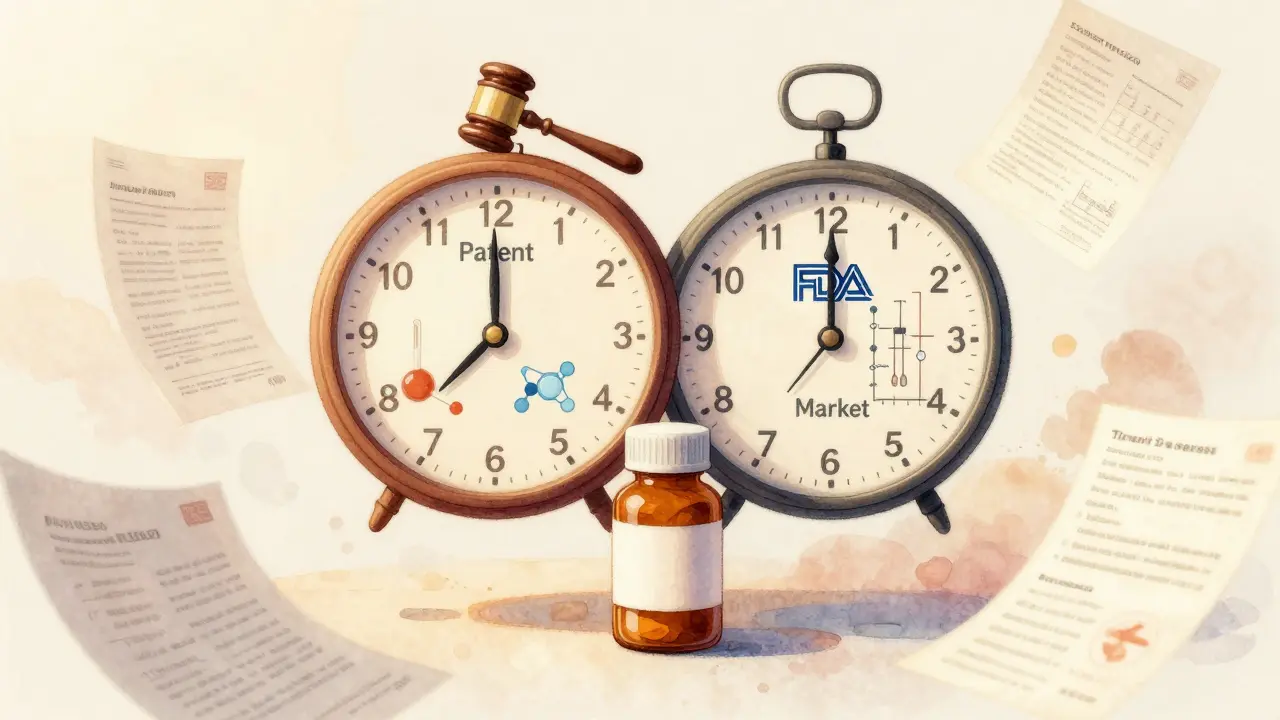
When a new drug hits the market, it doesn’t just have a price tag-it has a clock. A very specific, very legal clock that tells everyone when competitors can step in. But here’s the thing: that clock isn’t just one timer. It’s two. Patent exclusivity and market exclusivity are often confused, but they’re completely different systems with different rules, different enforcers, and very different impacts on your medicine bill.
Patent Exclusivity: The Legal Shield
A patent is a legal right granted by the U.S. Patent and Trademark Office (USPTO). It says, "This invention is mine, and no one else can make, use, or sell it without my permission." For pharmaceuticals, that usually means the chemical formula, how it’s made, or how it’s used to treat a disease.
By law, a patent lasts 20 years from the day it’s filed. Sounds long, right? But here’s the catch: most drugs take 10 to 15 years just to get approved by the FDA. That means by the time the drug actually hits shelves, you’ve already lost half your patent life. A drug filed in 2010 might not be approved until 2022-leaving only 8 years of real market protection.
That’s why companies fight for patent extensions. The law allows up to 5 extra years under something called Patent Term Extension (PTE), but only if the delay was caused by the FDA’s review process. And even then, the total time a drug can be protected after approval can’t go past 14 years. So even with extensions, you’re rarely looking at more than a decade of true monopoly.
Patents also come in layers. The strongest is a "composition of matter" patent-it protects the actual molecule. But many companies file secondary patents: for new formulations, new dosages, new delivery methods. These don’t protect the drug itself, just how it’s packaged or used. The FDA’s Orange Book lists over 68% of patents as secondary, and these are the ones most often challenged by generic makers.
Market Exclusivity: The FDA’s Secret Weapon
Market exclusivity has nothing to do with patents. It’s a gift from the FDA. It’s not about whether the drug is new in the world-it’s about whether the company submitted new clinical data to get approval.
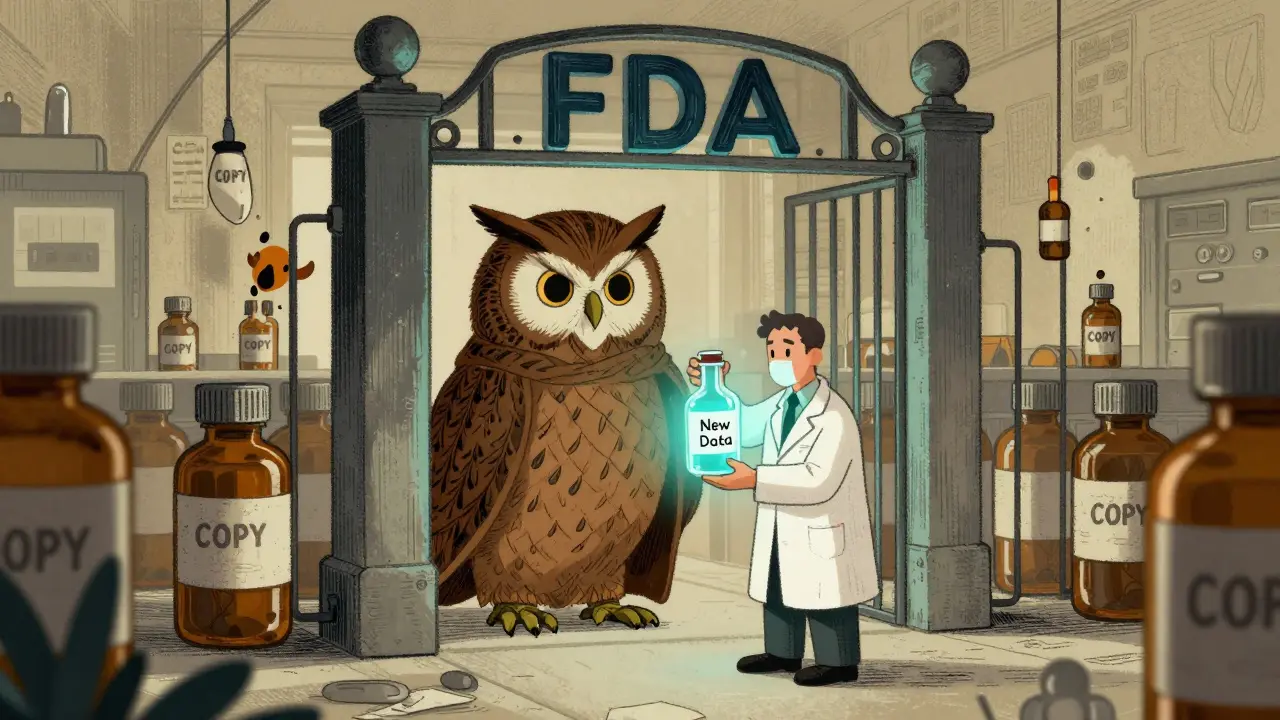
Think of it this way: patents protect the invention. Market exclusivity protects the data. If you spent $200 million running trials to prove your drug works, the FDA won’t let a competitor copy your results to get their version approved. That’s the core of market exclusivity.
Here’s how it breaks down:
- New Chemical Entity (NCE): 5 years of exclusivity. During this time, the FDA can’t even accept an application from a generic maker using your data.
- Orphan Drug: 7 years for drugs treating rare diseases (under 200,000 patients in the U.S.). This one doesn’t care if the drug is patented or not.
- Pediatric Exclusivity: Add 6 months to any existing patent or exclusivity if you test the drug in kids. Since 1997, this has generated over $15 billion in extra revenue for drugmakers.
- Biologics: 12 years of exclusivity under the BPCIA law. That’s longer than most patents last after approval.
- First Generic: If a generic company successfully challenges a patent, they get 180 days of exclusive market access. That’s worth $100 million to $500 million in extra sales.
Here’s the kicker: market exclusivity starts the day the FDA approves the drug-not when the patent was filed. And it runs even if there’s no patent. That’s why, in 2010, a drug called colchicine-used since ancient Egypt-got 10 years of exclusivity after a company submitted new clinical data. The price jumped from 10 cents to $5 per tablet.
How They Work Together (or Don’t)
Patent and market exclusivity don’t always overlap. Sometimes they do. Sometimes one runs out and the other keeps going.
The FDA found that:
- 27.8% of branded drugs have both protections
- 38.4% have only patents
- 5.2% have only market exclusivity
- 28.6% have neither
That 5.2% is critical. It means hundreds of drugs have no patent protection at all-but still can’t be copied for years because of FDA exclusivity. Small biotech companies rely on this. In fact, 73% of small biotech firms say they depend more on regulatory exclusivity than patents for their main products.
And when both protections are in place, the longer one wins. If a drug has a 5-year market exclusivity and a 10-year patent, the patent doesn’t kick in until the exclusivity ends. The FDA won’t approve generics until both clocks are done.
Why This Matters to You
Let’s say your doctor prescribes a new drug. You’re told it’s brand-name only. Why? Maybe the patent expired years ago. But the FDA exclusivity hasn’t. That’s why some drugs stay expensive for over a decade-even when the chemical formula is public knowledge.
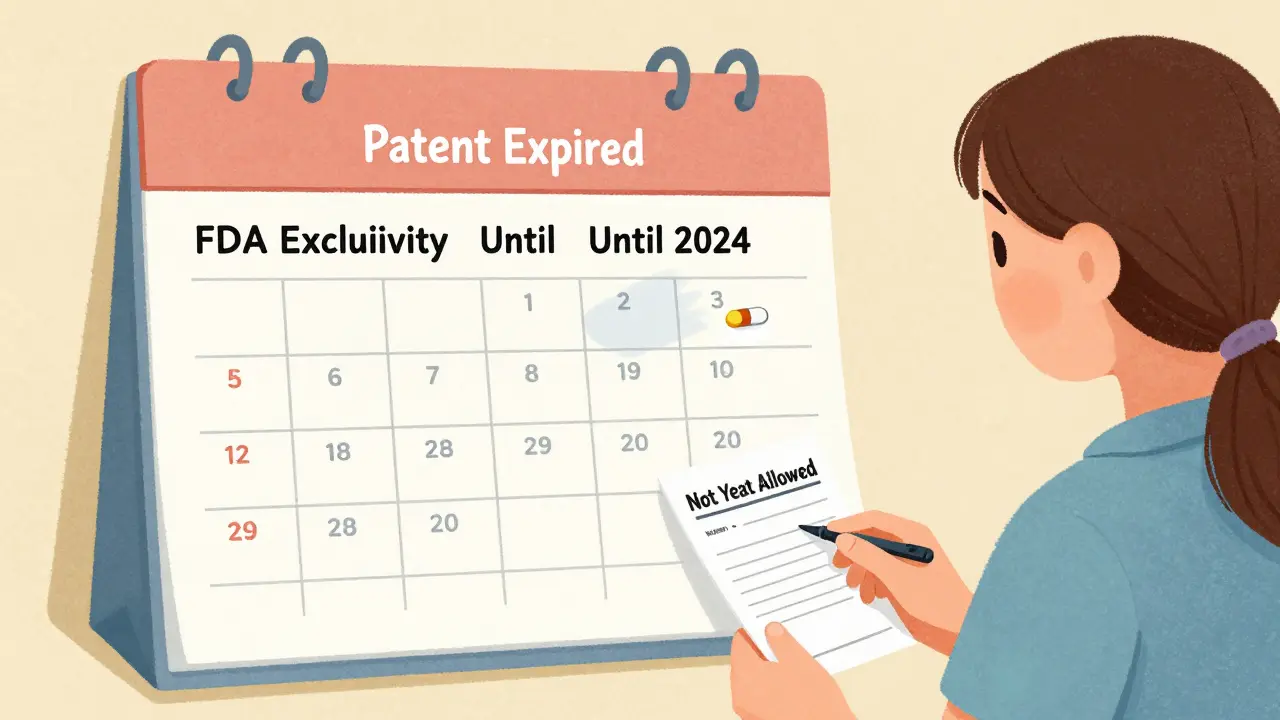
Take Trintellix, an antidepressant. Its main patent expired in 2021. But the FDA granted 3 years of exclusivity for new data submitted by the maker. Generic versions couldn’t enter until 2024. Teva Pharmaceuticals lost an estimated $320 million because of that delay.
On the flip side, if you’re a patient waiting for a cheaper version, understanding these rules helps you know when to expect relief. The FDA’s Exclusivity Dashboard, launched in September 2023, now shows real-time expiration dates for every drug’s exclusivity period. You can track when generics might arrive-even before the patent expires.
What’s Changing in 2025 and Beyond
The system is under pressure. The average cost to develop a new drug is now $2.3 billion. Companies need those exclusivity years to recoup that. But Congress and the public are pushing back.
The PREVAIL Act of 2023 proposes cutting biologics exclusivity from 12 to 10 years. The FDA is also requiring more detailed justifications for exclusivity claims starting January 1, 2024. That means companies can’t just claim exclusivity on minor tweaks-they’ll need to prove real clinical innovation.
Meanwhile, McKinsey predicts that by 2027, regulatory exclusivity will account for 52% of total drug protection time-up from 41% in 2020. Patents are getting weaker. Exclusivity is getting stronger.
And here’s the irony: many companies don’t even claim all the exclusivity they’re entitled to. Scendea Consulting found that between 2018 and 2022, 22% of drugmakers missed out on an average of 1.3 years of protection per product. That’s over $100 million in lost revenue for some.
What You Need to Remember
- Patents are about invention. Market exclusivity is about data.
- Patents are enforced in court. Market exclusivity is enforced by the FDA.
- Patents can expire before a drug even launches. Market exclusivity only starts at approval.
- Exclusivity can protect drugs that aren’t even patented.
- Both protections can run at the same time-but the longer one controls the clock.
If you’re wondering why your prescription is still expensive years after the drug became public knowledge, it’s not because no one can copy it. It’s because the FDA won’t let them.
Oladeji Omobolaji
January 23, 2026 AT 08:46Sue Stone
January 24, 2026 AT 07:20Susannah Green
January 25, 2026 AT 10:56dana torgersen
January 26, 2026 AT 18:01Vanessa Barber
January 27, 2026 AT 19:00Janet King
January 28, 2026 AT 18:46charley lopez
January 29, 2026 AT 19:16Anna Pryde-Smith
January 31, 2026 AT 17:45Kerry Moore
February 1, 2026 AT 03:45Kerry Evans
February 1, 2026 AT 12:15Laura Rice
February 1, 2026 AT 15:44Sallie Jane Barnes
February 2, 2026 AT 10:58