
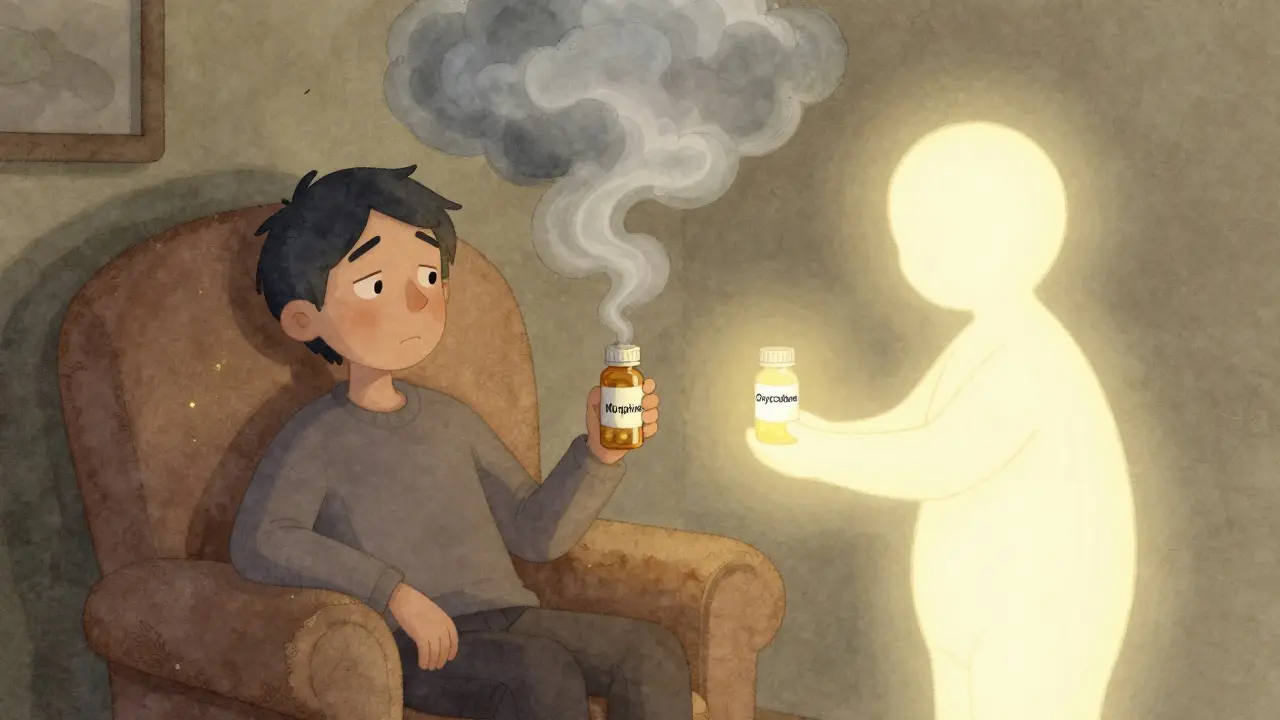
Opioid Rotation Dose Converter
Opioid Rotation Calculator
Calculate the equivalent dose when switching between opioids to reduce side effects. This tool applies the recommended 25-50% safety reduction when rotating opioids.
Safe Rotation Dose
Based on the 2009 guidelines and current evidence, this tool applies a 25-50% reduction factor when switching opioids.
mg of
Always consult with your healthcare provider before making any medication changes. This tool is for informational purposes only.
How This Works
When rotating opioids, it's critical to reduce the dose by 25-50% due to residual tolerance from the previous medication. This safety margin helps prevent overdose while maintaining pain control.
The conversion ratios shown here are based on established equianalgesic dose relationships, but individual patient factors (like kidney/liver function) may require further adjustments.
Note: Methadone often requires more conservative dose reductions and may allow for lower total daily doses compared to other opioids due to its unique pharmacology.
When opioid pain meds stop working well-or start making you feel worse-many patients and doctors turn to a strategy called opioid rotation. It’s not about increasing the dose. It’s about changing the drug. For people dealing with chronic pain, especially cancer-related or long-term neuropathic pain, this isn’t a last resort. It’s often the smartest next step.
Why Switch Opioids at All?
Not all opioids work the same way in every body. You might be on morphine and feel like you’re walking through fog-drowsy, nauseous, confused. Your pain hasn’t improved, but your side effects are unbearable. Increasing the dose won’t fix it. It’ll just make the fog thicker. That’s where rotation comes in. Swapping morphine for oxycodone, fentanyl, or methadone can suddenly make a difference. Studies show 50% to 90% of patients see fewer side effects or better pain control after switching. The key isn’t that the new drug is stronger. It’s that your body responds differently to it. The 2009 expert guidelines from the Journal of Pain and Symptom Management laid out the clear reasons to consider rotation: intolerable side effects like nausea, vomiting, sedation, or muscle twitching; pain that won’t budge even after doubling or tripling the dose; drug interactions; or changes in liver or kidney function. Even if your pain is under control but the side effects are ruining your life, rotation is still a valid option.What Side Effects Can Rotation Help With?
Some side effects respond better to certain switches. For example:- Nausea and vomiting often improve when switching from morphine to oxycodone or fentanyl.
- Constipation may lessen with hydromorphone or methadone in some patients.
- Clouded thinking or mental fogginess can clear up after switching to fentanyl patches or buprenorphine.
- Myoclonus (involuntary muscle jerks) sometimes disappears with a switch to methadone or tapentadol.
How Is the Switch Done Safely?
You can’t just stop one opioid and start another. That’s dangerous. You need to calculate an equianalgesic dose-the equivalent pain-relieving strength of the new drug based on the old one. But here’s where things get tricky. Traditional conversion tables say 30 mg of oral morphine equals 10 mg of oral oxycodone. But real-world data shows that’s not always accurate. For methadone, the ratio used to be 10:1 (10 mg morphine = 1 mg methadone). Newer studies suggest it’s closer to 9:1 for side-effect-driven switches, and even lower for pain control. Some patients need only 1/5th of what old charts say. That’s why experts always recommend a 25% to 50% dose reduction when switching, especially when moving to a drug with a longer half-life like methadone. Why? Because your body doesn’t instantly adapt. You’re still partially tolerant to the old drug. Give too much of the new one, and you risk overdose. Methadone is the exception that proves the rule. It often lets doctors lower the total daily dose (MEDD) while maintaining or improving pain control. That’s rare. Most rotations don’t reduce total opioid use-they just swap one problem for another. But methadone’s unique ability to block NMDA receptors (which are linked to pain sensitization) gives it an edge.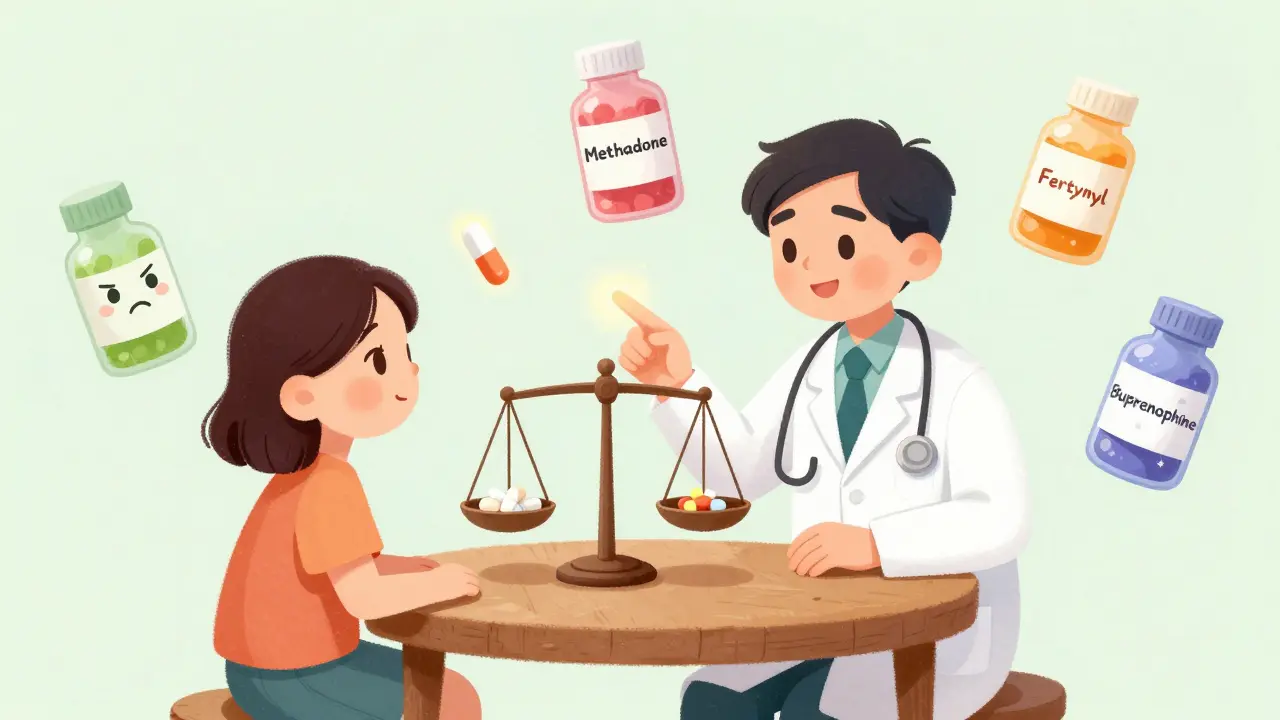
What About Opioid-Induced Hyperalgesia?
This is a hidden problem. Some patients on long-term opioids end up more sensitive to pain-not less. Their body starts reacting to pain signals like they’re fire alarms going off all the time. They feel worse even as their dose climbs. This isn’t addiction. It’s a neurological side effect. And it’s a major reason to rotate. If your pain is getting worse despite higher doses, opioid-induced hyperalgesia might be the culprit. Switching opioids-especially to one with different receptor activity like buprenorphine or methadone-can reset your nervous system’s pain sensitivity. The 2009 guidelines didn’t include this because it wasn’t well understood then. But by 2022, it was added as a key indication. Now, it’s part of standard assessment.Why Isn’t This More Common?
Despite solid evidence, many doctors still avoid rotation. Why? First, it’s complicated. Calculating equianalgesic doses requires knowing the patient’s full history, current dose, route of administration, and kidney/liver function. It’s not something you can do in a 10-minute visit. Second, there’s no big clinical trial proving it works better than increasing the dose. Most evidence comes from observational studies. That means doctors don’t have the high-level proof they’re used to. But in pain management, we often work with what we have-not what we wish we had. Third, there’s fear. Fear of making a mistake. Fear of causing harm. Fear of regulatory scrutiny. But the bigger risk is doing nothing. Staying on a drug that makes you sick, or keeps increasing the dose until you’re on 200 mg of morphine a day with no real benefit.
What’s the Real Success Rate?
Success isn’t about eliminating all pain. It’s about improving quality of life. If you can reduce nausea enough to eat, stop vomiting so you can sleep, or clear your brain fog enough to talk to your grandkids-that’s success. In outpatient palliative care clinics, rotation visits were linked to higher baseline pain scores and higher opioid doses. These weren’t easy cases. Yet, many still improved. The ones who didn’t? Often had other issues-depression, nerve damage, uncontrolled inflammation-that needed separate treatment. The goal isn’t to get off opioids. It’s to get the right opioid. One that lets you live, not just survive.What Comes Next?
The future of opioid rotation is personal. Researchers are looking at genetic testing to predict who responds to which drug. Some people have gene variants that make them metabolize codeine too fast-or not at all. Others process oxycodone slowly, leading to buildup and side effects. Electronic health records are starting to include built-in conversion calculators and safety alerts. That’s a big step. But the human element still matters most. A good doctor doesn’t just run numbers. They listen. They ask: How are you really feeling? What’s your life like right now? Documentation is critical. Write down why you switched. What dose you used. What happened after. That’s how we learn. That’s how future patients get better care.Final Thoughts
Opioid rotation isn’t magic. It’s medicine. It’s science. It’s the recognition that not every person is the same, and not every opioid is interchangeable. If you’ve been on the same opioid for months and it’s no longer working-or it’s making you miserable-it’s not your fault. It’s not weakness. It’s biology. Talk to your doctor. Ask about rotation. Ask about methadone. Ask about fentanyl patches. Ask about buprenorphine. Don’t settle for a drug that’s just tolerable. You deserve better.There’s no shame in switching. There’s only courage in asking for a better option.
Cassie Widders
January 12, 2026 AT 15:05I switched from morphine to oxycodone last year after three months of nausea so bad I couldn’t hold down tea. Within a week, I was eating real food again. No magic, just biology.
Still on it. Still functional. Still alive.
That’s all I needed.
Konika Choudhury
January 14, 2026 AT 14:25Why are we even talking about opioids like they’re some kind of solution? India has real pain problems like malnutrition and lack of clean water and you people are debating which pill makes you less foggy? This is what happens when you have too much money and too little purpose.
Darryl Perry
January 15, 2026 AT 19:33The data is insufficient. Observational studies don’t meet clinical trial standards. Without RCTs, this is anecdotal at best. You’re risking patient safety with unvalidated protocols.
Windie Wilson
January 17, 2026 AT 00:15So let me get this straight. You’re telling me the solution to being drugged up and miserable is… to get drugged up with a *different* drug?
Wow. Just wow.
Next they’ll tell us the cure for a broken leg is a different kind of cast.
At least the fog had a nice view.
Amanda Eichstaedt
January 17, 2026 AT 08:10This post made me cry. Not because I’m sad-but because I finally feel seen.
I was on 120mg morphine a day for five years. Couldn’t remember my daughter’s birthday. Couldn’t laugh without feeling like I’d swallowed lead.
Switched to methadone. Dose cut in half. Suddenly I could hear birds again.
It’s not about quitting opioids. It’s about finding the one that lets you be human.
Thank you for writing this.
Someone needed to say it.
Jose Mecanico
January 18, 2026 AT 05:06I’ve seen this work in hospice. Not every time. But enough times that I’ll always bring it up. It’s not the first thing you try, but it’s not the last either. Just… another tool.
Worth asking about.
Alex Fortwengler
January 18, 2026 AT 21:39Big Pharma loves this. More pills. More prescriptions. More profits. They don’t care if you live or die as long as you keep buying. Methadone? Fentanyl? They’re just new ways to hook you. They’re not fixing pain-they’re selling addiction with a fancy name. Wake up.
There’s no safe opioid. Only ones you haven’t overdosed on yet.
jordan shiyangeni
January 20, 2026 AT 09:34It’s appalling how casually this community treats opioid rotation as if it were a grocery list. You’re manipulating neurochemical pathways with compounds that alter synaptic plasticity, and you’re treating it like swapping coffee brands. The fact that you’re even suggesting a 25% dose reduction without rigorous pharmacokinetic modeling is medically irresponsible. You’re not ‘helping’-you’re gambling with GABAergic and mu-opioid receptor dynamics in patients who already have compromised hepatic metabolism. And don’t get me started on the lack of standardized documentation protocols. This isn’t medicine. It’s chaos with a prescription pad.
Abner San Diego
January 21, 2026 AT 14:20They say ‘rotation’ like it’s some noble science. In reality, it’s just the last ditch effort before they give you a cane and a pity look. I’ve seen guys on 400mg morphine a day get switched to methadone and still cry in the waiting room. It’s not fixing anything. It’s just moving the pain to a different room.
And yeah, the doctors are scared. Not of overdosing you-they’re scared of getting audited.
Eileen Reilly
January 21, 2026 AT 15:29ok so i got switched from hydromorphone to buprenorphine and my pain got worse but at least i stopped twitching so… win? lol
my doc said it was because my body was ‘resetting’ but honestly i think she was just tired of my texts at 2am.
also i miss my old meds. they made me sleepy but at least i could sleep without thinking i was being chased.
Monica Puglia
January 22, 2026 AT 12:21Thank you for this. 🙏
My mom went through this last year. She was on morphine for 8 years. Couldn’t hold my baby. Couldn’t smell flowers. Couldn’t watch TV without nodding off.
We asked about rotation. The doctor said ‘it’s risky.’ We asked again. He said ‘most people don’t need it.’
We found a pain specialist on our own. Switched to fentanyl patches. She cried the first time she hugged me without falling asleep.
It’s not about being brave. It’s about being heard.
If you’re suffering and your doctor won’t listen… keep asking.
You deserve to feel like yourself again.
And if you’re a doctor reading this? Please don’t dismiss this. It’s not just pills. It’s people.