
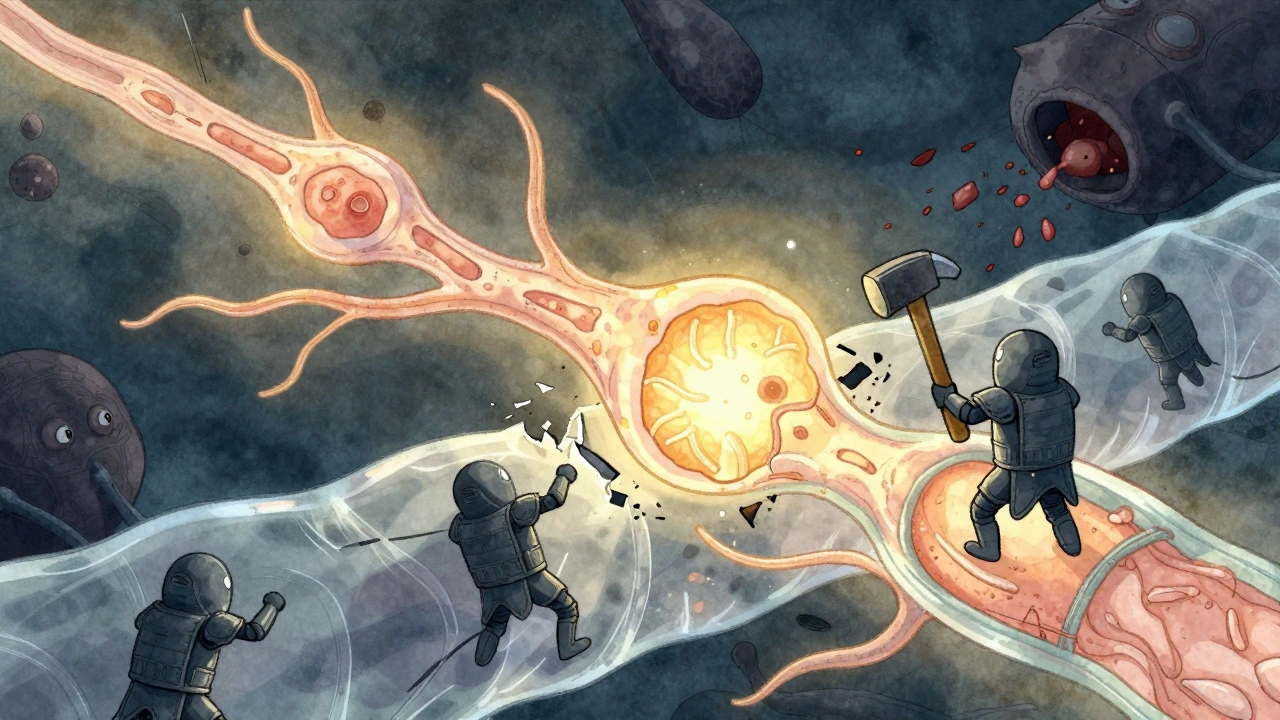
Multiple sclerosis isn’t just a neurological condition-it’s an internal betrayal. Your own immune system, designed to protect you, turns against your brain and spinal cord, stripping away the protective coating around your nerves. This isn’t a slow decline you can ignore. It’s an active, ongoing war inside your central nervous system, and the damage builds up silently until symptoms become impossible to overlook.
What Happens When Your Immune System Goes Rogue
In multiple sclerosis (MS), the immune system mistakes parts of your nervous system for foreign invaders. Specifically, it targets the myelin sheath-the fatty insulation wrapped around nerve fibers (axons) that lets electrical signals zip through your body at lightning speed. When myelin gets damaged, those signals slow down, get scrambled, or stop entirely. That’s when you feel numbness, weakness, blurred vision, or trouble walking. This isn’t random. It starts with immune cells-mainly T cells and B cells-breaking through the blood-brain barrier, a normally tight filter that keeps harmful substances out of the brain and spinal cord. Once inside, these cells find myelin proteins and launch an attack. Macrophages swarm in, eating away the insulation. Microglia, the brain’s own immune guards, get activated and start releasing inflammatory chemicals that make things worse. The result? Scar tissue, or plaques, form in patches across the brain and spinal cord. These are the lesions doctors see on MRIs. Research shows this isn’t just one type of attack. There are four distinct patterns of damage seen in MS tissue. Some involve mostly T cells and macrophages. Others show heavy antibody deposits. One pattern even reveals dying myelin-producing cells without much inflammation. This complexity explains why MS affects people so differently.Who Gets MS-and Why?
About 2.8 million people worldwide live with MS. Women are two to three times more likely to be diagnosed than men. The disease usually shows up between ages 20 and 40, though it can strike earlier or later. It’s not inherited like a gene disorder, but genetics do play a role. If you have a parent or sibling with MS, your risk goes up-though it’s still low overall. Environmental triggers matter just as much. Epstein-Barr virus (EBV), the virus that causes mononucleosis, is the strongest known link. People who’ve had EBV are 32 times more likely to develop MS than those who haven’t. Vitamin D deficiency also increases risk-especially in people living far from the equator, where sunlight is weaker. Smoking doesn’t just harm your lungs; it doubles the chance of MS worsening over time. Even where you grew up matters. People who move from a high-risk area (like Canada or Scandinavia) to a low-risk one before age 15 lower their risk. Move after that, and your risk stays high.The Symptoms You Can’t Ignore
Symptoms vary wildly because MS lesions can appear anywhere in the central nervous system. But some patterns show up again and again.- Fatigue hits 80% of people with MS. It’s not just being tired. It’s a crushing, bone-deep exhaustion that doesn’t improve with rest.
- Vision problems often come first. Optic neuritis-swelling of the optic nerve-can blur vision, cause pain when moving the eye, or even lead to temporary blindness in one eye.
- Numbness or tingling in the face, arms, or legs is common. Some describe it like pins and needles, others say it feels like their limb is asleep.
- Walking difficulties affect nearly half of people with MS. Weakness, poor balance, or spasticity (muscle stiffness) make even short walks exhausting.
- Lhermitte’s sign is a telltale sign: a sharp electric shock running down your spine when you bend your neck forward. It’s caused by demyelinated nerves in the neck.

How MS Progresses-Relapsing vs. Progressive
There are two main types of MS progression. Most people start with RRMS. Flares last days to weeks, followed by periods of remission where symptoms fade or disappear. But even during remission, damage continues quietly. About half of untreated RRMS patients need a cane or walker within 15 to 20 years. Then there’s primary progressive MS (PPMS), affecting 15%. No flares. No remissions. Just a steady, slow decline. Nerve damage accumulates without the inflammatory bursts seen in RRMS. This form is harder to treat because the immune system isn’t as visibly active. The real tragedy isn’t the relapses-it’s the hidden neurodegeneration. Axons, the long wires that carry signals, start breaking down. Once they’re gone, they don’t grow back. That’s why disability gets worse over time, even if inflammation is controlled.Current Treatments: Stopping the Attack
There’s no cure yet-but treatments have changed everything. Disease-modifying therapies (DMTs) don’t fix damaged nerves. They stop the immune system from attacking new ones. Ocrelizumab, approved in 2017, targets B cells. It cuts relapses by 46% in RRMS and slows disability progression by 24% in PPMS. Natalizumab blocks immune cells from crossing into the brain. It’s powerful-reducing relapses by 68%-but carries a rare but deadly risk: progressive multifocal leukoencephalopathy (PML), a brain infection. That’s why doctors test for the JC virus before prescribing it. Newer drugs like siponimod and cladribine work by trapping immune cells in lymph nodes or wiping out specific cell types. Each has trade-offs: effectiveness vs. side effects, convenience vs. monitoring needs.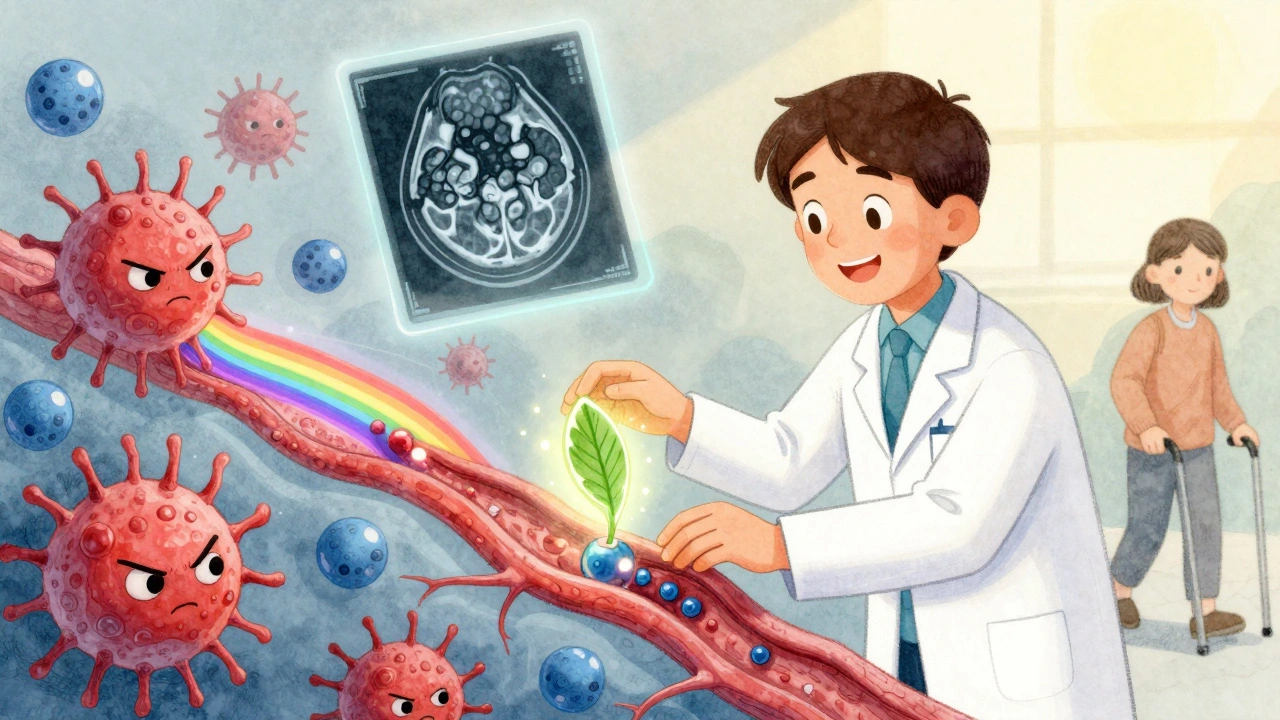
The Hope: Repairing What’s Broken
The next frontier isn’t just stopping damage-it’s fixing it. Scientists are racing to find ways to rebuild myelin. One drug, clemastine fumarate, showed promise in early trials: patients improved their visual signal speed by 35%. That’s not just a lab result-it means better vision, faster reaction times, maybe even less fatigue. Researchers are also looking at how to calm microglia and stop dendritic cells from presenting myelin as a threat. Neutrophil extracellular traps (NETs), sticky webs of DNA and toxins released by immune cells, are now known to damage the blood-brain barrier. Blocking them could be a new way to prevent attacks. Blood tests for neurofilament light chain (sNfL) are becoming routine. Levels above 15 pg/mL mean active nerve damage is happening-even if the patient feels fine. This lets doctors adjust treatment before disability grows.What Life With MS Looks Like Today
People with MS aren’t waiting for a miracle. They’re managing. Physical therapy keeps muscles strong. Cooling vests help with heat sensitivity. Medications for spasticity, bladder control, and depression are part of daily life. Many use mobility aids-not because they’re giving up, but because they’re staying active. The stigma is fading. More workplaces offer flexibility. Online communities like Reddit’s r/MS are full of real stories: someone describing how they lost vision overnight, then regained it after steroids. Another talks about the terror of Lhermitte’s sign, then the relief of finding a brace that helps. These aren’t just anecdotes-they’re data points from real lives. The message is clear: MS isn’t a death sentence. It’s a chronic condition that requires attention, but with modern tools, many people live full, active lives. The immune system may have turned traitor, but science is learning how to outsmart it.Is multiple sclerosis hereditary?
MS isn’t directly inherited like a genetic disease. But having a close relative with MS increases your risk-especially if it’s a parent or sibling. Still, even then, your overall chance of developing it remains low. Genetics load the gun, but environment pulls the trigger. Things like Epstein-Barr virus, low vitamin D, and smoking play bigger roles than family history alone.
Can you get MS if you’ve never had mono?
Yes, but it’s rare. Nearly everyone with MS has been infected with Epstein-Barr virus (EBV), the cause of mono. In fact, people who’ve had EBV are 32 times more likely to develop MS than those who haven’t. While not everyone with EBV gets MS, it’s extremely uncommon to develop MS without prior EBV exposure. The virus seems to reset the immune system in a way that makes it more likely to attack myelin.
Does vitamin D prevent MS?
Taking vitamin D won’t guarantee you won’t get MS, but low levels are strongly linked to higher risk. Studies show people with serum vitamin D below 50 nmol/L have about 60% higher risk of developing MS. While supplements aren’t a cure, maintaining healthy levels (through sun exposure or supplements) is a simple, safe way to reduce risk-especially if you live in a northern climate or have a family history.
Can MS be cured?
There’s no cure yet. But modern treatments can stop or greatly slow progression. Many people with MS, especially those who start treatment early, live with minimal disability for decades. Research into remyelination and neuroprotection is advancing fast. The goal isn’t just to manage symptoms-it’s to repair damage and restore function. Some experts believe a true cure could be possible within the next 10 to 20 years.
Why do symptoms get worse when it’s hot?
Heat makes MS symptoms worse because damaged nerves can’t conduct signals well when they’re warm. Even a small rise in body temperature-like from a hot shower, exercise, or a sunny day-can slow down nerve impulses enough to trigger temporary symptoms: blurred vision, fatigue, or weakness. This is called Uhthoff’s phenomenon. It’s not a new attack-it’s just the nervous system struggling under stress. Cooling down usually reverses the symptoms quickly.
Are MS lesions visible on an MRI?
Yes. MRI scans are the main tool doctors use to diagnose and track MS. Lesions-areas of scar tissue from past attacks-appear as bright spots on T2-weighted images. New lesions show up as enhancing spots after contrast dye is injected, meaning inflammation is active. Monitoring lesion count and size over time helps doctors decide if treatment is working or needs to change.
Ignacio Pacheco
December 2, 2025 AT 11:19So let me get this straight - our immune system is basically a rogue AI that forgot it was supposed to protect us, and now it’s just spamming our nerves with DDoS attacks? Cool. Cool cool cool.
parth pandya
December 3, 2025 AT 18:00u mean the myelin sheath is like the insulation on a frayed power cord? and when it wears out, the signal gets all janky? yeah i get it. been there with my old laptop charger lol
Rashmin Patel
December 5, 2025 AT 16:19Honestly? This post made me cry. Not because I have MS, but because I’ve watched my aunt go from hiking every weekend to needing a cane in 5 years. And no one talks about how the fatigue isn’t just ‘being tired’ - it’s like your bones are filled with wet cement and someone keeps turning up the heat. I’m so glad someone finally said it out loud. 💔
Kara Bysterbusch
December 6, 2025 AT 22:50What strikes me most is how deeply cultural this is - the stigma, the invisibility of symptoms, the way Western medicine treats MS like a ‘problem to solve’ rather than a life to adapt to. In India, we say ‘dard hai toh zindagi hai’ - if you feel pain, you’re still alive. That’s not weakness. That’s resilience. And people with MS are the ultimate embodiment of that.
Gene Linetsky
December 8, 2025 AT 16:24They don’t want you to know this - but MS is linked to 5G towers and chemtrails. The CDC hides the real cause: nanobots injected via vaccines that latch onto myelin. The same ones they used in the 2020 election surveillance drones. You think your MRI shows lesions? Nah. That’s just the nanobot signature. Wake up.
Jim Schultz
December 8, 2025 AT 20:32Oh wow. So you’re telling me that after decades of research, we still can’t fix a damaged nerve? That’s adorable. I mean, we’ve sent robots to Mars, but we can’t regrow a myelin sheath? Please. If you spent half as much time reading papers as you do scrolling TikTok, you’d know that oligodendrocyte progenitor cell transplantation has been in phase 2 since 2021. But no - let’s just keep slapping on DMTs like Band-Aids on a hemorrhage.
Joykrishna Banerjee
December 9, 2025 AT 15:08Interesting. But have you considered the Vedic perspective? In Ayurveda, MS is a vata imbalance - aggravated by modern diets, excessive screen time, and the erosion of dharma in society. The real cure? Daily abhyanga, pranayama, and avoiding gluten. Western medicine is just a symptom-masker. 🙏
Archie singh
December 9, 2025 AT 16:54It’s not about the immune system. It’s about epigenetic silencing of myelin repair genes triggered by environmental toxins. The fact that you’re still talking about EBV like it’s the root cause shows how little you understand. The real villain? Glyphosate. And the pharmaceutical industry profits from keeping you distracted.
Rashi Taliyan
December 10, 2025 AT 14:29I read this and I just… I can’t. My sister got diagnosed at 24. She cried for three days. Then she started painting again. Her canvases are all swirls of color - blues and reds and black. She says they’re what her nerves feel like. I don’t know if this helps anyone. But I needed to say it.
Kidar Saleh
December 12, 2025 AT 00:13My grandfather had MS in the ‘70s. Back then, they told him to go home and rest. He walked with a cane for 30 years. He never complained. He just kept gardening. I think we’ve lost something in this race for ‘cures’ - the quiet dignity of living with it, not just fighting it.
Myson Jones
December 12, 2025 AT 09:12To everyone who’s been affected by MS - whether you’re living with it, caring for someone who is, or just trying to understand - thank you for showing up. This isn’t a battle to be won. It’s a journey to be walked. And you’re not walking it alone. There’s a community here. We see you. We honor you.
shalini vaishnav
December 12, 2025 AT 17:12India has zero MS cases because we don’t eat processed food and we don’t get vaccines. This is a Western disease caused by decadence. Stop importing your problems here. We have real issues - like poverty and corruption - not this overmedicated nonsense.