

Anticoagulant Risk & Safety Checker
Safety Analysis Results:
Imagine taking a medication designed to save your life by preventing a stroke, only to find that a simple bump on the arm leads to a bruise that won't stop growing. This is the delicate tightrope of anticoagulation therapy. While blood thinners are essential for millions, they introduce a paradox: the very mechanism that stops dangerous clots from forming also makes it harder for your body to stop a bleed. For about 1-3% of patients every year, this balance tips toward a serious hemorrhage, turning a preventative treatment into a medical emergency.
The goal isn't to avoid these medications-since the risk of a stroke or pulmonary embolism is often far higher-but to master the art of hemorrhage prevention. Whether you are managing a long-term condition like atrial fibrillation or recovering from a deep vein thrombosis, understanding how these drugs interact with your body is the only way to stay safe.
The Different Types of Blood Thinners
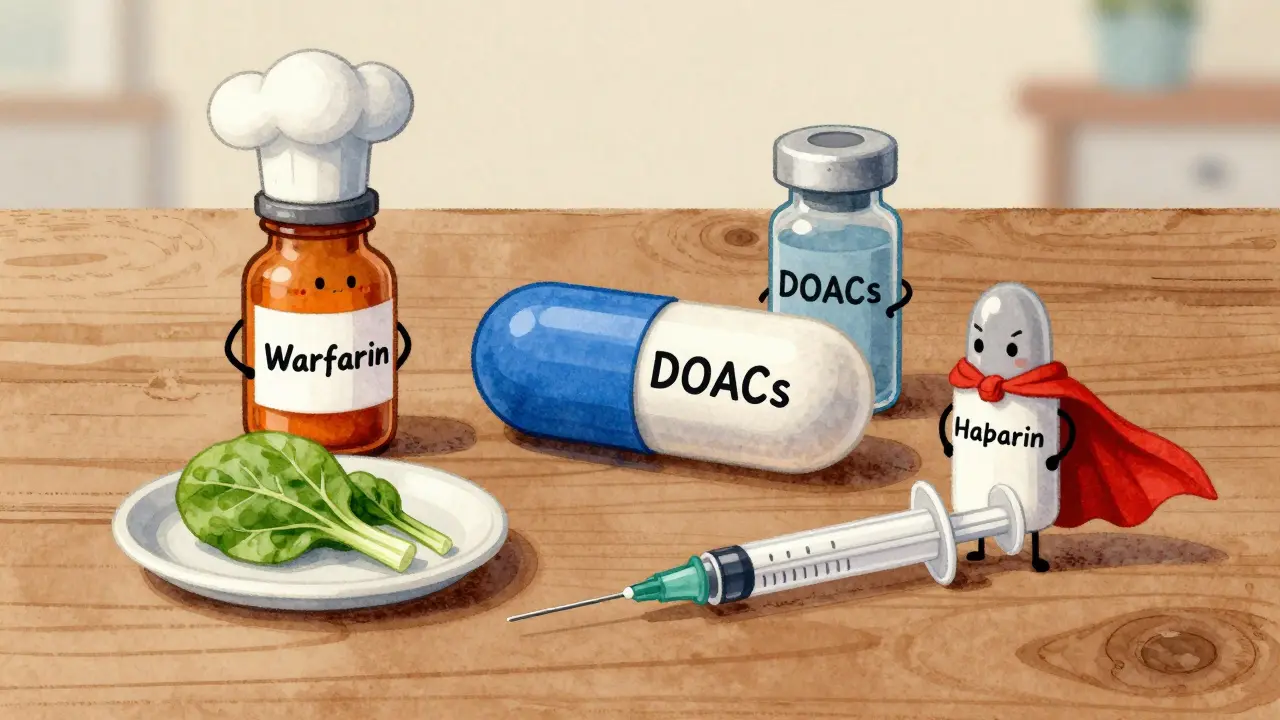
Not all anticoagulants work the same way. To prevent bleeding, you first have to know which "tool" is being used to thin your blood. We generally group them into three main categories based on how they interfere with the clotting process.
Warfarin is a vitamin K antagonist that prevents the liver from using vitamin K to create clotting factors. Because it is so sensitive to diet and other drugs, it requires regular blood tests to check your International Normalized Ratio (INR). Most people aim for an INR between 2.0 and 3.0, but if you have a mechanical heart valve, your doctor might push that target higher, to 2.5-3.5.
Direct Oral Anticoagulants (DOACs) are newer medications that target specific clotting proteins directly without needing vitamin K interference. These include the direct thrombin inhibitor dabigatran and factor Xa inhibitors like apixaban, rivaroxaban, and edoxaban. They are popular because they don't require the constant blood monitoring that Warfarin does.
Heparins are fast-acting anticoagulants typically used in hospitals or for short-term bridges. This group includes unfractionated heparin (delivered via IV) and Low Molecular Weight Heparins (LMWHs) like enoxaparin, which are often injected under the skin. They work by activating antithrombin to shut down the clotting cascade almost instantly.
| Feature | Warfarin | DOACs (e.g., Apixaban) | Heparins |
|---|---|---|---|
| Monitoring Required | High (INR tests) | Low/None | Moderate (aPTT) |
| Onset of Action | Slow (Days) | Fast (Hours) | Immediate |
| Dietary Restrictions | Yes (Vitamin K foods) | No | No |
| Major Bleeding Risk | Baseline | ~20% Lower than Warfarin | Variable (HIT risk) |
Identifying Your Individual Bleeding Risk
Why does one person bleed through a nosebleed for an hour while another barely notices? Bleeding risk isn't universal; it's a combination of the drug's potency and your body's current state. Age is a massive factor. If you're over 75, your risk of major bleeding is two to three times higher than a younger patient. This isn't just about "fragile skin," but about how the body processes these chemicals.
Your kidneys are the unsung heroes of anticoagulant safety. Since many DOACs are cleared by the kidneys, any decline in function means the drug stays in your system longer, effectively "over-thinning" your blood. If your creatinine clearance (CrCl) drops below 50 mL/min, your risk of major bleeding can double. This is why doctors insist on kidney function tests every few months; it's not just routine paperwork-it's the only way to know if your dose needs to be lowered to prevent a hemorrhage.
Then there is the "drug cocktail" effect. Many people take aspirin or other antiplatelet drugs alongside anticoagulants. While this might seem like double protection, it's often dangerous. Adding dual therapy can increase your major bleeding risk by as much as 50% to 70%. Always tell your provider every single supplement or over-the-counter pill you take, even the ones you think are harmless.
How Doctors Stop the Bleed: Reversal Agents
When a bleed becomes a crisis, doctors don't just wait for the drug to wear off. They use reversal agents, which are essentially "antidotes" that neutralize the blood thinner.
For those on Warfarin, the gold standard is now 4-factor prothrombin complex concentrate (4f-PCC). In the past, doctors used fresh frozen plasma, but that takes too long to thaw and requires huge volumes of fluid. 4f-PCC can correct an INR in about 15 minutes, which is critical when every second counts in a brain bleed. This is usually paired with a dose of Vitamin K to keep the levels stable long-term.
The reversal process for DOACs is more specialized. If you're on dabigatran, there is a specific antidote called idarucizumab. For the factor Xa inhibitors (like apixaban or rivaroxaban), doctors use andexanet alfa. While highly effective, andexanet alfa is incredibly expensive-sometimes costing $13,000 per dose-which has limited its availability in some smaller hospitals.
For heparin, the process is simpler. Protamine sulfate is used to neutralize unfractionated heparin, though it's only about 60% effective against the lower molecular weight versions. This variability is why LMWHs are often preferred for certain patients despite the harder reversal process.

Practical Prevention Strategies for Daily Life
You don't have to live in fear, but you do have to be mindful. Hemorrhage prevention starts with the small things. For those on Warfarin, consistency is key. If you suddenly start eating massive amounts of spinach or kale (which are rich in Vitamin K), you can actually cancel out your medication, increasing your risk of a clot. Conversely, a sudden drop in these foods can make your blood too thin.
For everyone on anticoagulants, the "Warning Signs Checklist" should be memorized. You aren't just looking for a cut that won't stop; you're looking for internal clues:
- Gums and Nose: Frequent or prolonged bleeding during brushing or nose-picking.
- Skin: Unexplained purple splotches (purpura) or tiny red dots (petechiae).
- Urinary/Digestive: Pink or red urine, or stools that look like black, sticky tar.
- Neurological: Sudden, severe headaches or confusion, which could signal an internal bleed.
If you are scheduled for a procedure-even a dental cleaning-you must coordinate the timing of your dose. Some doctors suggest a "bridge" where you switch to a short-acting heparin before the surgery and switch back to a DOAC afterward. This minimizes the time you are at high risk for a bleed during the procedure while keeping you protected from clots.
What Happens After a Bleeding Event?
Once a bleed is stopped, the hardest question is: When do we start the meds again? This is a high-stakes calculation. If you stop the anticoagulant for too long, you risk a stroke. If you start too early, you might re-trigger the hemorrhage.
Medical teams use risk scores like CHA₂DS₂-VASc to decide. If you have a low risk of clots-for instance, you had a one-time blood clot in your leg a year ago-your doctor might suggest staying off the medication entirely. However, for someone with a mechanical heart valve or a history of frequent strokes, the medication is usually restarted as soon as the bleeding is clinically stable, often at a reduced dose.
Looking forward, the medical world is moving toward "universal reversal agents." Researchers are testing drugs like ciraparantag, which could potentially neutralize several different types of anticoagulants with one shot. Until then, the best defense is a proactive relationship with your doctor and a strict adherence to your dosing schedule.
Can I take aspirin while on a blood thinner?
Only if your doctor specifically prescribes it. Taking aspirin or other NSAIDs (like ibuprofen) alongside anticoagulants significantly increases your risk of stomach bleeds and other internal hemorrhages. Always check before taking any over-the-counter pain relief.
What is the biggest risk for someone over 75 on DOACs?
The biggest risk is renal decline. As kidneys age, they may not clear the medication as efficiently, leading to an accumulation of the drug in the bloodstream. This increases the risk of major bleeding, which is why frequent creatinine clearance tests are mandatory for elderly patients.
Why is Warfarin still used if DOACs are safer?
Warfarin remains the first-line choice for patients with mechanical heart valves (especially mitral valves) and those with antiphospholipid syndrome. In these specific conditions, DOACs have shown higher rates of thrombotic events, meaning Warfarin is actually the safer choice to prevent clots.
How quickly does the reversal agent work for a Warfarin bleed?
When using 4-factor prothrombin complex concentrate (4f-PCC), the INR can be corrected within about 15 minutes. This is significantly faster than using Vitamin K alone, which can take 8 to 24 hours to fully reverse the effect.
Are there dietary changes I need to make for all blood thinners?
Dietary restrictions are primarily specific to Warfarin because it interferes with Vitamin K. For DOACs like apixaban or rivaroxaban, there are generally no major dietary restrictions, though you should still avoid excessive alcohol and certain herbal supplements that might interact with the medication.