
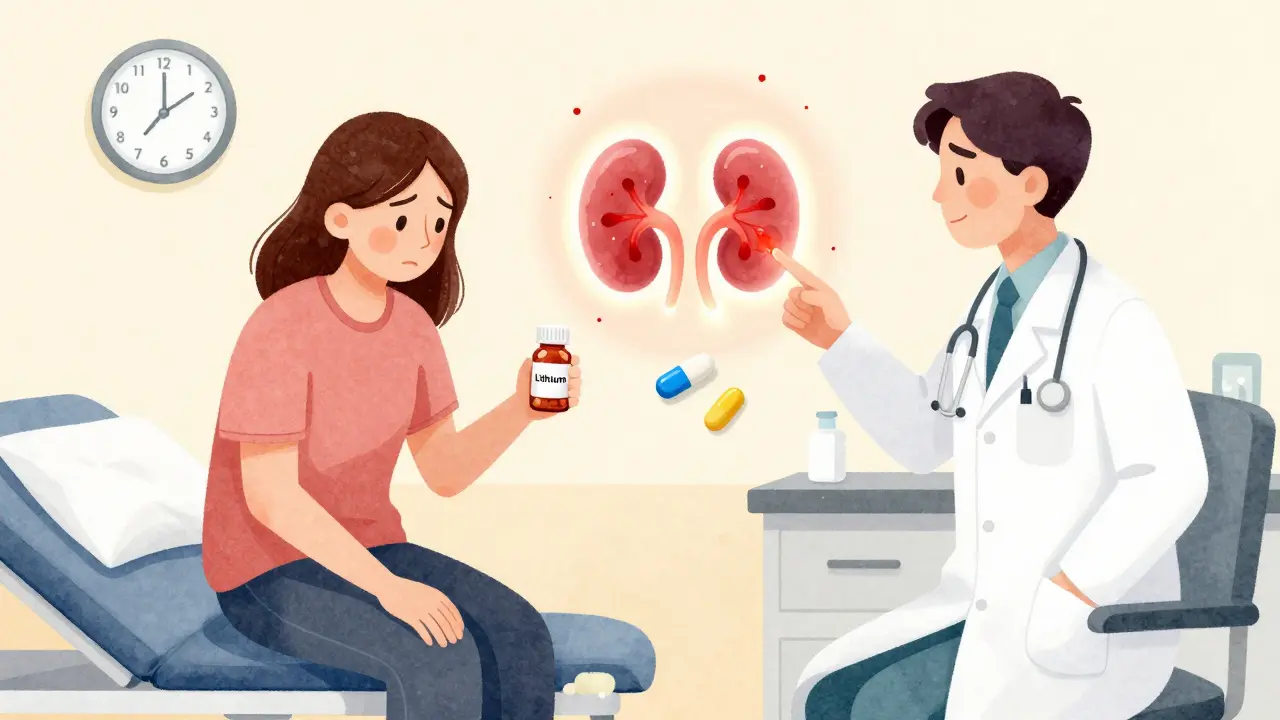
When someone takes lithium for bipolar disorder, even small changes in their body can push lithium levels into the danger zone. Lithium isn't broken down by the liver or stored in fat-it's filtered by the kidneys and mostly reabsorbed back into the blood. That means anything that alters kidney function can cause lithium to build up. Two of the most common culprits? Diuretics and NSAIDs. These drugs are prescribed for high blood pressure, swelling, or pain, but when taken with lithium, they can turn a safe treatment into a medical emergency.
Why Lithium Is So Sensitive
Lithium works by stabilizing mood, but it has one of the narrowest therapeutic windows of any psychiatric drug. The safe range is just 0.6 to 1.2 mmol/L. Go above 1.5 mmol/L, and symptoms like nausea, tremors, confusion, or dizziness start to appear. At 2.0 mmol/L or higher, you’re looking at muscle weakness, slurred speech, or even seizures. Levels above 2.5 mmol/L can be fatal. This isn’t theoretical-case reports show people ending up in the ICU after taking a common painkiller or diuretic without realizing the risk.
Unlike most drugs, lithium doesn’t bind to proteins or get metabolized. It moves freely through the bloodstream and is filtered out by the kidneys. The kidneys reabsorb lithium in the same way they reabsorb sodium. If sodium levels drop-like when you take a diuretic or NSAID-your kidneys hold onto more lithium instead of flushing it out. That’s why even a small change in kidney function can cause lithium to accumulate.
Diuretics: The Hidden Danger
Diuretics, often called water pills, help reduce fluid buildup. But not all diuretics affect lithium the same way.
Thiazide diuretics-like hydrochlorothiazide or bendroflumethiazide-are the most dangerous. They work in the distal part of the kidney, where lithium gets reabsorbed. Studies show they can raise lithium levels by 25% to 40%, and in some cases, more than 4-fold. One study found that 75% to 85% of patients on thiazides had significant lithium increases. This isn’t a slow process-it happens within 3 to 5 days. Many patients don’t even realize their lithium levels are climbing until they feel sick.
Loop diuretics like furosemide are less risky. They act higher up in the kidney and don’t interfere as much with lithium reabsorption. While they can still raise lithium levels by 10% to 25%, the risk is much lower-especially in people with healthy kidneys. For patients who need a diuretic, furosemide is often the safer choice.
Doctors sometimes prescribe diuretics to treat lithium-induced diabetes insipidus (excessive thirst and urination). But even then, close monitoring is required. One case from Medsafe New Zealand involved a 72-year-old woman who started furosemide for swelling and developed lithium toxicity within a week. Her lithium level jumped from 0.8 mmol/L to 1.9 mmol/L. She survived-but only because her symptoms were caught early.
NSAIDs: Over-the-Counter Risks
NSAIDs are everywhere. Ibuprofen, naproxen, aspirin-they’re sold without a prescription. But if you’re on lithium, even a single dose of Advil or Aleve can be risky.
NSAIDs block prostaglandins, chemicals that help keep blood flowing to the kidneys. Less blood flow means less filtration, which means lithium sticks around longer. The effect isn’t immediate, but it builds up over a few days. Ibuprofen (600 mg three times a day) can raise lithium levels by 15% to 30%. Naproxen increases levels by 15% to 25%. But the worst offender? Indomethacin. It can spike lithium levels by 20% to 40%.
One case in Case Reports in Nephrology described a man who took 600 mg of ibuprofen three times daily for back pain. His lithium level shot up to 2.8 mmol/L-severe toxicity. He needed hemodialysis because lithium had built up inside his cells. Even after his blood levels dropped, his symptoms didn’t fully improve for days.
The problem? Many people don’t tell their doctors they’re taking over-the-counter painkillers. A 2023 GoodRx analysis found that nearly 60% of patients on lithium didn’t realize NSAIDs could interact with their medication. And since these drugs are so easy to get, the risk is constant.
Other Drugs That Raise the Risk
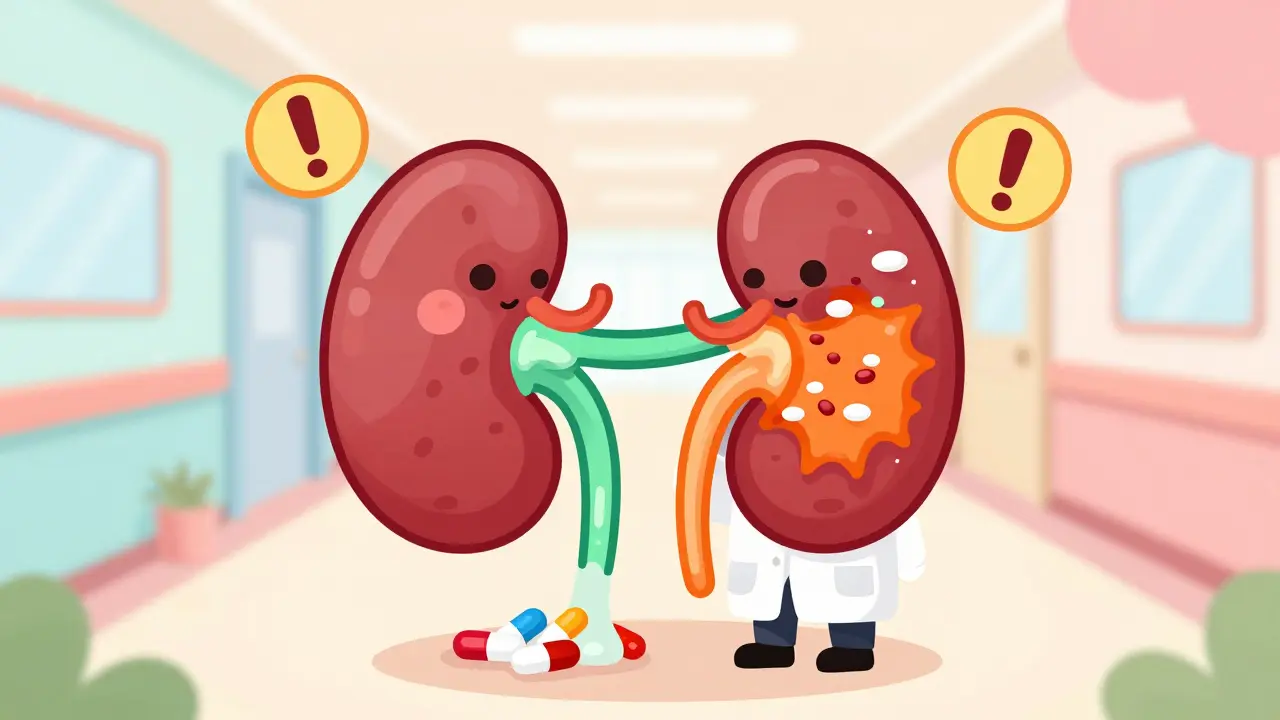
It’s not just diuretics and NSAIDs. Other common medications also interfere with lithium clearance:
- ACE inhibitors (like lisinopril) and ARBs (like valsartan) can raise lithium levels by 10% to 25%. They reduce kidney blood flow and alter sodium handling.
- Calcium channel blockers (like amlodipine) don’t increase lithium levels much, but they can worsen side effects like tremors and ringing in the ears.
- Antidepressants, especially SSRIs like fluoxetine, can also increase lithium levels by slowing its clearance.
Even herbal supplements and vitamins aren’t safe. There’s not enough data to say what’s harmless. The safest rule? Don’t start anything new without talking to your doctor.
What You Should Do
If you’re on lithium, here’s what you need to do:
- Get your lithium level checked before starting any new medication. This includes antibiotics, painkillers, or even supplements.
- Monitor closely after starting a new drug. If you begin a diuretic or NSAID, your doctor should check your lithium level every 4 to 5 days for the first week. After that, weekly checks for the first month.
- Know the warning signs. If you feel unusually tired, shaky, confused, nauseous, or have trouble speaking, call your doctor immediately.
- Don’t stop or change doses on your own. If your doctor suggests lowering your lithium dose when adding a new drug, follow their plan exactly.
- Use furosemide instead of thiazides. If you need a diuretic, ask if furosemide is an option.
- Choose celecoxib over other NSAIDs. If you need an NSAID, celecoxib has the weakest interaction. But even then, use the lowest dose for the shortest time possible.
What Happens in Toxicity?
When lithium levels get too high, treatment depends on how severe it is.
- Mild toxicity (1.5-2.0 mmol/L): Stop the interacting drug. Drink fluids. Monitor levels daily.
- Moderate toxicity (2.0-2.5 mmol/L): Hospitalization. IV fluids. Stop lithium. Daily monitoring.
- Severe toxicity (above 2.5 mmol/L): Emergency hemodialysis. Lithium doesn’t just stay in the blood-it gets into brain and muscle cells. Dialysis is the only way to remove it fast enough.
One key point: Blood levels don’t always match symptoms. Someone with a level of 2.2 mmol/L might feel fine, while another with 1.8 mmol/L might be confused and vomiting. That’s why doctors treat based on symptoms, not just numbers.
What’s Changing in 2026
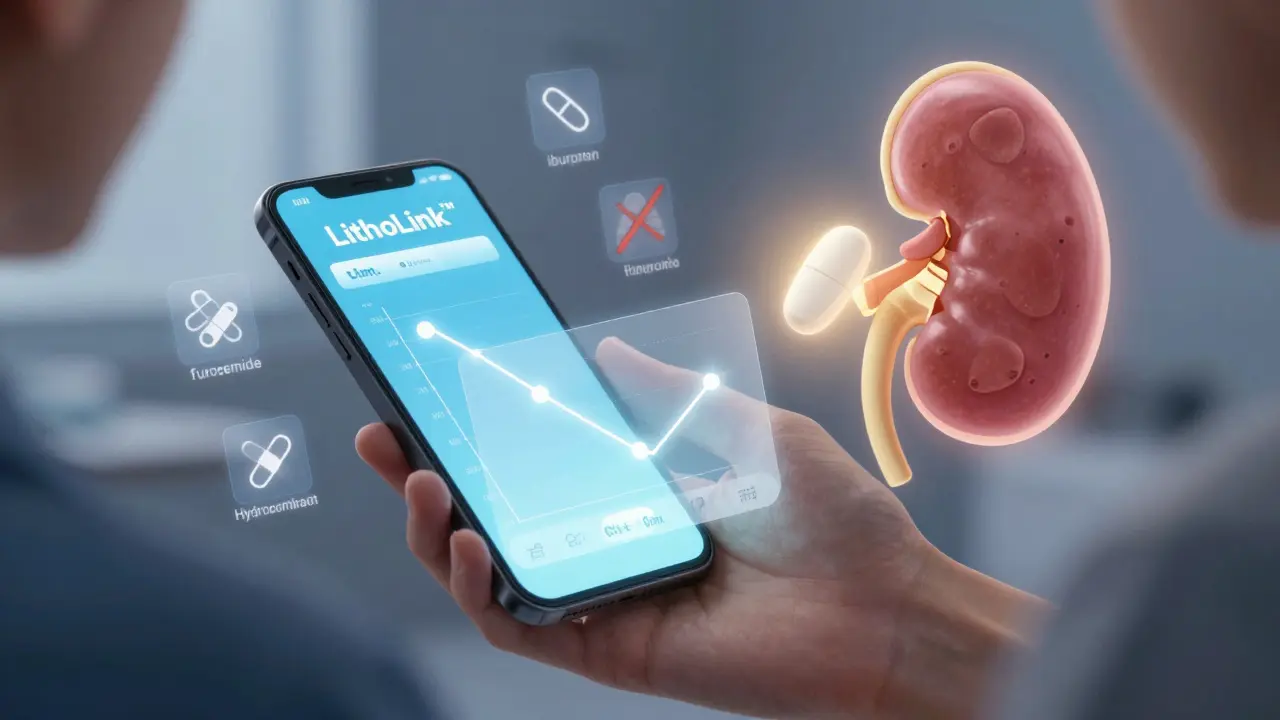
New tools are helping patients stay safe. In 2023, the FDA approved LithoLink™, a smartphone-connected device that lets patients test their lithium levels at home. Results are sent automatically to their doctor. This could cut down missed monitoring appointments by more than half.
Researchers are also testing a new form of lithium-nano-encapsulated lithium citrate-in clinical trials. Early results show it causes 40% less fluctuation when taken with ibuprofen. It could mean fewer dose changes and less risk.
Still, the biggest change is awareness. A 2021 study found that while 65% of psychiatrists use electronic alerts for drug interactions, only 45% actually follow up with the recommended monitoring. That gap is where people get hurt.
Final Advice
Lithium is one of the most effective treatments for bipolar disorder. It reduces suicide risk by 44% compared to no treatment. But its safety depends entirely on careful management. You can’t afford to assume a painkiller or water pill is harmless.
If you’re on lithium:
- Keep a list of every medication, supplement, and OTC drug you take.
- Bring that list to every appointment.
- Ask: "Could this change my lithium level?" before taking anything new.
- Don’t wait for symptoms. Regular blood tests save lives.
The goal isn’t to avoid lithium. It’s to use it safely. And that means knowing exactly what’s in your body-and what’s not.
Caroline Dennis
March 24, 2026 AT 22:02Lithium's narrow therapeutic window is one of those brutal facts of psychiatric pharmacology. You're balancing on a razor's edge-0.6 to 1.2-and the slightest shift in sodium handling can send you into toxicity. Thiazides? Absolute landmines. I’ve seen patients crash after a simple HCTZ prescription. No warning. No red flags until tremors set in. It’s not about the drug-it’s about the physiology. The kidneys don’t discriminate. They reabsorb lithium like sodium. And when you block that with a diuretic? You’re essentially telling the body to hold onto poison.
NSAIDs are just as insidious. People pop ibuprofen like candy. They don’t realize it’s a renal vasoconstrictor. Prostaglandin inhibition = reduced GFR = lithium retention. It’s not magic. It’s renal hemodynamics. And yet, no one asks. No one checks. That’s the real tragedy.
Mihir Patel
March 25, 2026 AT 10:51OMG this is so real i had a friend on lithium and he took naproxen for his back and he started slurring his words and his hands were shaking like he had parkinsons and he went to er and they said his lithium was at 2.7 like bro what the hell i thought advil was just for pain not a death sentence
winnipeg whitegloves
March 26, 2026 AT 23:36Lithium is the unsung hero of mood stabilization-brutal, beautiful, and terrifyingly fragile. Imagine your brain running on a single volt of precision, and someone hands you a power surge disguised as an ibuprofen tablet. That’s the paradox. It’s not just about kidney function-it’s about the body’s quiet, invisible ballet of reabsorption. Thiazides? They’re the silent saboteurs. Furosemide? The reluctant ally. And NSAIDs? The sneaky intruders at the party no one invited.
What fascinates me is how something so simple-a water pill, a painkiller-can unravel a life built on stability. We treat psychiatric meds like they’re candy. They’re not. They’re surgical instruments. And lithium? The scalpel with no safety guard.
Korn Deno
March 28, 2026 AT 23:29Lithium toxicity isn't a side effect it's a system failure
Doctors forget the kidneys aren't just filters they're negotiators
Thiazides don't just increase excretion they hijack the reabsorption pathway
NSAIDs don't just reduce inflammation they throttle renal perfusion
And patients? They're left guessing because no one told them the truth
It's not about compliance it's about awareness
And awareness is still optional in most clinics
Fix the system not the patient
Aaron Sims
March 29, 2026 AT 11:06HAHAHA so let me get this straight-lithium, a drug that’s been around since the 1940s, is so dangerous that taking an Advil could kill you… but we’re still prescribing it like it’s vitamin C? And now they want to sell us a $200 smartphone device to check our levels? Who’s making money off this? Pharma? The FDA? The dialysis centers?
And don’t even get me started on “nano-encapsulated lithium citrate.” Sounds like a sci-fi movie. Next thing you know, they’ll be injecting lithium into your eyeballs with a drone. This isn’t medicine. It’s a money-printing scheme wrapped in fear. Who’s really at risk here? The patient-or the corporate board?
Stephen Alabi
March 29, 2026 AT 12:10It is my professional assessment, based on empirical data and clinical literature, that the current paradigm of lithium management is fundamentally inadequate. The reliance on reactive monitoring-rather than proactive, algorithm-driven, biomarker-integrated protocols-is not merely suboptimal; it is indefensible. The fact that 45% of psychiatrists fail to follow up on automated drug-interaction alerts constitutes a systemic breach of the standard of care.
Moreover, the promotion of “celecoxib” as a safer NSAID is a misleading oversimplification. The COX-2 selectivity does not eliminate risk-it merely attenuates it. The true solution lies in pharmacogenomic screening for renal transporter polymorphisms (e.g., SLC22A2, SLC47A1) prior to lithium initiation. Until this is standard, we are not practicing medicine-we are gambling with neurotoxicity.
Agbogla Bischof
March 29, 2026 AT 13:12This is why I always tell my patients: if you're on lithium, treat every new medication like a bomb. Even the ones you buy at the corner store. NSAIDs? Diuretics? ACE inhibitors? They’re not just drugs-they’re lithium accelerants.
And yes, I’ve seen patients with 2.8 mmol/L levels. One man had to be dialyzed. He didn’t even know he was taking ibuprofen daily. His wife bought it for him because he complained of headaches. No one asked. No one checked. That’s the gap.
Keep a list. Update it every time. Bring it to every appointment. Even if it’s just a vitamin. Even if it’s “just” turmeric. We don’t have enough data-but we have enough evidence to be terrified.
Pat Fur
March 29, 2026 AT 18:14I love how lithium forces you to be hyper-aware of your body. It’s not just a mood stabilizer-it’s a teacher. Every time I get a new prescription, I pause. I ask. I double-check. It’s annoying. It’s inconvenient. But it’s saved my life.
My doctor told me once: “Lithium doesn’t care if you’re busy, tired, or stressed. It only cares if your sodium is low.”
So now I drink water. I avoid ibuprofen. I check my levels. I don’t take anything without asking. It’s not paranoia. It’s self-respect.
Anil Arekar
March 29, 2026 AT 20:14The scientific and clinical rigor presented in this post is commendable. The integration of pharmacokinetic principles with practical clinical guidance represents a model for patient education in psychiatric pharmacotherapy.
It is imperative that healthcare systems institutionalize mandatory pre-prescription lithium level screening when introducing any renally active agent. Furthermore, standardized patient handouts, integrated into electronic health records, should be developed and distributed across primary care, cardiology, and pain management services.
Collaborative care models, involving pharmacists and nephrologists in lithium management, have demonstrated a 68% reduction in toxicity events in Canadian trials. This must become global practice.
Elaine Parra
March 30, 2026 AT 20:35Let’s be real-this isn’t about lithium. It’s about how the U.S. healthcare system turns vulnerable people into ticking time bombs. You get diagnosed with bipolar, you’re handed lithium, and then you’re told to go to Walmart and buy painkillers like they’re gum. Meanwhile, your psychiatrist doesn’t even ask what you’re taking. They’re overworked. Underpaid. And frankly, they don’t care enough.
And now they want to sell you a $200 phone gadget? That’s not innovation-that’s exploitation. If you’re going to keep prescribing lithium, you better have a national monitoring program. Not a gimmick. Not a profit center. A system. Or stop pretending you care.
Natasha Rodríguez Lara
April 1, 2026 AT 08:43I’m a nurse in a psychiatric unit, and I’ve seen lithium toxicity three times this year. All three patients were on NSAIDs. None of them knew it was dangerous. One was taking naproxen for arthritis. Another, ibuprofen for headaches. The third? Just “to help with the flu.”
We need better education-not just for patients, but for every doctor who writes a prescription. Your dentist. Your physical therapist. Your grandma’s primary care doc. They all need to know: lithium + painkiller = emergency.
And maybe, just maybe, we need a simple sticker on every NSAID box. Like cigarette warnings. “WARNING: MAY CAUSE LITHIUM TOXICITY. CONSULT YOUR PSYCHIATRIST.”
It’s not rocket science. It’s basic human care.