
Medication Cost Calculator
How Much Will My Medication Cost?
Every January, thousands of Americans wake up to find their medication no longer covered-or suddenly costing five times more. It’s not a mistake. It’s a formulary change. And if you’re on long-term medication for diabetes, heart disease, arthritis, or mental health, this can be more than an inconvenience-it can be dangerous.
What Is a Formulary, Really?
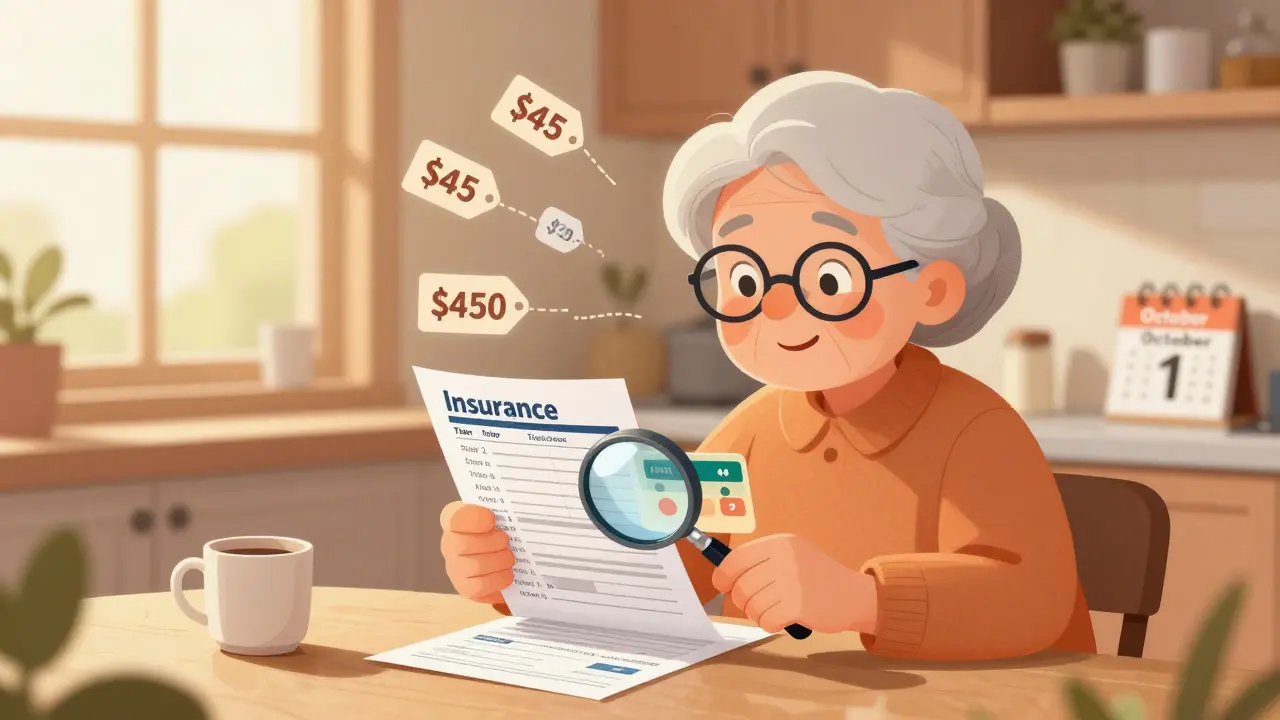
A formulary is the list of drugs your insurance plan will pay for. It’s not just a catalog. It’s a tool used by your insurer to decide which medications are affordable, effective, and worth covering. Every Medicare Part D plan and nearly all commercial health plans use one. The list gets updated every year, usually on January 1, and sometimes in the middle of the year too. Formularies are built by teams of doctors and pharmacists who look at three things: how well the drug works, how safe it is, and how much it costs. But here’s the catch: cost often wins. That’s why your $45 monthly pill might suddenly jump to $450 overnight. It didn’t get more expensive-you just got moved from Tier 2 to Tier 4.How Formulary Tiers Work (And Why They Matter)
Most plans use a tier system to sort drugs by price. Here’s how it breaks down in 2026:- Tier 1: Generic drugs. Usually $0-$10 copay. These are the cheapest and most preferred.
- Tier 2: Preferred brand-name drugs. $25-$50. Still covered well.
- Tier 3: Non-preferred brand-name drugs. $50-$100. You’re paying more because there’s a cheaper alternative.
- Tier 4/5: Specialty drugs. $100+, or you pay a percentage of the full price. These are for complex conditions like cancer, MS, or rheumatoid arthritis.
Why Formularies Change (And When You’ll Be Affected)
Formularies change for three main reasons:- New generic drugs enter the market. Insurers want you to switch to the cheaper version.
- A drug gets a safety warning. The FDA might flag a side effect, and your plan removes it.
- Drug prices rise. If a brand-name drug jumps in cost, your insurer may drop it or move it to a higher tier.
What You Can Do Before January 1
Don’t wait for a surprise bill. Here’s your action plan:- Find your plan name. Look at your insurance card. It’s not just “Blue Cross.” It’s “Blue Cross Silver 1000 PPO.” Write it down.
- Go to your insurer’s website. Search for “formulary,” “drug list,” or “prescription coverage.” If you can’t find it, call customer service and ask for the current year’s formulary document.
- Search for every medication you take. Include generics and brand names. Note the tier and any restrictions like prior authorization or step therapy.
- Compare plans during Open Enrollment (October 15-December 7). If your drug is moving to a higher tier or getting dropped, switch plans now. Don’t wait.
What to Do If Your Drug Gets Removed
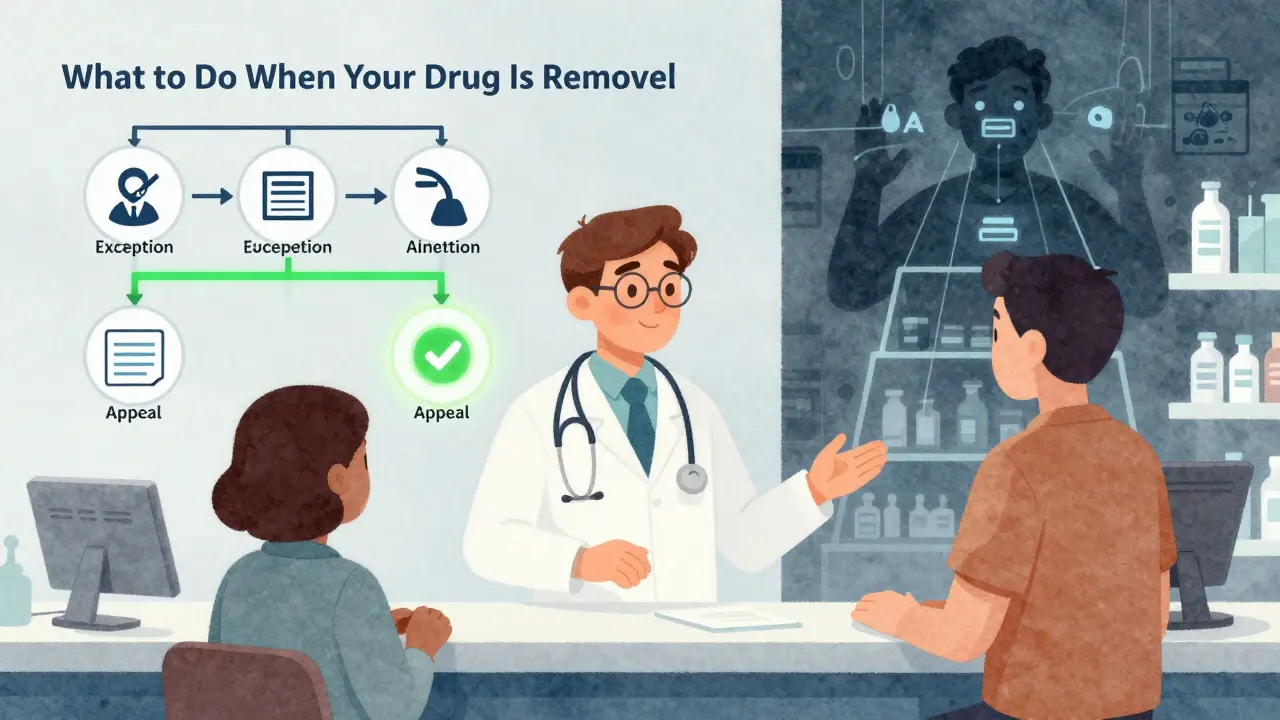
If your medication is taken off the formulary, you have options:- Ask your doctor for a therapeutic equivalent. There’s often another drug in the same class that works just as well and is still covered. For example, if your brand-name statin is dropped, your doctor can switch you to a generic.
- File an exception request. Your doctor submits a form saying why you need this specific drug. Common reasons: you tried alternatives and had side effects, or the alternative won’t work for your condition. Approval rates are high-78% within 72 hours-if the paperwork is solid.
- Appeal if denied. If your exception is denied, you can appeal. Most plans have a two-step process. Keep records of every call, email, and form.
Special Cases: Insulin, Mental Health, and Rare Diseases
Some drugs have special protections:- Insulin: Since January 2023, Medicare Part D plans can’t charge more than $35 for a month’s supply. Almost all plans removed cost-sharing for insulin entirely.
- Mental health drugs: Medicare must cover all antidepressants, antipsychotics, and anti-seizure meds. Commercial plans don’t have to-but many do.
- Rare disease drugs: If you’re on a medication with no alternatives (like for ALS or certain genetic disorders), your insurer may still deny coverage. That’s when patient advocacy groups step in. Organizations like the National Patient Advocate Foundation can help you navigate these cases.
The Hidden Cost: When Formularies Hurt Your Health
Formularies save money-for insurers. But they can cost you in other ways. A 2022 JAMA study found that each extra formulary restriction (like prior authorization or step therapy) reduces medication adherence by 5.2%. That means people skip doses, stop taking pills, or delay refills because they can’t afford it or can’t get the drug. The National Council on Aging reported a 72-year-old cancer patient went 21 days without her medication because her plan removed it without warning. She had to go to the ER. That’s not a rare case. The system isn’t broken-it’s designed to prioritize cost over convenience. But you’re not powerless.Who’s Behind the Formulary? PBMs and AI
You might not realize it, but your formulary isn’t decided by your insurance company. It’s managed by Pharmacy Benefit Managers (PBMs)-companies like CVS Caremark, Express Scripts, and OptumRx. They control 87% of commercial plans. These companies use AI to predict which drugs will be profitable. They might push a drug onto the formulary because it gives them a bigger rebate from the manufacturer-even if it’s not the best option for you. That’s why transparency matters. The FTC sued PBMs in 2023 for hiding rebates and steering patients toward pricier drugs. You deserve to know why your medication was changed.
What’s Changing in 2026?
By 2026, three big shifts are coming:- AI-driven formularies. More PBMs are using algorithms to auto-adjust tiers based on real-world data-like how often a drug causes hospitalizations.
- More specialty tiers. By 2026, over half of all specialty drugs will be in the highest tier, meaning higher costs unless you qualify for aid.
- Drug price negotiation. Starting in 2026, Medicare will negotiate prices for 10 high-cost drugs. That could mean lower tiers and fewer restrictions.
Your Safety Plan: A Checklist
Use this every October:- ✅ Write down every medication you take, including dose and frequency.
- ✅ Find your plan’s current formulary online.
- ✅ Check each drug’s tier and restrictions.
- ✅ Talk to your pharmacist-they know what’s changing.
- ✅ If a drug is moving to a higher tier or being dropped, ask your doctor for alternatives NOW.
- ✅ If you’re switching plans, confirm coverage before you enroll.
- ✅ Keep a printed copy of your formulary and your doctor’s notes.
Frequently Asked Questions
What if I can’t find my insurance formulary online?
Call your insurer’s customer service line and ask for the current year’s formulary document. Be specific: say, “I need the 2026 drug list for [your plan name].” If they can’t send it to you immediately, ask for a reference number and follow up in 24 hours. You have a right to this information.
Can I switch plans mid-year if my medication is dropped?
Only under special circumstances-like moving to a new state, losing other coverage, or if your plan fails to give proper notice. For most people, you have to wait until the next Open Enrollment period (October 15-December 7). But you can still file an exception request to keep your drug.
Why does my doctor say the alternative won’t work for me?
Some medications work differently for different people. For example, one person might tolerate a generic statin fine, but another develops muscle pain. If you’ve had side effects or treatment failures with alternatives, your doctor can document this in your exception request. That’s the #1 reason exceptions get approved.
Are there programs to help pay for drugs that aren’t covered?
Yes. Many drug manufacturers offer patient assistance programs (PAPs) for people who can’t afford their meds. You can also check NeedyMeds.org or the Partnership for Prescription Assistance. Nonprofits like the Patient Advocate Foundation help with appeals and financial aid.
How do I know if my drug is a “preferred” brand or a “non-preferred” one?
Look at the tier. Preferred brands are usually Tier 2. Non-preferred are Tier 3. If you’re unsure, search the drug name on your plan’s formulary tool. It will say “preferred” or “non-preferred” next to the tier number. If it says “requires prior authorization,” it’s likely non-preferred.
Rosalee Vanness
January 13, 2026 AT 10:57Okay, I just spent 45 minutes scrolling through my insurer’s formulary like it was a cryptic treasure map-and I found my insulin still at Tier 1, thank god. But my blood pressure med? Moved to Tier 4. $380 a month now. I cried. Not dramatic. Just exhausted. I’m 61, on fixed income, and this isn’t a ‘budgeting issue’-it’s a survival one. I called my pharmacist, she gave me a free sample and whispered, ‘File an exception, honey, and don’t let them bully you.’ So I did. Took three days. Got approved. I’m not proud of how much energy this takes just to stay alive. But I’m proud I didn’t give up. If you’re reading this and you’re scared? You’re not alone. Write it down. Call someone. Set the October reminder. Do it now. Don’t wait for the bill to hit.
John Tran
January 15, 2026 AT 01:51so like… i mean… this whole system is just a cosmic joke right? like we’re all just lab rats in a giant pharmaceutical casino and the house always wins. i mean, who even decides these tiers? some guy in a cubicle with a spreadsheet and a caffeine IV? and then they use AI to make it *feel* scientific? lol. it’s not science-it’s capitalism with a stethoscope. and don’t get me started on PBMs. they’re like the middlemen between your health and your bank account. they don’t care if you live or die, they care if the rebate check clears. i just want to take my meds without feeling like i’m negotiating with a robot that’s been programmed to hate me. also, i typoed ‘formulary’ as ‘formulry’ 12 times while typing this. i’m tired.
Angel Molano
January 15, 2026 AT 06:43You people are pathetic. If you can’t afford your meds, don’t take them. Stop whining. Your insurance isn’t your mom. Get a job that pays better or switch to generics. Simple.
Vinaypriy Wane
January 15, 2026 AT 12:41Thank you for this post-it’s one of the few times I’ve felt seen. I’m from India, but I’ve lived in the U.S. for 12 years, and I still don’t understand how a system that claims to care about health can treat medication like a luxury item. My mother had to stop her heart medication last year because of a tier change. She didn’t tell me until she collapsed. I wish I’d known sooner. I’ve been checking formularies every October since. I don’t sleep well, but I sleep better knowing I’m not helpless. If you’re reading this, please, for your own sake-don’t wait. Call. Write. Demand. You have rights. Even if they make it hard to find them.
Acacia Hendrix
January 16, 2026 AT 23:02Frankly, the formulary architecture reflects a neoclassical economic paradigm optimized for marginal utility maximization under asymmetric information asymmetries-yet, the lay public persists in anthropomorphizing insurers as benevolent actors. The PBM-driven rebate cascades, coupled with tiered formulary stratification, are not failures of policy-they are efficient market mechanisms. The real pathology lies in the public’s delusional expectation of healthcare as a right rather than a commoditized service. If one cannot afford Tier 4 biologics, one should ideally transition to value-based alternatives or, better yet, pursue a high-deductible health plan with an HSA. The burden of complexity is not a bug-it’s a feature of rational resource allocation.
James Castner
January 17, 2026 AT 01:34Let me say this with all the clarity I can muster: this isn’t about insurance. It’s about dignity. Every time a drug gets moved to a higher tier, someone’s life gets smaller. They start skipping doses. They ration pills. They choose between food and refills. That’s not healthcare. That’s moral bankruptcy dressed in corporate jargon. And yes, the PBMs are the villains-but we’re the ones who let them win. We vote. We speak. We show up. We demand transparency. We stop accepting ‘that’s just how it is.’ The Inflation Reduction Act? A start. But real change? That’s when millions of us stop being silent. You’re not just managing a formulary-you’re fighting for your right to breathe. And you’re not alone. I’ve been there. I’m still here. So are you.
Adam Rivera
January 18, 2026 AT 04:53Hey, I just want to say thank you for writing this. I’m a 34-year-old guy with rheumatoid arthritis, and I’ve been on the same biologic for 6 years. Last year, my plan dropped it. I panicked. Called my doc, filed an exception, and got approved in 36 hours. No drama. Just paperwork. I didn’t know you could do that. I’m sharing this with my support group. If you’re scared, reach out. Someone’s got your back. And yeah, set that October reminder. I’ve got mine on my phone, with a little heart emoji. Because you deserve to keep living. You really do.
Trevor Davis
January 19, 2026 AT 17:55So I just got off the phone with my insurance rep. She said my antidepressant was being moved to Tier 4. I didn’t cry. I just… stared at the wall. For 10 minutes. Then I called my therapist. She said, ‘You’re not broken because you can’t afford to feel better.’ That hit me harder than the bill. I’ve been on this med for 8 years. It’s not ‘just a pill.’ It’s the reason I get up. I’m filing an exception. I’m writing to my senator. I’m telling my story. Because if I don’t, who will? And if you’re reading this and you’re holding back? Please-don’t. Your life matters more than their spreadsheets.
mike swinchoski
January 21, 2026 AT 09:00Why do people even take brand name drugs? Just use generics. It’s not that hard. I’ve been on generic metformin for 10 years. No issues. Stop being lazy and entitled.
Rosalee Vanness
January 22, 2026 AT 18:29Oh, sweet summer child. My generic metformin gave me diarrhea so bad I had to quit. My brand-name one? Zero side effects. You think everyone’s body is a copy-paste of yours? I didn’t choose this. I tried the generic. I lost 15 pounds in a month. I didn’t lose weight-I lost my life. I’m not lazy. I’m surviving. And if you can’t see the difference between convenience and survival, maybe you’ve never had to choose between rent and insulin.