
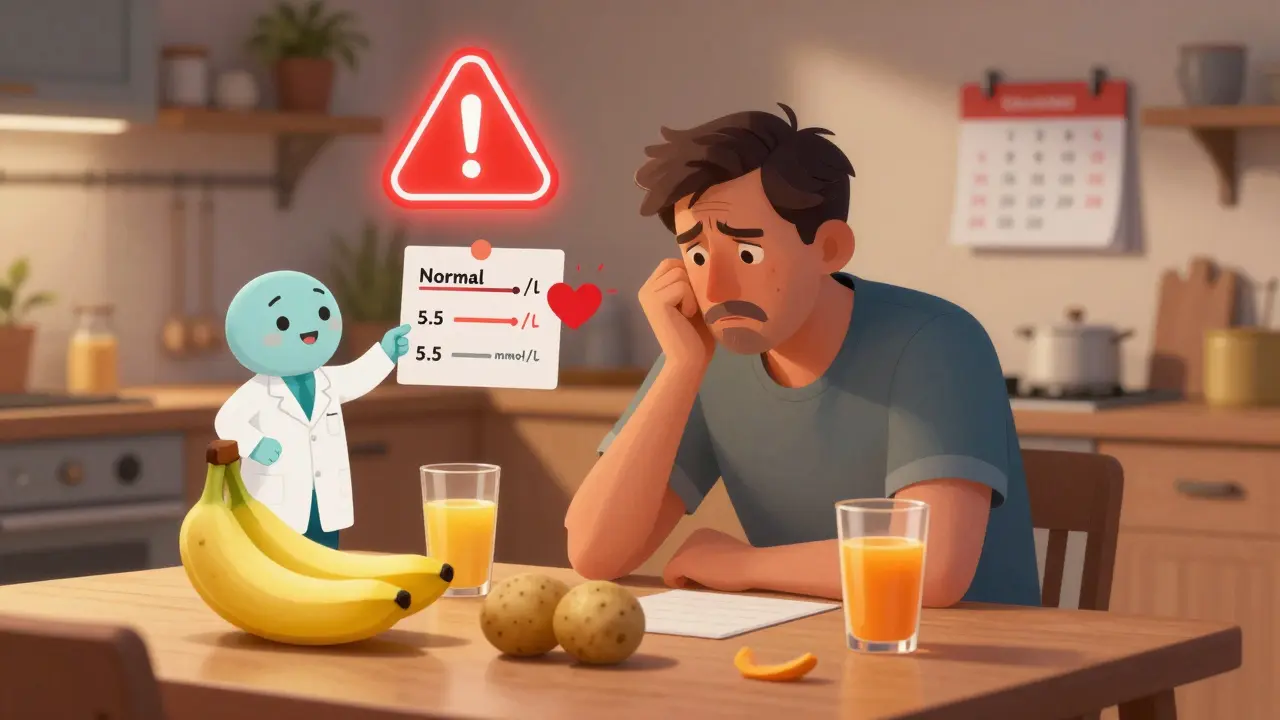
When your kidneys aren't working well, even simple foods can become dangerous. For people with chronic kidney disease (CKD), high potassium levels-called hyperkalemia-can sneak up without warning and trigger a heart rhythm problem or even cardiac arrest. This isn’t rare. In advanced CKD, up to half of patients experience dangerously high potassium levels at some point. The problem? Many of the best medications for protecting the heart and kidneys, like ACE inhibitors and ARBs, also raise potassium. So you’re stuck: take the drugs that save your life, or risk your heart because your potassium is too high.
What Is Hyperkalemia and Why Does It Happen in CKD?
Hyperkalemia means your blood potassium level is above 5.0 mmol/L. Normal is 3.5 to 5.0. In healthy people, kidneys easily flush out extra potassium. But when kidney function drops below 30 mL/min (Stage 3b CKD or worse), that system breaks down. Potassium builds up. And it doesn’t just sit there-it affects your heart’s electrical system. The danger isn’t just the number. It’s what happens when potassium hits 5.5 mmol/L or higher. That’s when ECG changes start: peaked T-waves. At 6.0 mmol/L, the QRS complex widens. At 6.5 mmol/L, you risk ventricular fibrillation or cardiac arrest. Many patients feel nothing until it’s too late. That’s why monitoring is non-negotiable.Dietary Limits: How Much Potassium Can You Really Eat?
Diet is the first line of defense. But it’s not one-size-fits-all. The rules change depending on how far your kidneys have declined. - If you’re in Stage 1-3a CKD (mild to moderate), you don’t need to cut potassium drastically. Just avoid excessive amounts-no banana smoothies for breakfast, no five baked potatoes a week. A “prudent but not restrictive” approach works best. - If you’re in Stage 3b-5 CKD (not on dialysis), you need strict limits: 2,000 to 3,000 mg per day. That’s about half what a healthy person eats. A single banana has 422 mg. One medium potato? 421 mg. A cup of orange juice? 496 mg. One serving of spinach? 840 mg. You don’t have to eliminate these foods. You can reduce potassium by leaching. Slice potatoes, soak them in warm water for at least two hours, then rinse and boil them. Do the same with vegetables like carrots and beets. Drain the water-don’t reuse it. That can cut potassium by 50% or more. Avoid salt substitutes. Most contain potassium chloride. One teaspoon can add 1,000 mg of potassium. Same with low-sodium broths and “health” foods labeled “high in potassium.” They’re not helping you.Emergency Treatment: What Happens When Potassium Spikes?
If your potassium hits 5.5 mmol/L and you have ECG changes-or if it’s above 6.0 mmol/L-you’re in an emergency. This isn’t something you wait to see your nephrologist about. You go to the ER. The immediate goal isn’t to lower total body potassium-it’s to protect your heart. That’s done with calcium gluconate. You get 10 mL of 10% solution through an IV, over 2-5 minutes. It doesn’t reduce potassium. It just stabilizes your heart muscle so it doesn’t fibrillate. Effects last 30-60 minutes. Then you move to shifting potassium into cells. The most common method is insulin and glucose: 10 units of regular insulin with 50 mL of 50% dextrose. It kicks in within 15-30 minutes and lowers potassium by 0.5 to 1.5 mmol/L. But watch out: 10-15% of patients get low blood sugar. You’ll need glucose monitoring for hours after. If you’re also acidotic (low bicarbonate), sodium bicarbonate helps. Give 50-100 mmol IV. It works in 5-10 minutes. It’s not a magic bullet, but in the right patient, it’s fast and useful. Beta-agonists like albuterol (inhaled) can help too-especially if you can’t use insulin. But they’re less reliable in CKD patients. None of these fix the root problem. They’re temporary. You still need to remove potassium from the body. That’s where binders or dialysis come in.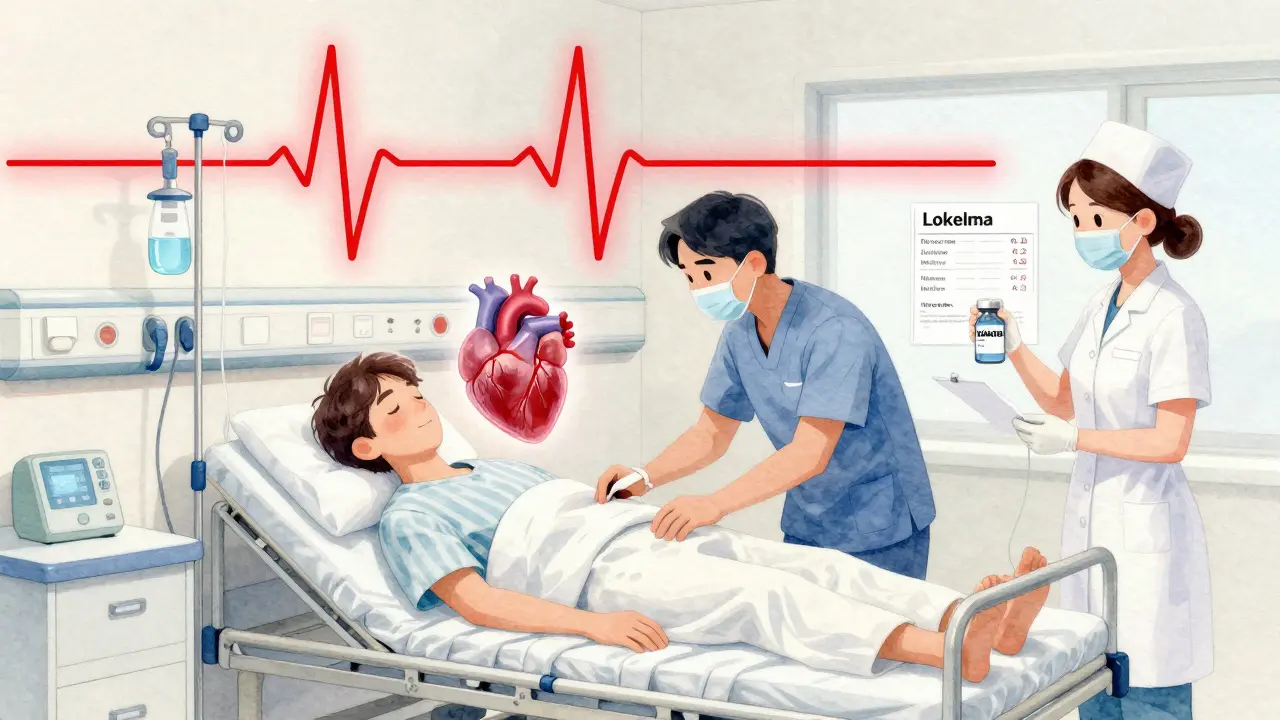
Chronic Management: Beyond Diet and Emergency Care
For long-term control, you need more than diet. You need medication. For years, the only option was sodium polystyrene sulfonate (SPS)-a powder you mixed with water or sorbitol. It worked, sort of. It lowered potassium by 0.4-0.6 mmol/L. But it caused serious side effects: colonic necrosis (rare but deadly), severe constipation, and sodium overload. One gram of SPS contains 11 mmol of sodium. For someone with heart failure or high blood pressure, that’s dangerous. Now we have better tools. Patiromer (Veltassa) binds potassium in the colon and is excreted in stool. It’s taken once daily. It lowers potassium by 0.8-1.0 mmol/L in 4-8 hours. It doesn’t add sodium. But it causes constipation in 14% of users and can lower magnesium levels in nearly 19%. It also interferes with other medications-like levothyroxine-if taken too close together. You need to space them by at least 3 hours. Sodium zirconium cyclosilicate (Lokelma) works faster. It starts lowering potassium within an hour. In 24 hours, it can drop levels by 1.0-1.4 mmol/L. That makes it the preferred choice for acute episodes. But it adds sodium-about 1.2 grams per day. That’s a problem for heart failure patients. About 12% of them develop swelling or fluid retention. Both drugs let you keep your heart-protecting medications. In one trial, 78% of patients stayed on full-dose RAASi with patiromer. Without it, only 38% could. With SZC, 83% kept their mineralocorticoid receptor antagonists. That’s huge. Stopping those drugs increases heart attack and death risk by more than 20%.Monitoring and Follow-Up: The Key to Long-Term Safety
You can’t just start a binder and forget about it. Potassium levels need tracking. After starting or increasing RAASi therapy, check potassium within 1-2 weeks. Then every 3-6 months if stable. But if you’re on a binder, check every 2-4 weeks at first. Adjust the dose based on the result. Many clinics now use electronic alerts. If your potassium hits 5.0 mmol/L, the system flags it and auto-schedules a dietitian visit or pharmacist review. That’s changed outcomes. One clinic saw RAASi continuation jump from 52% to 81% just by adding structured monitoring. Dietitians play a critical role. A 45-60 minute initial session teaches you how to read food labels, identify hidden potassium, and plan meals. Follow-ups at 2 and 6 weeks help you adjust. But adherence is low. Only 37% of patients stick to the diet long-term. The social cost is real. Many say they avoid family dinners or travel because they’re afraid of eating something unsafe.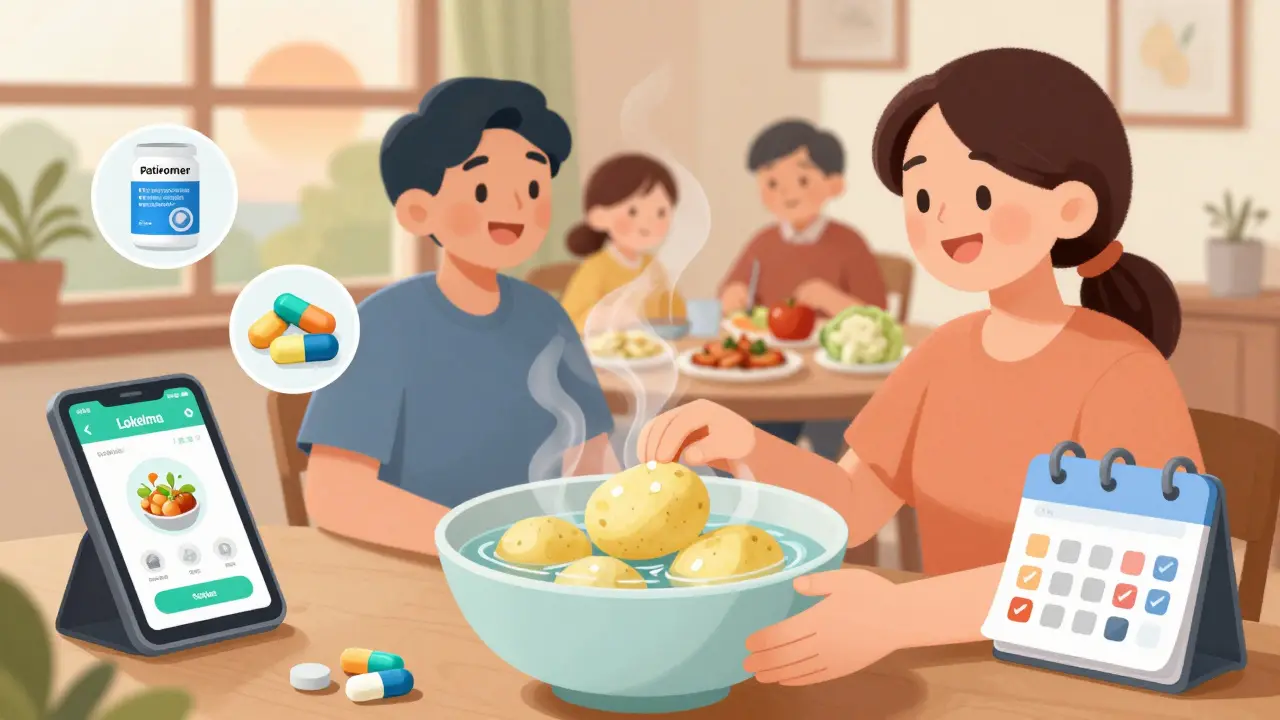
What’s Next? The Future of Managing Hyperkalemia
New tools are coming. Tenapanor, originally for phosphate control, is being tested for potassium. It works differently-by blocking potassium absorption in the gut. Early results show a 0.5 mmol/L drop. No sodium, no binding, no constipation. Phase 3 trials are underway. Digital tools are helping too. Apps that scan food barcodes and calculate potassium content are improving adherence. In pilot studies, users stuck to their diet 32% better than those using paper lists. Guidelines are shifting. The European Renal Association now suggests treating potassium levels above 5.3 mmol/L in advanced CKD. That’s lower than before. Why? Because even small increases above 5.0 mmol/L raise death risk by 18% per 0.5 mmol/L jump. By 2027, experts predict 75% of CKD patients on RAASi will also be on a potassium binder. The cost is high-patiromer runs over $600 a month in the U.S. But compared to a hospital stay for hyperkalemia ($12,450 on average), it’s a bargain. And it keeps you alive.Bottom Line: Balance Is Everything
Hyperkalemia in CKD isn’t about cutting potassium completely. It’s about smart management. You need diet, monitoring, and the right meds. You can’t stop your heart-protecting drugs. But you don’t have to live in fear either. Work with your nephrologist, dietitian, and pharmacist. Know your numbers. Learn which foods are safe. Understand how your binder works. And don’t wait for symptoms. Check your potassium before it’s an emergency. The goal isn’t perfection. It’s sustainability. A life where you can eat dinner with your family, take your meds, and sleep without worrying your heart might stop.What is the normal potassium level for someone with CKD?
For most people with CKD, the target range is 4.0-4.5 mmol/L. This is lower than the general population’s normal range (3.5-5.0 mmol/L) because even slightly elevated levels increase heart risk. Levels above 5.0 mmol/L are considered hyperkalemia and require action. Above 5.5 mmol/L with ECG changes is an emergency.
Can I still eat fruits and vegetables with CKD and hyperkalemia?
Yes, but you need to choose wisely and prepare them correctly. Low-potassium options include apples, berries, grapes, cabbage, green beans, and cauliflower. High-potassium foods like bananas, oranges, potatoes, tomatoes, and spinach can be eaten in small amounts if you leach them-soak sliced vegetables in warm water for 2+ hours, then boil and drain. Avoid fruit juices and dried fruits, which are concentrated sources of potassium.
What’s the difference between patiromer and sodium zirconium cyclosilicate?
Patiromer (Veltassa) works slowly, taking 4-8 hours to lower potassium, and is better for long-term control. It doesn’t add sodium, making it safer for heart failure patients. Sodium zirconium cyclosilicate (Lokelma) works faster-within 1 hour-and is preferred for acute spikes. But it adds about 1.2 grams of sodium daily, which can cause fluid retention. Patiromer may cause constipation and low magnesium; SZC may worsen swelling. Choice depends on your other conditions and whether you need fast or sustained control.
Why can’t I just stop my blood pressure meds if my potassium is high?
Stopping RAAS inhibitors (like lisinopril or losartan) may lower potassium, but it increases your risk of heart attack, stroke, and faster kidney decline by up to 34%. These drugs protect your heart and kidneys even when potassium is slightly high. The modern approach is to keep them on and use potassium binders or diet to control levels-not to quit the meds.
How often should I get my potassium checked?
After starting or changing a RAAS inhibitor, check within 1-2 weeks. If stable, every 3-6 months is fine. If you’re on a potassium binder, check every 2-4 weeks at first, then monthly or as directed. Always check if you feel muscle weakness, palpitations, or dizziness. Don’t wait for symptoms-many people have no warning signs until it’s critical.
Are there any new treatments on the horizon?
Yes. Tenapanor, a drug originally for phosphate control, is being tested for hyperkalemia and shows promise with minimal side effects. Encapsulated potassium binders in early trials can reduce potassium by over 1 mmol/L in 24 hours. Digital tools like food-scanning apps are improving diet adherence by 30% or more. By 2027, most CKD patients on heart-protecting drugs will likely be on a potassium binder as standard care.
Sarthak Jain
December 15, 2025 AT 14:46man i had no idea potassium could be such a sneaky bastard. i thought it was just bananas and avocados that were the villains. leaching potatoes? that’s wild. i’ve been boiling mine like a savage. guess i’m doing it wrong. also, who the hell puts potassium chloride in salt substitutes? that’s like putting rat poison in your coffee and calling it ‘healthy’.
Edward Stevens
December 16, 2025 AT 06:04lol so the real villain here isn’t the disease-it’s the pharmaceutical industry’s ability to sell us two problems and one expensive fix. ‘Oh you can’t stop your ACE inhibitor? No worries, here’s a $600/month binder that might give you constipation and make your magnesium vanish. Enjoy your life!’
Meanwhile, my grandma in Ohio takes two pills a day and eats a whole watermelon. She’s 82. Her potassium? Perfect. Coincidence? I think not.
Rulich Pretorius
December 17, 2025 AT 08:08Hyperkalemia isn’t just a lab value-it’s a conversation between your kidneys, your heart, and the food on your plate. The real tragedy isn’t the elevated potassium. It’s that we treat it like a technical glitch instead of a systemic failure of how we manage chronic illness.
People aren’t failing diets. The system is failing people. We give them a list of forbidden foods and no real support. No meal plans. No grocery tours. No community. Then we wonder why they stop trying.
The binders help, sure. But the real win is when someone can sit at the dinner table with their grandkids and eat a baked potato without fear. That’s the goal. Not just survival. Living.
Dwayne hiers
December 17, 2025 AT 18:12Just to clarify a common misconception: patiromer and SZC are cation exchange resins, but they’re not the same mechanism as SPS. Patiromer is a non-absorbable polymer that binds K+ via calcium exchange, while SZC is a crystalline silicate that traps potassium via ion exchange in the gut lumen. Both are GI-targeted, but SZC has faster onset due to higher affinity and wider distribution in the colon.
Also, tenapanor is an NHE3 inhibitor-it reduces apical sodium/hydrogen exchange in the ileum and colon, which indirectly reduces paracellular potassium flux. It’s not a binder at all. Big difference.
And yes, the sodium load from SZC is real. In HF patients, even 1.2g/day can tip the balance. Monitor weights daily. If they gain >2 lbs in 48h, consider switching.
Natalie Koeber
December 19, 2025 AT 15:34They say ‘eat your veggies’ like it’s a commandment. But what if the government is secretly using potassium to control us? Think about it-why are all the ‘healthy’ foods so high in it? Kale, spinach, sweet potatoes… it’s like they want us to die slowly so they can sell us binders. And don’t get me started on the ‘electronic alerts’-that’s how they track you. Your doctor’s system is just a front for the surveillance state.
Also, I heard the FDA banned real salt in 2019. That’s why we’re all getting potassium poisoning. The truth is out there.
jeremy carroll
December 20, 2025 AT 21:51Man, this thread is giving me hope. I’ve been scared to even eat an apple since my last blood test. But hearing that you can still have berries and cabbage? That’s a game-changer. And leaching potatoes? I’m trying that this weekend. Also, the part about not stopping your meds? That’s huge. I was seriously thinking of ditching my lisinopril. Thanks for the clarity.
Wade Mercer
December 21, 2025 AT 21:33People treat this like it’s a diet issue. It’s not. It’s a moral failure. You choose to eat that banana. You choose to skip your binder. You choose to ignore the warning signs. Then you wonder why your heart gave out. Stop blaming the system. Take responsibility.
Rich Robertson
December 22, 2025 AT 08:52I’m from the U.S., but I’ve seen this play out in South Africa too. The gap between knowing what to do and being able to do it is a chasm. In rural areas, people don’t have access to leaching instructions, let alone patiromer. They’re choosing between food and meds. And the system doesn’t blink.
One of my patients-a 68-year-old teacher-used to make her own low-potassium chapati flour by soaking and drying cassava. No fancy apps. No binders. Just grit and tradition. She’s been stable for 5 years. Sometimes the best medicine isn’t in a pill bottle-it’s in the hands of someone who refuses to give up.
Jonny Moran
December 23, 2025 AT 03:21Just wanted to say-this post is gold. I’ve been telling my patients for years that potassium isn’t the enemy. The fear is. You can still eat. You can still live. You just need to be smart about it. And yes, the binders suck. But they’re better than the alternative. Keep going. You’ve got this.
Tim Bartik
December 23, 2025 AT 22:13AMERICA’S HEALTHCARE IS A SCAM. THEY WANT YOU TO PAY $600 A MONTH FOR A BINDER SO THEY CAN KEEP SELLING YOU THE DRUGS THAT CAUSE THE PROBLEM IN THE FIRST PLACE. THE PHARMA BOSS IN NEW JERSEY IS LAUGHING RIGHT NOW. HE’S DRINKING A $2000 BOTTLE OF WINE WHILE YOU’RE CHOOSING BETWEEN POTATOES AND YOUR HEART. STAND UP. STOP BEING A SLAVE TO THE MEDICAL INDUSTRIAL COMPLEX. EAT REAL FOOD. STOP TRUSTING DOCTORS WHO GET PAID BY BIG PHARMA. #KILLTHEBINDERS