
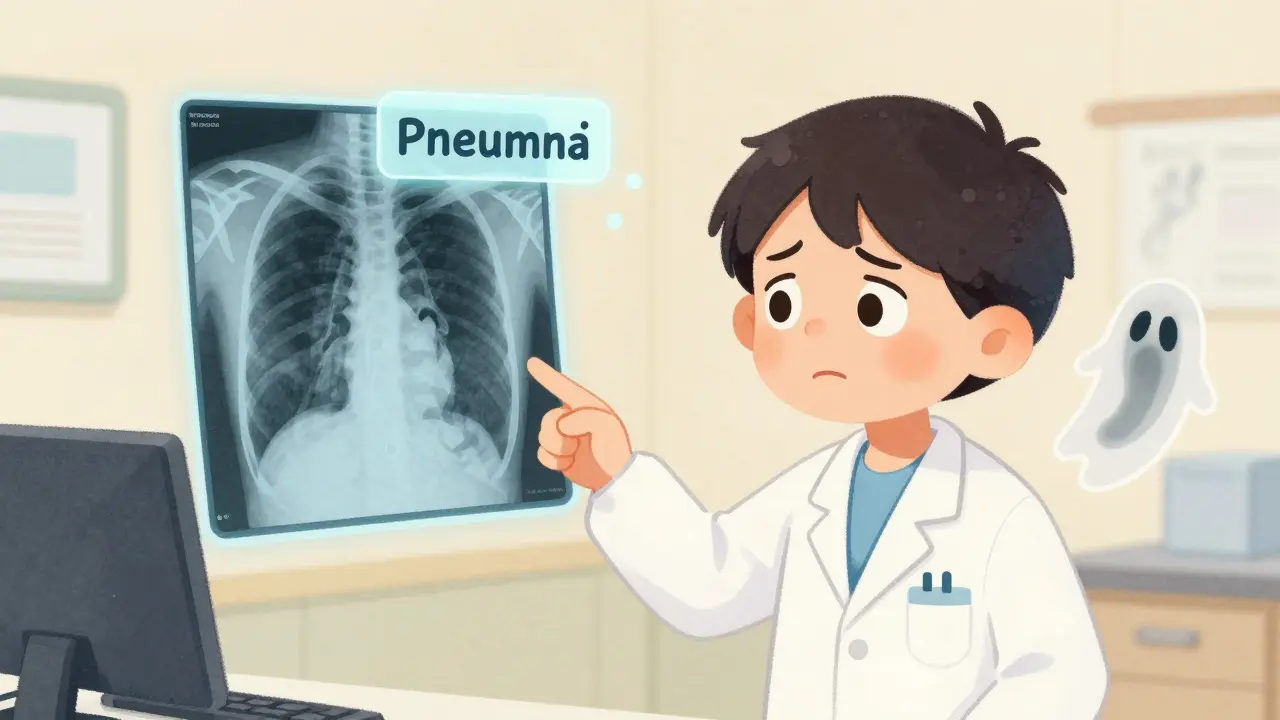
When you're building a machine learning model, the quality of your data matters more than the complexity of your algorithm. A state-of-the-art neural network can still fail if it's trained on data with bad labels. In healthcare, where models help diagnose conditions from X-rays or predict patient outcomes from electronic records, even a 5% labeling error can mean the difference between life and death. Labeling errors aren't just typos-they're misclassifications, missed annotations, or incorrect boundaries that trick models into learning the wrong patterns. Recognizing these errors and knowing how to ask for corrections isn't optional. It's a core skill for anyone working with training data.
What Labeling Errors Look Like in Real Data
Labeling errors don’t always scream "mistake." Sometimes they hide in plain sight. In a dataset of chest X-rays used to detect pneumonia, a radiologist might accidentally label a normal lung image as "pneumonia" because of a shadow from the patient’s arm. In another case, a bounding box around a tumor might be too small, missing part of the lesion. These aren’t rare. According to MIT’s Data-Centric AI research in 2024, even high-quality datasets like ImageNet contain around 5.8% labeling errors. In medical imaging, that number jumps to 8-12%. Here are the most common error types you’ll run into:- Missing labels: An object or condition is present but not annotated at all. In autonomous driving datasets, this means a pedestrian wasn’t marked-dangerous if the model learns to ignore them.
- Incorrect boundaries: The box or outline around an object is off. In entity recognition for clinical notes, "aspirin 81 mg" might be labeled as one drug when it should be two separate entities: "aspirin" and "81 mg".
- Wrong class assignment: A label gets assigned to the wrong category. A benign tumor labeled as malignant, or a non-diabetic glucose reading marked as diabetic.
- Ambiguous examples: The image or text genuinely could fit two labels. A photo of a lung with both fluid and nodules might be labeled as one condition when it should be multi-labeled.
- Out-of-distribution samples: Data that doesn’t belong in the dataset at all. A photo of a dog labeled as "pneumonia"? That’s not just wrong-it’s noise.
These errors often come from unclear instructions. A 2022 TEKLYNX study found that 68% of labeling mistakes happened because annotators weren’t given enough examples or context. If your team doesn’t know what "moderate" or "severe" looks like in practice, they’ll guess-and guess wrong.
How to Spot Labeling Errors Without Guessing
You can’t catch every error by eye. That’s where tools come in. The most effective way to find mistakes is to use a combination of algorithmic detection and human review. The leading method is confident learning, used by the open-source tool cleanlab. It works by training a model on your data, then looking for examples where the model is highly confident but the label contradicts that confidence. For example, if a model predicts a 98% chance that an image contains pneumonia, but the label says "normal," cleanlab flags it. This method catches 78-92% of errors across datasets, according to cleanlab’s 2023 benchmarks. Another approach is multi-annotator consensus. Have three people label the same image or text. If two say "pneumonia" and one says "normal," the odd one out is likely wrong. Label Studio’s 2022 data shows this cuts errors by 63%. It’s slower and costs more, but it’s reliable. For medical or technical data, use model-assisted validation. Train a model on clean data, then run it on your labeled dataset. Any time the model predicts something strongly but the label disagrees, flag it. Encord’s 2023 testing showed this catches 85% of errors when the model has at least 75% accuracy. You don’t need to be a programmer to use these tools. Platforms like Argilla and Datasaur integrate error detection directly into their annotation interfaces. Argilla lets you upload your data, run cleanlab in the background, and then click through flagged examples with a simple UI. Datasaur highlights inconsistencies in text classification tasks and suggests corrections based on patterns it sees across your dataset.How to Ask for Corrections Without Causing Conflict
Finding an error is only half the battle. The real challenge is getting someone to fix it-especially when they’re the one who labeled it. Start by framing it as a team effort, not a personal failure. Say: "I noticed this label might not match the image. Can we review it together?" Avoid saying, "You got this wrong." Instead, say, "The model flagged this as inconsistent. Let’s check the guidelines." Always refer to your labeling instructions. If your team has a document with examples, use it. Point to a specific example: "In the guideline, section 3.2 shows how to label this type of lesion. This one looks similar but is missing part of the boundary." If you’re using a tool like Argilla or Datasaur, use their built-in comment feature. Leave a note on the flagged item: "Boundary extends beyond tumor edge-see example 7 in guidelines." This creates a traceable record and avoids back-and-forth emails. For high-stakes data-like clinical trials or diagnostic models-require a second reviewer. Have a senior annotator or domain expert (like a radiologist or pharmacist) validate every correction. This reduces rework and builds trust in the process.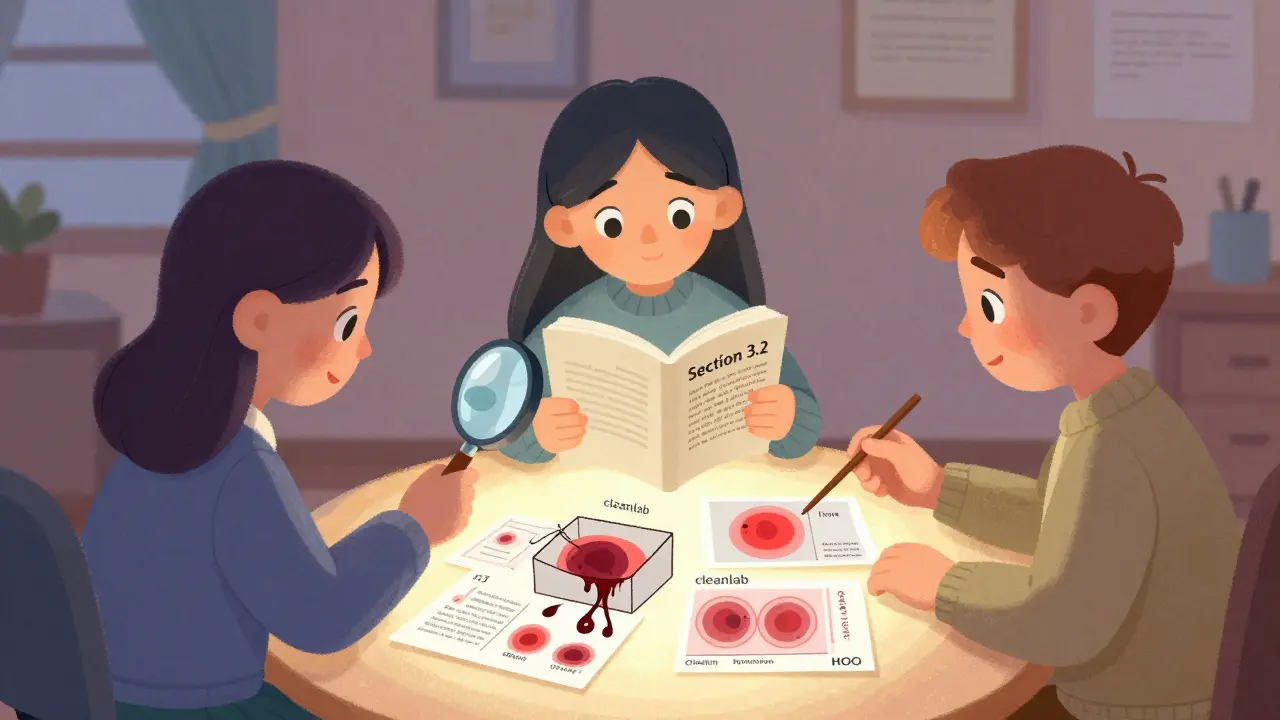
What to Do After You Find an Error
Don’t just fix the label and move on. Document it. Update your labeling guidelines. If you see the same error happening repeatedly, your instructions are too vague. Add a new example. Include a "common mistake" section. For example: "Do not label the stent as part of the vessel. The stent is a separate object, even if it’s inside the artery." Use version control for your data. Tools like Datasaur and Label Studio let you tag dataset versions. If you fix 200 errors in version 2.1, keep version 2.0 untouched. That way, if a model trained on v2.0 performs better, you can compare why. Track your progress. Keep a simple log: Date, Error Type, # of Fixes, Impact on Model Accuracy. One medical AI team at a Denver hospital tracked their corrections and found that fixing just 120 mislabeled X-rays improved their model’s sensitivity for detecting early-stage tumors by 14%.Tools That Actually Work (And What They Can’t Do)
Not all tools are created equal. Here’s what’s working in 2026:| Tool | Best For | Limitations | Accuracy |
|---|---|---|---|
| cleanlab (v2.4.0) | Statistical precision, research use, text and image classification | Requires Python, steep learning curve, struggles with class imbalance over 10:1 | 78-92% detection rate |
| Argilla (v1.13.0) | User-friendly corrections, Hugging Face integration, academic labs | Weak with multi-label tasks over 20 labels, no object detection support | 80-87% detection rate |
| Datasaur (Q2 2022 update) | Enterprise annotation teams, tabular and text data, seamless workflow | No support for object detection, only 65% correction accuracy in complex cases | 75-85% detection rate |
| Encord Active (v0.1.37) | Computer vision, medical imaging, large datasets | Needs 16GB+ RAM, slow on datasets over 10,000 images | 85% detection rate |
Choose based on your team. If you’re a researcher or engineer, cleanlab gives you control. If you’re managing annotators, Argilla or Datasaur saves time. If you’re working with medical images, Encord is worth the hardware cost.

Why This Matters More Than You Think
Curtis Northcutt, creator of cleanlab and an MIT researcher, put it plainly: "Label errors degrade model performance more than bad architecture." In one study, fixing just 5% of labels in a cancer detection dataset improved accuracy by 1.8%. That’s not a small gain-it’s the difference between a model that’s useful and one that’s dangerous. The FDA now requires systematic label error detection for AI-based medical devices. Gartner warns that organizations without this process will see 20-30% lower model accuracy than competitors. And in healthcare, that’s not just a metric-it’s a risk to patient safety. But don’t over-rely on automation. Dr. Rachel Thomas from the University of San Francisco warns that algorithms can misidentify minority classes as errors. A rare disease might be labeled wrong because the model has never seen enough examples. Always pair algorithmic detection with human oversight.Next Steps: Build Your Correction Routine
Here’s how to start today:- Identify one high-impact dataset (e.g., your most-used training set).
- Run it through cleanlab or your annotation tool’s error detection feature.
- Review the top 50 flagged examples with your team.
- Update your labeling guidelines with new examples based on what you find.
- Implement a two-reviewer system for any future labeling.
- Track how many errors you fix and how model performance changes over time.
Labeling isn’t a one-time task. It’s a cycle. Every time you correct an error, you make the next model better. And in healthcare, better models save lives.
Can labeling errors really make a model useless?
Yes. Even a 5% error rate can cause a model to miss critical patterns. In a study of pneumonia detection models, researchers found that models trained on datasets with label errors performed worse than models trained on smaller but cleaner datasets. The model didn’t learn the disease-it learned the noise. In clinical use, that meant false negatives, where patients with pneumonia were told they were healthy. No amount of extra layers or more data can fix bad labels.
Do I need to retrain my model after fixing label errors?
Not always, but you should. If you fix a small number of errors (under 10%), you might get away with fine-tuning. But if you’ve corrected more than 5% of your dataset, retraining from scratch is safer. Models learn from every example they’re given. If they learned from wrong labels, even a few corrections won’t undo the damage. Think of it like teaching a student from a textbook full of typos. You can’t just correct a few pages-you need to start over with a clean version.
Why can’t I just use more data to fix label errors?
More data doesn’t fix bad labels-it makes the problem worse. Imagine you have 1,000 images, 50 of which are mislabeled. Now you add 10,000 more images, and 500 of those are also mislabeled. Your model now has 550 bad examples to learn from. Instead of improving, it gets more confused. Clean data beats big data every time.
What if my annotators keep making the same mistakes?
That’s a training issue, not a labeling issue. Go back to your guidelines. Are they clear? Do they include visual examples? Are you testing annotators with quizzes before they start? A 2022 study found that teams using annotated examples in their guidelines reduced errors by 47%. Also, rotate annotators. People get tired or complacent. A fresh pair of eyes often spots what others miss.
Is there a free way to detect labeling errors?
Yes. cleanlab is open-source and free to use. It works with Python and integrates with scikit-learn, TensorFlow, and PyTorch. You can run it on your laptop with a small dataset. It won’t have the polish of Datasaur or Argilla, but it’s powerful. For non-technical users, start with Label Studio’s free tier-it includes basic consensus checking. It’s not perfect, but it’s better than nothing.
Aaron Sims
March 26, 2026 AT 05:54Stephen Alabi
March 27, 2026 AT 16:57Agbogla Bischof
March 29, 2026 AT 14:10Anil Arekar
March 29, 2026 AT 16:31Elaine Parra
March 31, 2026 AT 13:54Natasha Rodríguez Lara
April 1, 2026 AT 23:07peter vencken
April 2, 2026 AT 04:17Chris Crosson
April 3, 2026 AT 07:01Linda Foster
April 5, 2026 AT 04:35