
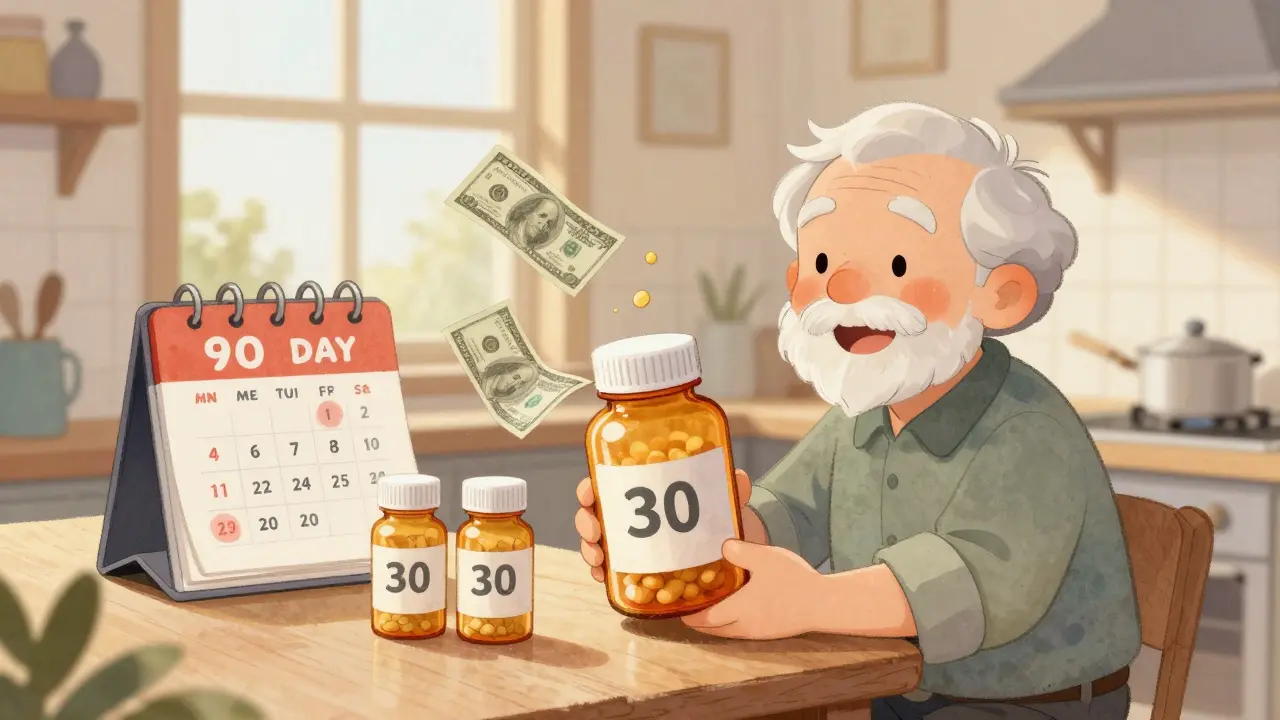
Every time you pick up your blood pressure or cholesterol medicine, you’re paying the same copay-even if you’re only getting 30 days of pills. But what if you could get 90-day fills and pay the same amount? That’s not a trick. It’s a real, widely available way to save hundreds of dollars a year on medications you take every day.
Most people don’t even ask for it. They assume their doctor wrote the prescription for 30 days, so that’s all they can get. But that’s not how it works. If you’re on a long-term medication-like for diabetes, high blood pressure, thyroid issues, or depression-you’re likely eligible for a 90-day supply. And if your insurance covers it, you’ll pay the same copay as you do for a 30-day refill. That means you get three months of pills for the price of one.
How Much Can You Really Save?
Let’s say your copay for a 30-day supply of your medication is $4.90. That’s common with many Medicare Part D and commercial plans. If you refill every month, you pay $4.90 × 12 = $58.80 per year.
But if you switch to a 90-day fill, you only refill four times a year. Same $4.90 copay each time. That’s $4.90 × 4 = $19.60. You just saved $39.20-almost $40-on one medication alone.
Now imagine you’re on two or three maintenance meds. That’s over $100 saved a year, just by asking for a longer supply. Some plans even offer lower copays for 90-day fills. A few patients report paying $10 for a 90-day supply of a drug that would’ve cost $15 for 30 days. That’s 50% off per dose.
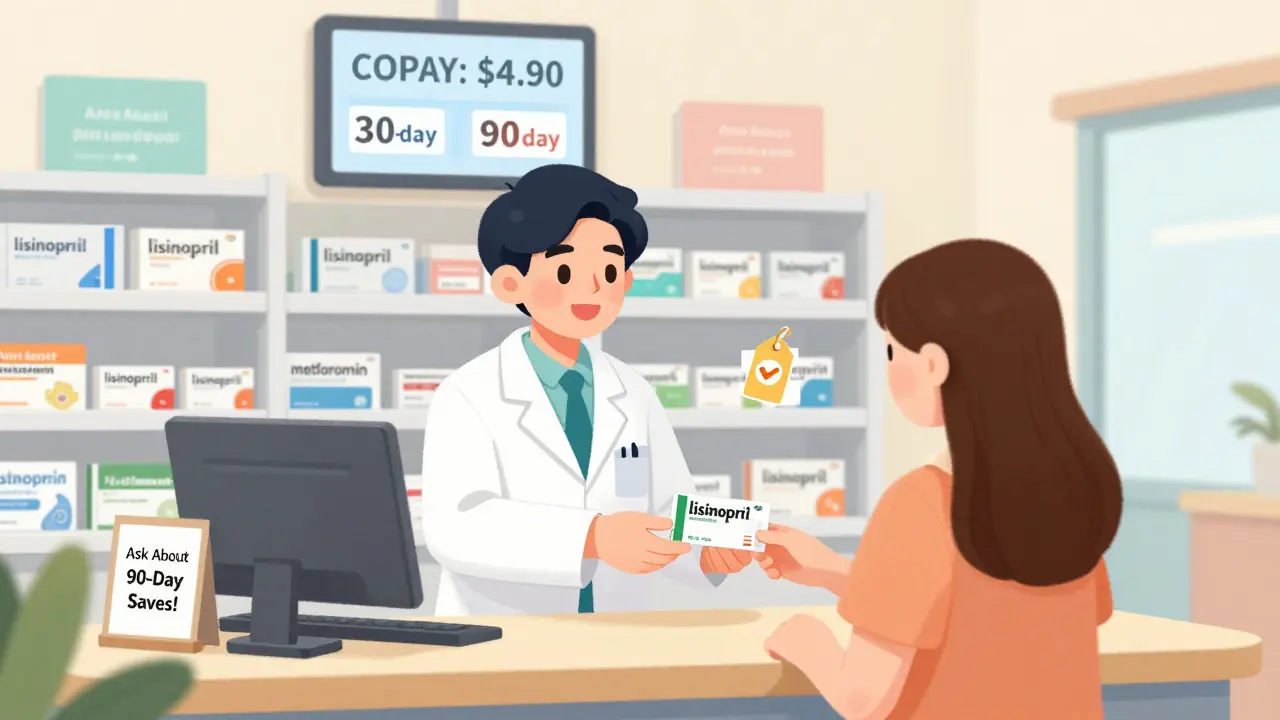
Mail-order pharmacies like CVS Caremark or HPSM’s Postal Prescription Services often give the best deals. But even your local CVS or Walgreens can fill 90-day prescriptions now. You don’t need to switch to home delivery unless you want to. You can still walk in, get your 90-day supply, and leave with your other prescriptions.
Who Qualifies for a 90-Day Fill?
You don’t need special permission or a rare condition. If you’re taking a medication regularly for a chronic health issue, you’re probably eligible. Common examples include:
- High blood pressure (lisinopril, amlodipine)
- Cholesterol (atorvastatin, rosuvastatin)
- Diabetes (metformin, glimepiride)
- Thyroid (levothyroxine)
- Depression or anxiety (sertraline, escitalopram)
- Asthma or COPD (fluticasone, salmeterol)
The only real requirement is that you’ve already been taking the medication successfully for at least one cycle-usually 30 days. That tells your doctor and insurer you’re not trying it for the first time. You’re not at risk of side effects or needing to switch.
Some plans won’t cover 90-day fills for brand-name drugs unless a generic is available. Others require prior authorization. But that’s not a dealbreaker. It just means you need to check first.
How to Get a 90-Day Prescription
It’s not complicated. Here’s exactly what to do:
- Check your current prescription. Look at the label. How many refills are left? You need at least one refill remaining. If you’re out of refills, call your doctor’s office. Ask them to write a new prescription for 90 days instead of 30.
- Call your pharmacy. Don’t wait until you’re out of pills. Call ahead. Say: “I’d like to fill my [medication name] for a 90-day supply. Is that covered under my plan?”
- Ask your doctor directly. During your next appointment, say: “Can we switch my [medication] to a 90-day prescription? I’d like to save money and reduce trips to the pharmacy.” Most doctors are happy to do it. They know it helps patients stay on track.
- Choose your pickup method. You can get it at your local pharmacy, or sign up for mail order. Mail order is often cheaper and comes with free shipping. But if you prefer to pick it up, most retail pharmacies can do it now.
Some pharmacies will automatically offer a 90-day option when you refill online. If you don’t see it, look for a dropdown menu or a checkbox that says “I want a 90-day supply.” If you can’t find it, call them.
Mail Order vs. Retail Pharmacy
You have two main options for getting your 90-day supply:
| Feature | Mail-Order Pharmacy | Retail Pharmacy |
|---|---|---|
| Cost | Usually lowest copay | Same as 30-day, sometimes slightly higher |
| Delivery | Free shipping, arrives in 3-7 days | Pick up in person |
| Convenience | No trips needed | One trip every 3 months |
| Refill Process | Automatic reminders, often auto-refills | You must request refill each time |
| Best For | People who want hands-off management | People who like to see their pharmacist or need other meds at the same time |
Mail order is ideal if you’re on the same meds every month. You sign up once, and they send your 90-day supply automatically. No calls, no trips. Some plans even let you get two 90-day supplies at once-so you’re covered for six months.
But if you like going to your local pharmacy, or you need to pick up antibiotics or pain meds at the same time, retail works just fine. CVS, Walgreens, and Rite Aid all offer 90-day fills in-store now. Just ask.
What to Do If Your Plan Says No
Not all plans cover 90-day fills for every drug. Some require prior authorization. Others only allow it for mail order, not retail.
If you’re told no, don’t give up. Ask:
- “Is there a way to get this covered through mail order instead?”
- “Can you check if a generic version is available? Sometimes that unlocks 90-day coverage.”
- “Can I appeal this decision?”
Many people get approved on appeal. Insurance companies often approve 90-day fills once they see the patient is stable and the cost savings are clear.
You can also use GoodRx or SingleCare to compare cash prices. Sometimes, even without insurance, paying cash for a 90-day supply is cheaper than using insurance for three 30-day fills. Always check.
Why This Matters Beyond Saving Money
Saving money is great. But the real win is better health.
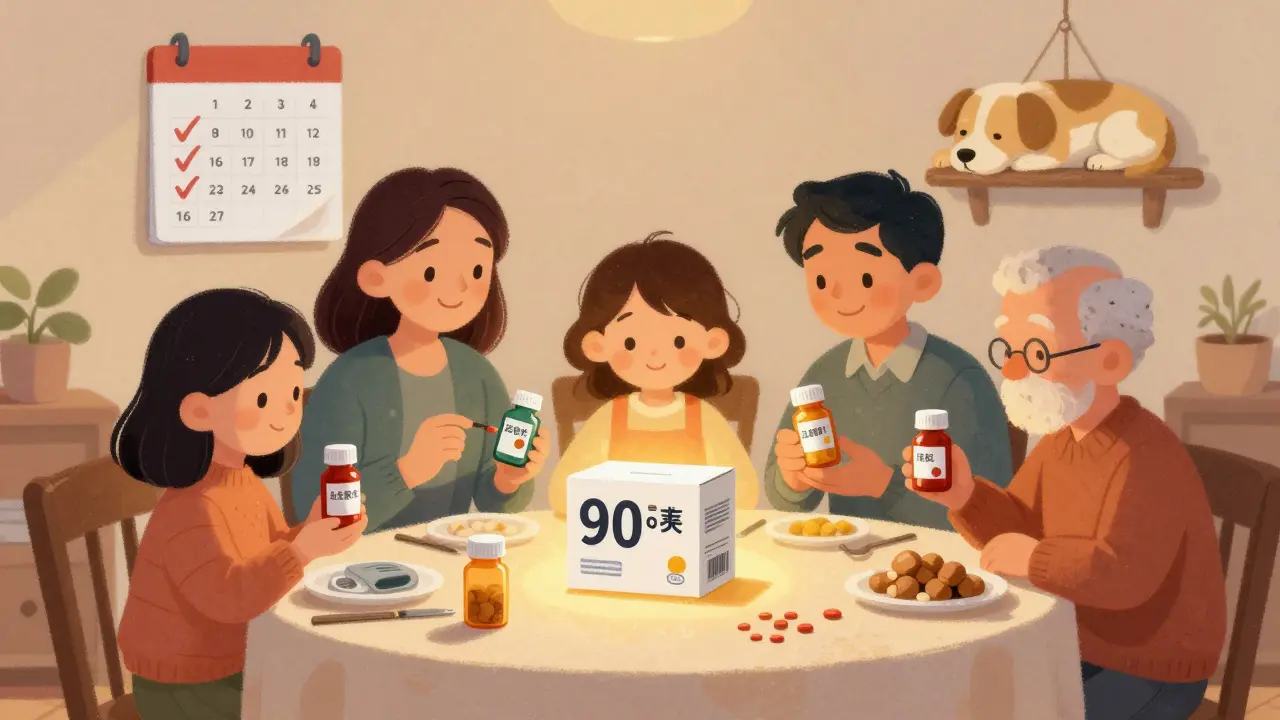
Studies show people who take their meds for 90 days at a time are far more likely to stick with them. Fewer trips to the pharmacy means fewer chances to forget. You’re not running out halfway through the month. You’re not scrambling to refill before a weekend trip.
One study found patients on 90-day supplies had 25% fewer hospital visits for preventable issues related to missed doses. That’s not just savings-it’s fewer ER trips, fewer complications, fewer stress-filled days.
And if you’re on multiple medications, it cuts down on pill clutter. Instead of juggling 12 bottles a year, you’re managing four. That’s simpler. Safer. Less confusing.
Common Mistakes to Avoid
Even when you know about 90-day fills, people still mess up. Here’s how to avoid the pitfalls:
- Don’t wait until you’re out. Call your pharmacy at least two weeks before you run out. If you wait too long, you might have to go back to 30-day fills.
- Don’t assume your doctor knows. Some doctors assume you know to ask. Don’t wait for them to bring it up.
- Don’t skip checking your copay. Sometimes, a 90-day fill costs the same as three 30-day refills. That’s not a win. Ask: “What’s my out-of-pocket for 90 days?”
- Don’t forget to update your insurance info. If you switch plans, your 90-day coverage might change. Always verify with your new insurer.
And if you’re on a Medicare Advantage plan or Medicaid, you’re more likely to have this benefit. Check your member handbook or call customer service. They’ll tell you exactly what’s covered.
Next Steps: What to Do Today
You don’t need to wait for your next doctor’s visit. Here’s your action plan:
- Make a list of every medication you take every day for a chronic condition.
- Check your last prescription label. How many refills are left?
- Call your pharmacy. Ask: “Can I get a 90-day supply of [medication]?”
- If they say yes, schedule your refill. If they say no, ask why-and if there’s another way.
- Repeat for each medication.
It takes 10 minutes. The savings add up fast. And the peace of mind? That’s priceless.
Can I get a 90-day supply for any medication?
No, only for maintenance medications used for chronic conditions like high blood pressure, diabetes, or cholesterol. You can’t get a 90-day supply for antibiotics, painkillers, or short-term meds. Your doctor and insurer determine eligibility based on how long you’ve been taking the drug and whether it’s for ongoing treatment.
Do I need to switch to mail order to get a 90-day fill?
No. Many retail pharmacies like CVS, Walgreens, and Rite Aid now offer 90-day fills in-store. You can still walk in, get your prescription filled, and leave with your other meds. Mail order is often cheaper, but it’s not required.
Will my copay be the same for 90 days as for 30 days?
Usually, yes. Most insurance plans charge the same copay for a 90-day supply as they do for a 30-day supply. That means you’re getting three months of pills for the price of one. Some plans even offer a lower copay for 90-day fills. Always ask your pharmacy to confirm your exact cost before filling.
What if my pharmacy says they can’t fill a 90-day prescription?
Ask if your plan allows 90-day fills through mail order. If not, call your insurance provider directly. Sometimes the pharmacy doesn’t have the right system set up, but your insurer can override it. Also, ask your doctor to write a new prescription for 90 days instead of 30. That often clears up the issue.
Can I get two 90-day supplies at once?
Some insurance plans allow it, especially with mail-order pharmacies. If you’re stable on your meds and have good adherence, your insurer may let you get six months’ worth at once. This cuts your refill trips down to just two per year. Ask your pharmacy or insurer if this option is available for your medications.
Edith Brederode
January 20, 2026 AT 06:46Arlene Mathison
January 21, 2026 AT 16:42Carolyn Rose Meszaros
January 23, 2026 AT 09:26Greg Robertson
January 25, 2026 AT 01:37Crystal August
January 26, 2026 AT 21:12Nadia Watson
January 28, 2026 AT 17:33Courtney Carra
January 29, 2026 AT 18:23thomas wall
January 31, 2026 AT 11:23Paul Barnes
January 31, 2026 AT 20:27Manoj Kumar Billigunta
February 2, 2026 AT 20:11Thomas Varner
February 3, 2026 AT 06:21Art Gar
February 3, 2026 AT 18:09Emily Leigh
February 4, 2026 AT 19:14