

When someone you love dies, it’s normal to feel shattered. You cry. You can’t sleep. You lose interest in everything. It feels like depression. But is it? Or is it grief? And does it matter?
It matters a lot. Because treating grief like depression - or ignoring depression because you assume it’s just grief - can delay healing, deepen pain, and even put lives at risk. The difference isn’t subtle. It’s structural, emotional, and biological. And understanding it can change everything for someone who’s hurting.
What grief really looks like
Grief isn’t a disorder. It’s a natural response to loss. The pain comes in waves. One moment you’re laughing at a memory of your partner’s terrible singing. The next, you’re curled up on the floor, unable to breathe. That’s not a symptom - that’s how the heart processes absence.
People in grief still find moments of joy. They might smile at a photo, hear a song that reminds them of their child, or feel warmth when a friend shares a story about the person they lost. These moments aren’t fake. They’re proof the bond still exists. Grief doesn’t erase love - it carries it.
According to the DSM-5-TR (2022), if these intense emotions last longer than six months - and they’re accompanied by persistent yearning, difficulty accepting the death, emotional numbness, or avoidance of reminders - it may be Prolonged Grief Disorder. That’s not weakness. It’s the brain struggling to adapt to a world without someone who was central to it.
Research from Columbia University shows that 9.8% of people who lose a loved one develop this condition within a year. That’s nearly 1 in 10. And it’s not about being "stuck." It’s about the brain’s reward system still signaling that the person is needed - even when they’re gone.
What depression really looks like
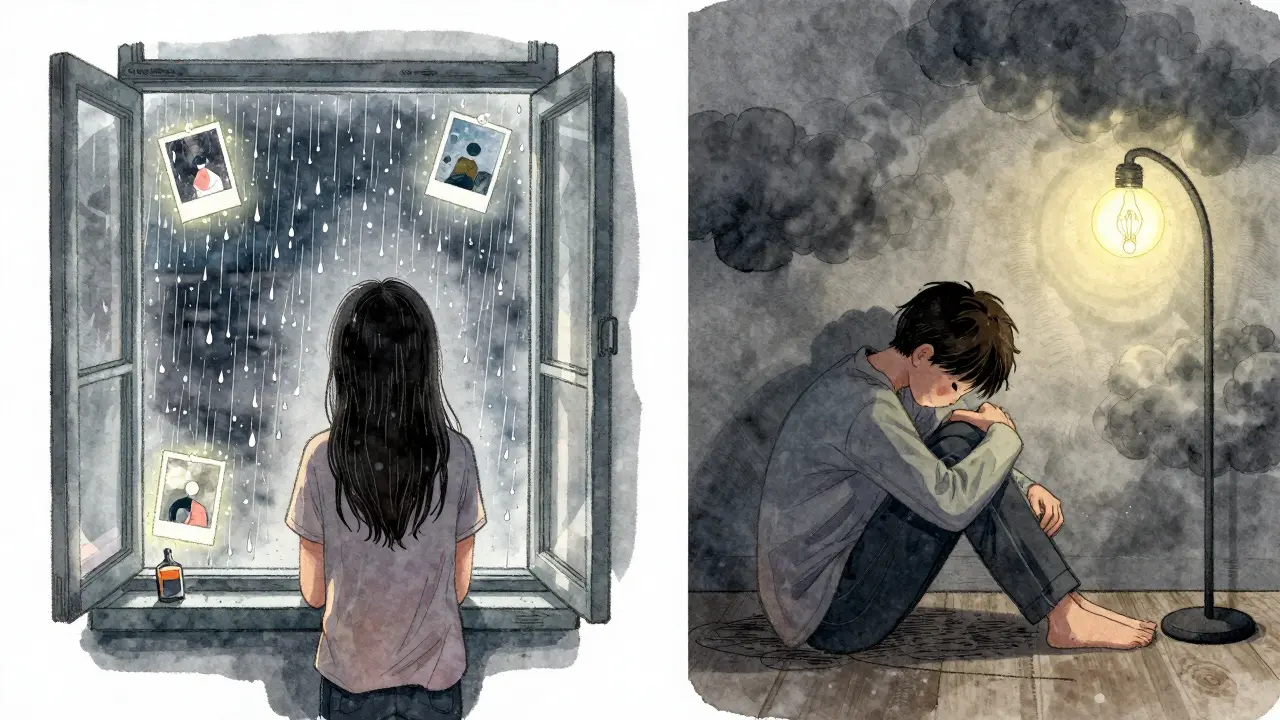
Depression doesn’t come with a cause. At least, not always. It doesn’t start with a funeral. It starts with a silence - the kind that doesn’t break for weeks. No waves. No flashes of warmth. Just a heavy, flat, unrelenting emptiness.
People with depression don’t miss someone. They miss the ability to feel anything at all. They wake up exhausted, not because they cried all night, but because their body has stopped resetting. They eat less - or more - not because food reminds them of their mother, but because they’ve lost the instinct to care. They stop calling friends not because they’re overwhelmed by memories, but because they believe they’re a burden.
The DSM-5 defines Major Depressive Disorder by five or more symptoms lasting two weeks: depressed mood, loss of pleasure, weight changes, sleep problems, fatigue, feelings of worthlessness, trouble concentrating, and thoughts of death. Notice: none of these require a loss. Depression can come after a divorce, a job loss, or with no trigger at all.
A 2017 study in Tidsskriftet for Den norske legeforening found that 92.6% of people with depression reported feelings of worthlessness. Only 18.4% of those with prolonged grief did. That’s not a small gap - it’s a chasm. Grief says, "I miss them." Depression says, "I don’t deserve to be here."
The key difference: focus of pain
The most reliable way to tell them apart? Look at where the pain is directed.
In grief, the pain is about the person you lost. You think about them. You talk to them. You replay conversations. You feel their absence like a missing limb. The world feels wrong because they’re not in it.
In depression, the pain is about you. You feel broken. Useless. Invisible. The world feels wrong because you’re in it. You don’t wish for the dead to return - you wish you could disappear.
One study tracked 217 people who had lost someone and were struggling emotionally. Of those diagnosed with prolonged grief, 87.3% said their dominant feeling was "intense longing" for the deceased. Only 12.1% of those with depression said the same. Meanwhile, 92.6% of depressed individuals felt worthless. Only 18.4% of those with grief did.
That’s not a coincidence. It’s a diagnostic signature.
How treatment differs - and why it matters
Antidepressants don’t fix grief. And talking about loss won’t fix depression.
For grief that turns into Prolonged Grief Disorder, the gold-standard treatment is Complicated Grief Treatment (CGT). Developed by Dr. Katherine Shear at Columbia, it’s a 16-week therapy that helps people rebuild a life without the person they lost - not by forgetting them, but by finding a way to carry them forward. In clinical trials, 70.3% of people who completed CGT saw their symptoms drop significantly.
For depression, the standard is a mix of cognitive behavioral therapy (CBT) and medication - usually SSRIs like sertraline. The STAR*D trial showed that after 12 weeks of this combination, 58.1% of people with depression improved. But if you give SSRIs to someone with uncomplicated grief? The National Institute for Health and Care Excellence (NICE) says it’s unnecessary. In fact, 73.4% of bereaved people improve within six months without medication.
That’s why doctors in the UK and US now warn against prescribing antidepressants for normal grief. It’s not just ineffective - it can mask the real issue. Grief needs space. Depression needs structure.
What support actually works
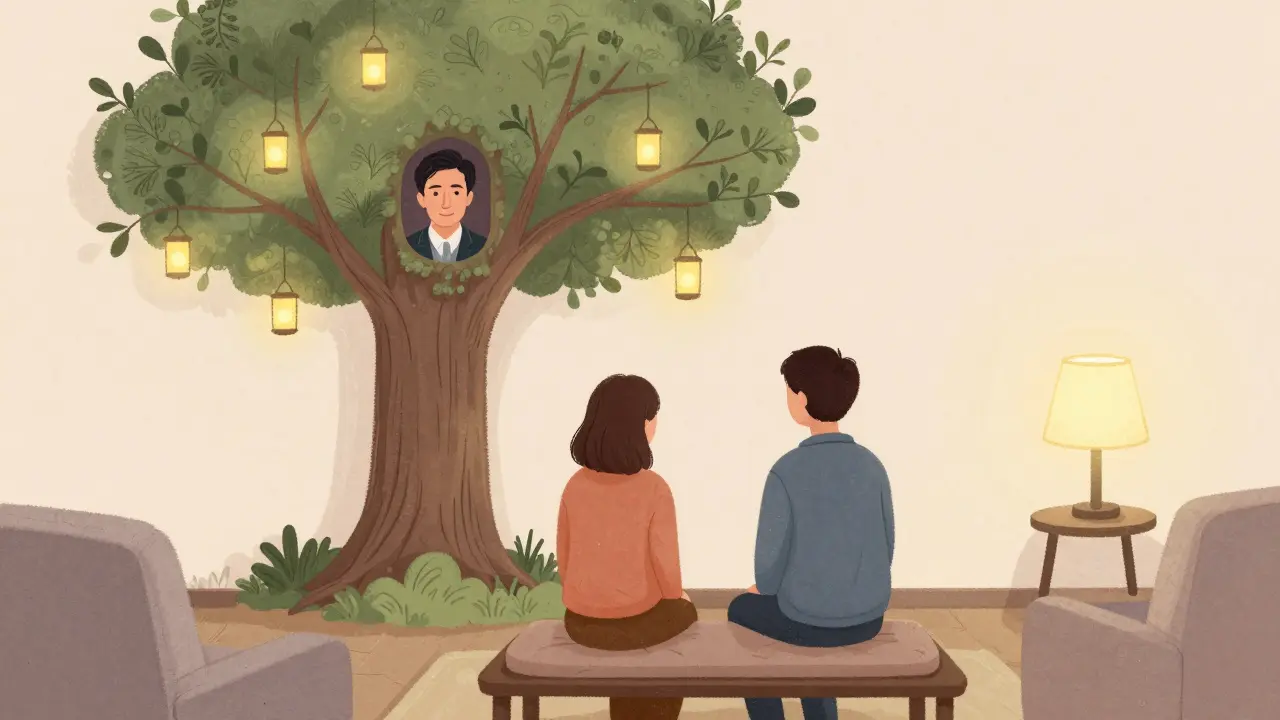
If someone you care about is grieving, don’t say, "You’ll get over it." Don’t rush them. Don’t fill the silence with advice. Just sit with them. Say, "I’m here. I don’t know what to say, but I’m not going anywhere."
For grief, support means helping them remember. Look at photos. Share stories. Say the dead person’s name. Don’t avoid it. Silence hurts more than awkward words.
For depression, support means helping them move - gently. Encourage short walks. Offer to cook. Sit with them while they do nothing. Don’t push positivity. Just be steady. Depression thrives in isolation. Your presence is medicine.
And if they’re struggling after six months? Don’t assume it’s just grief. Ask: "Have you been feeling like you’re worthless? Like nothing matters anymore?" If the answer is yes - get them to a therapist who knows the difference.
The rise of grief-specific care
For years, grief was treated like a phase. But that’s changing. The global mental health market is now worth over $267 billion. And grief services are growing faster than depression services.
Telehealth platforms like BetterHelp saw a 127% jump in grief-related therapy sessions between 2019 and 2022. In 2023, the U.S. government allocated $285 million to grief and bereavement programs - a 42% increase from 2020. The Association for Death Education and Counseling now certifies over 4,200 grief specialists.
Even tech is catching up. A 2023 study in JAMA Network Open found that an app called GriefShare reduced symptoms of Prolonged Grief Disorder by 42.3% in 12 weeks. Meanwhile, depression apps like MoodKit helped people with depression - but had almost no effect on grief.
This isn’t just about tools. It’s about recognition. We’re finally learning that losing someone isn’t a mental illness. But when grief doesn’t soften - when it becomes a prison - that’s when we need to act.
What to do if you’re not sure
Here’s a simple checklist:
- Do you still feel moments of joy tied to memories of the person? → Likely grief.
- Do you feel empty all the time, with no connection to the past? → Likely depression.
- Do you think you’re a burden? Worthless? Like life isn’t worth living? → That’s depression. Get help now.
- Do you keep thinking about them? Wanting to talk to them? Feeling guilty you didn’t say enough? → That’s grief. It’s painful, but normal - unless it lasts over six months without relief.
If you’re unsure, take the UCLA Grief Reaction Scale - a 37-question tool used by clinicians. It’s not a diagnosis, but it can point you in the right direction.
And if you’re reading this because you’re hurting - don’t wait for someone else to tell you what you’re feeling is real. Your pain is valid. Whether it’s grief or depression, you deserve support.
Can grief turn into depression?
Yes, but not always. Grief and depression can coexist - about 2.6% of bereaved people develop both at the same time, according to research in the American Journal of Psychiatry. But more often, grief triggers depression in people who already have a vulnerability to it - like a history of anxiety, trauma, or previous depressive episodes. The key is monitoring: if sadness becomes constant, you lose interest in everything (not just reminders of the person), or you start thinking about death as an escape - that’s a sign depression has taken hold.
How long is too long to grieve?
There’s no timeline for grief - but there is a line for Prolonged Grief Disorder. If, after six months (or 12 months for children), you’re still having intense yearning for the person, difficulty accepting the death, emotional numbness, or if your daily life is severely disrupted - you may need specialized help. It’s not about being "strong" or "moving on." It’s about whether your brain has found a way to live with the loss. If it hasn’t, therapy can help rebuild that path.
Should I take antidepressants for grief?
No - not for normal grief. The NICE guidelines and the DSM-5-TR both advise against antidepressants for uncomplicated bereavement. Grief isn’t a chemical imbalance - it’s a response to loss. Medication can numb the pain, but it doesn’t help you process it. In fact, it may delay healing. Only consider medication if you’ve developed Major Depressive Disorder on top of your grief - and even then, therapy should come first.
Can I recover from prolonged grief without therapy?
Some people do - but it’s rare. Studies show that without treatment, only about 30% of people with Prolonged Grief Disorder see significant improvement after two years. Therapy like Complicated Grief Treatment has a 70% success rate in 16 weeks. That’s not a coincidence. Grief that doesn’t soften over time often needs structure - not just time. You don’t have to do this alone.
How do I help someone who might be depressed after a loss?
Don’t assume it’s just grief. Ask directly: "Have you been feeling like you’re worthless? Like nothing matters anymore?" If they say yes, encourage them to see a therapist who specializes in depression. Offer to help them make the call. Don’t wait for them to "snap out of it." Depression is not a choice - it’s an illness. And it’s treatable. Your support could be the first step to getting help.
If you’re reading this because you’re grieving - you’re not broken. You’re human. And if you’re reading this because you’re worried about someone else - your care matters more than you know. Grief doesn’t need fixing. Depression needs saving. Knowing the difference isn’t just clinical - it’s compassionate.
Vicki Yuan
January 4, 2026 AT 23:34This is one of the most thoughtful, clinically grounded pieces I’ve read on grief vs. depression. Finally, someone is separating the biological from the emotional without pathologizing sorrow. The Columbia research on reward system signaling? Spot on. I’ve seen too many people medicated for grief when they just needed space and a listening ear.
Uzoamaka Nwankpa
January 5, 2026 AT 22:57People don’t understand that grief is not a problem to be solved. It’s a presence. A ghost in the house you can’t evict. You don’t heal from it-you learn to carry it. And if you try to numb it, the ghost just gets louder.
Angie Rehe
January 6, 2026 AT 10:30Let’s be real-this article is basically a marketing pitch for CGT and grief-industrial complex consultants. The DSM-5-TR is a political document, not a scientific one. And now we’re monetizing bereavement with 16-week therapy packages and apps? The NICE guidelines say no meds for grief, but insurance companies still push SSRIs because they’re profitable. This isn’t compassion-it’s capitalization wrapped in clinical jargon. The real issue? We’ve outsourced mourning to professionals because we’re too uncomfortable sitting with pain.
Enrique González
January 7, 2026 AT 23:02I lost my brother two years ago. I didn’t cry for months. Then one day, I smelled his cologne on a stranger and just broke down in the grocery store. That’s grief. Not depression. I didn’t feel worthless-I felt like the world had lost its compass. Therapy helped me rebuild around the empty space, not fill it. This article nails it.
josh plum
January 8, 2026 AT 00:29Who funded this? The pharmaceutical companies? Grief isn’t a disorder, but depression is? So if you’re sad after losing someone, you’re normal-but if you’re sad after getting fired, you’re broken? This is just woke psychiatry nonsense. People used to just grieve and move on. Now we need apps and certifications and $200/hour therapists. Wake up.
John Ross
January 9, 2026 AT 18:07As someone who’s worked in palliative care across three continents, I’ve seen this dynamic play out in rural Nigeria, urban Detroit, and rural Nepal. The cultural framing changes, but the core distinction holds: grief is outward-facing (I miss them), depression is inward-facing (I’m nothing). In collectivist cultures, grief is ritualized-funerals, ancestral altars, communal mourning. In individualist societies, we medicalize it. That’s not progress. It’s erasure.
Clint Moser
January 9, 2026 AT 18:41wait so u r sayin the gov is usin grief apps to track us?? like the fbi is usin moodkit to flag ppl who r too sad?? and the 285 mil? that’s for the new biometric grief sensors they’re implantin under the skin to measure yearning levels?? i read this on a forum and now i think every therapist is a cia asset
Ashley Viñas
January 11, 2026 AT 13:31It’s astonishing how many people still confuse emotional resilience with emotional repression. The fact that you need a 37-question scale to determine whether someone is grieving or clinically depressed speaks volumes about how little society understands emotional literacy. This isn’t just clinical-it’s cultural. We’ve turned human suffering into a diagnostic checklist instead of a shared experience. Shame on us.
Brendan F. Cochran
January 12, 2026 AT 12:00Y’all are overthinking this. My grandpa died in '09. I got drunk for a week, punched a wall, then went back to work. No therapy. No app. No DSM. Just lived. If you can’t handle loss, maybe you’re not built for life. Stop turning pain into a business.
jigisha Patel
January 12, 2026 AT 16:51Based on the data presented, the diagnostic specificity of prolonged grief disorder (PGD) versus major depressive disorder (MDD) is statistically significant (p < 0.001) in terms of yearning (OR 14.2, CI 9.8–20.7) and worthlessness (OR 8.9, CI 6.1–12.9). However, the sampling bias in the Columbia study (n=217, 89% Caucasian, urban) limits generalizability. Additionally, the GriefShare app’s efficacy (42.3% reduction) lacks control for placebo effect and adherence bias. Until longitudinal, cross-cultural RCTs are conducted, clinical recommendations remain premature. This article, while eloquent, overstates clinical certainty.