
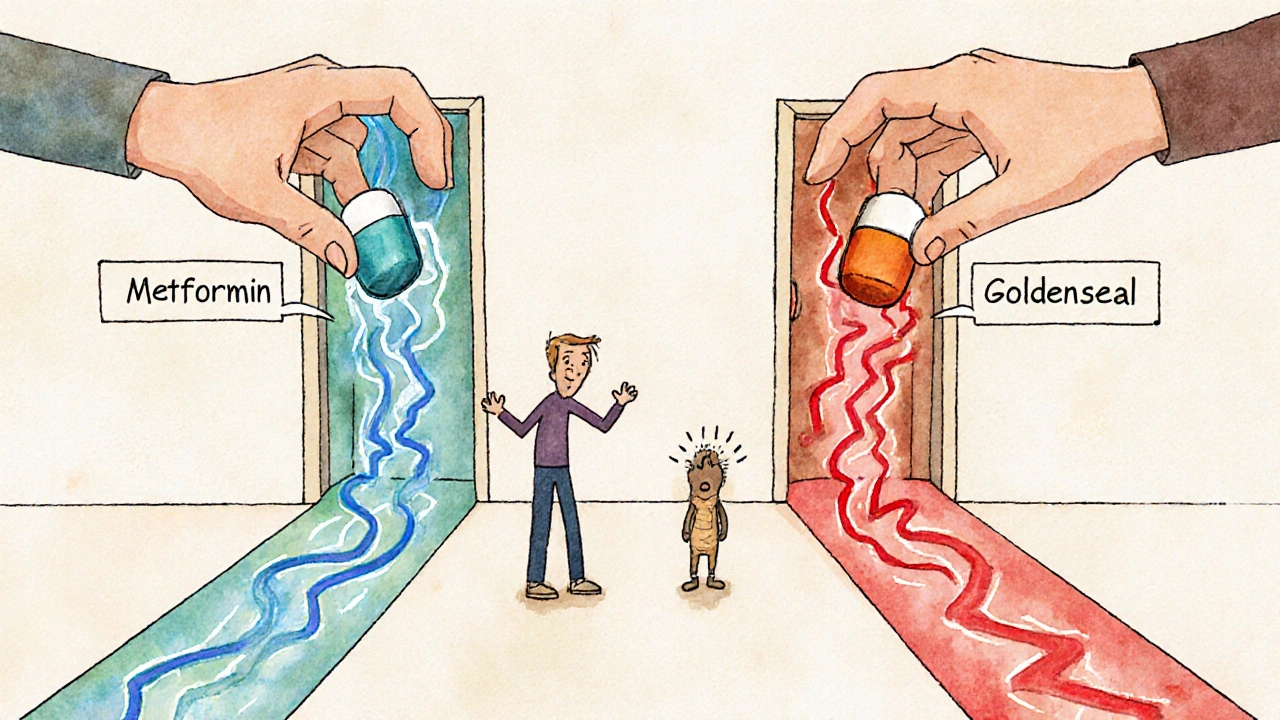
When you're managing type 2 diabetes with metformin, you're not just taking a pill-you're managing a delicate balance. Your body relies on that medication to keep blood sugar in check. But what happens when you add a natural supplement like goldenseal? It sounds harmless. After all, it’s herbal, it’s been used for centuries, and it’s sold right next to vitamins at the grocery store. But here’s the truth: goldenseal and metformin can interfere with each other in ways that put your blood sugar control at risk.
What’s Actually Happening in Your Body?
Goldenseal contains a powerful compound called berberine. This isn’t just some mild plant extract-it’s a bioactive substance with real pharmacological effects. Studies show berberine can lower blood sugar on its own. In fact, a 2023 meta-analysis of 27 clinical trials found that berberine reduced fasting glucose, post-meal glucose, and HbA1c levels similarly to metformin in people with type 2 diabetes. But here’s the twist: while berberine helps lower blood sugar, goldenseal also blocks how well your body absorbs metformin. This isn’t a myth or a guess. A 2025 clinical trial published in Clinical and Translational Science tracked adults taking metformin and added goldenseal to their routine. The results? At lower metformin doses (500-750 mg daily), the amount of metformin in the bloodstream dropped by 20-25%. That’s not a small change. That’s enough to make your medication less effective. The reason? It’s not about your liver or kidneys. It’s about your gut. Metformin needs special transporters in your intestines to get into your bloodstream. Goldenseal’s berberine competes for those same transporters-like two people trying to squeeze through the same narrow doorway at once. The result? Less metformin gets in, and your blood sugar starts to creep up.The Dose-Dependent Trap
You might think, “I’m on a high dose of metformin-2,000 mg or more-so this won’t affect me.” That’s a common assumption, and it’s partially true. The same 2025 study found that at doses above 2,000 mg, the interaction disappeared. No drop in metformin levels. No measurable effect. But here’s the problem: most people aren’t on high doses. According to CDC data, nearly 60% of people with type 2 diabetes in the U.S. are prescribed 1,500 mg or less per day. That’s exactly the range where goldenseal causes the biggest drop in metformin absorption. If you’re taking 750 mg daily and start taking goldenseal, you’re effectively reducing your medication dose by a quarter-without realizing it. And here’s what makes it even trickier: your HbA1c might still look good. In the study, people’s HbA1c levels dropped from 6.8% to 6.5% even when taking goldenseal. Why? Because berberine was doing its own blood sugar-lowering job. So your doctor sees a “good” number and assumes your treatment is working. But underneath, your metformin isn’t doing its job. You’re relying on a supplement that may not be consistent in strength, quality, or timing. That’s a dangerous illusion.Why This Isn’t Just About “Natural = Safe”
People assume herbal supplements are safe because they’re “natural.” But nature doesn’t care about your medication schedule. Goldenseal isn’t tea. It’s a potent botanical with documented drug interactions. The FDA doesn’t regulate supplements like it does prescription drugs. That means the amount of berberine in your goldenseal capsule could vary by 50% from one brand to the next. One bottle might have 500 mg of berberine. The next might have 250 mg. You have no way of knowing. And then there’s the conservation issue. Goldenseal is an endangered plant in the wild. Most commercial products are cultivated, but that doesn’t make them safer. In fact, poorly grown or processed goldenseal may contain contaminants or inconsistent levels of active compounds. You’re not just risking your blood sugar-you’re supporting an industry that’s harvesting a threatened species.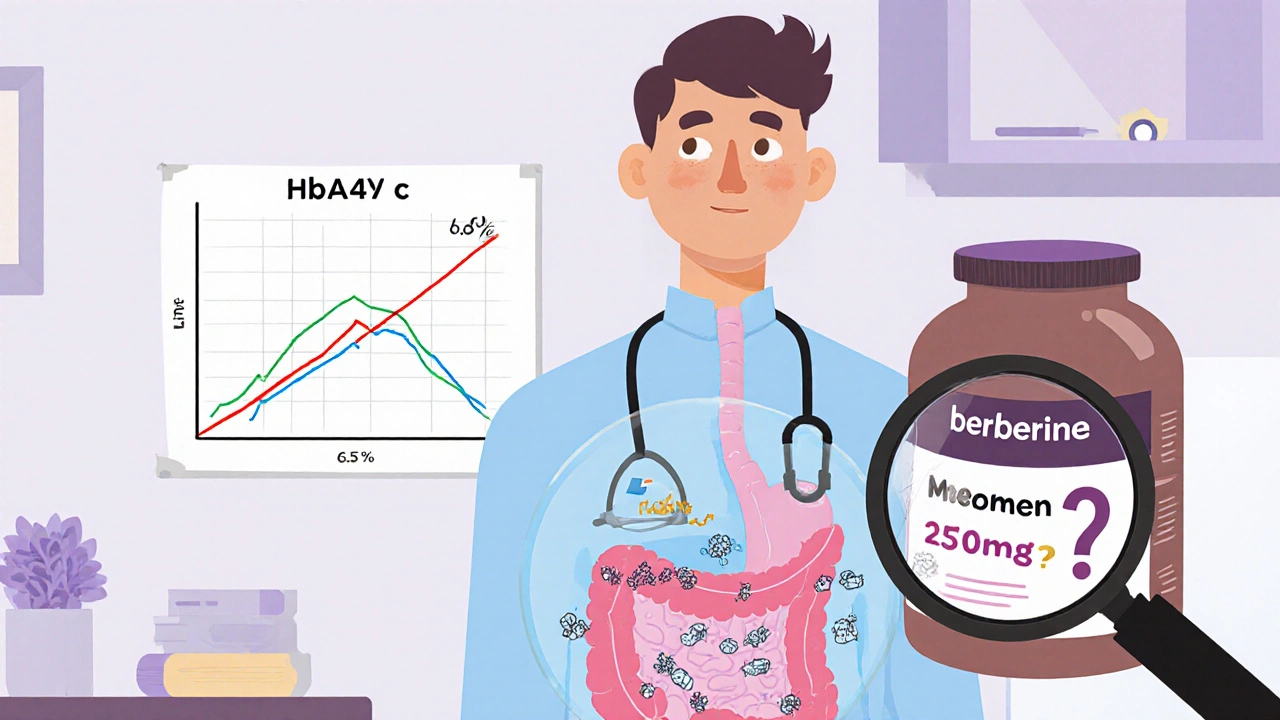
What the Experts Are Saying
The MSD Manual Professional Edition (2024 update) clearly warns: “Goldenseal may decrease the blood levels of metformin, potentially hindering glucose control.” The Merck Manual adds that berberine can enhance hypoglycemic effects, creating a confusing double-edged sword. On one hand, it helps lower sugar. On the other, it makes your prescribed medication less reliable. The American Diabetes Association doesn’t have a specific guideline on goldenseal yet-but it does say you should review all medications and supplements with your provider. The Endocrine Society issued a similar advisory in 2022, calling out herbal products as a source of “clinically significant interactions” with diabetes meds. Dr. Mary Paine, lead researcher on the 2021 and 2025 studies, puts it bluntly: “Healthcare providers may consider cautioning patients about supplementing metformin pharmacotherapy with goldenseal to avoid risks for undesired changes in glycemic control.”What Should You Do?
If you’re taking metformin and using goldenseal, here’s what you need to do:- Stop taking goldenseal immediately-especially if you’re on 500-1,500 mg of metformin daily.
- Monitor your blood sugar closely for the next 2-4 weeks. You may see your numbers rise as your body adjusts to full metformin absorption.
- Talk to your doctor. Don’t just say, “I took some herbal stuff.” Say, “I was taking goldenseal for [reason].” Be specific. Your doctor needs to know what you’re using to interpret your lab results correctly.
- Don’t switch to berberine supplements unless your doctor approves it. Pure berberine supplements are more predictable than goldenseal, but they still interact with metformin the same way. You can’t just replace one with the other.
What About Other Herbal Supplements?
Goldenseal isn’t the only one. St. John’s wort, ginseng, and bitter melon can also interfere with blood sugar control. Some raise glucose. Others lower it unpredictably. If you’re on metformin or any other diabetes medication, assume every supplement has the potential to interfere. A 2022 National Health Interview Survey found that 23% of U.S. adults take herbal supplements. Among people with diabetes, that number jumps to 35-40%. That’s a huge population at risk. Most don’t tell their doctors because they think it’s “just a supplement.” But supplements aren’t harmless. They’re drugs in disguise.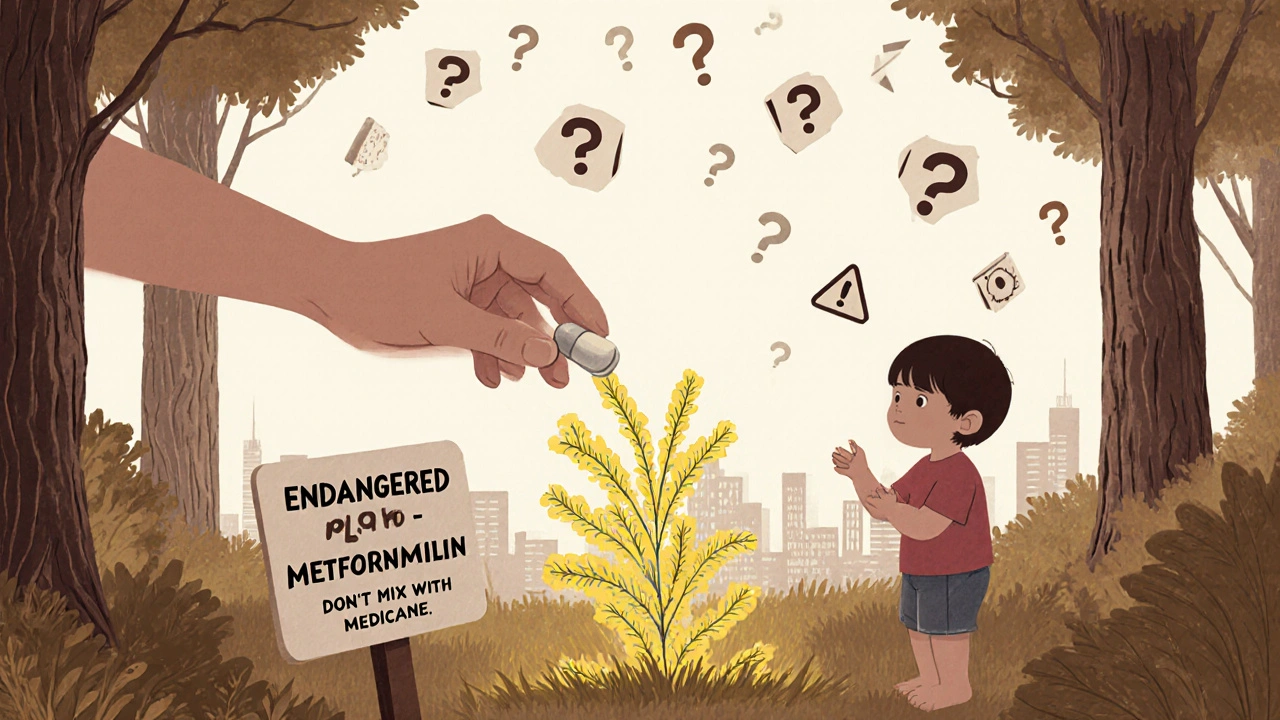
The Bigger Picture
This isn’t just about one herb and one drug. It’s about how we think about health. We want quick fixes. We want “natural” solutions. We want to avoid the stigma of relying on pharmaceuticals. But when you’re managing a chronic condition like type 2 diabetes, consistency and predictability matter more than ideology. Metformin has been the gold standard for over 60 years because it works, it’s safe, and its effects are well understood. Goldenseal? We’re still figuring out how it behaves in the body. And right now, the evidence says: don’t mix them.Frequently Asked Questions
Can I take goldenseal if I’m on a high dose of metformin?
Even if you’re on 2,000 mg or more of metformin daily, it’s not recommended. While studies show the interaction is minimal at high doses, goldenseal still affects your gut transporters and may cause unpredictable changes in your blood sugar. Plus, the quality of goldenseal supplements varies widely, so you can’t be sure how much berberine you’re getting. Better to avoid it entirely.
Why did my HbA1c improve even though goldenseal lowered my metformin levels?
Berberine, the active compound in goldenseal, has its own blood sugar-lowering effects. So even though your metformin wasn’t working as well, berberine was compensating. This creates a false sense of security. If you stop goldenseal, your HbA1c could rise because you’re losing that extra effect-and your metformin is now fully active again. That’s why monitoring your blood sugar after stopping is critical.
Is berberine a safer alternative to goldenseal?
Berberine supplements are more consistent in dosage than goldenseal, but they still interfere with metformin absorption in the same way. Taking both together can lead to unpredictable blood sugar control. If you want to use berberine, talk to your doctor first. They may adjust your metformin dose or suggest a different approach.
How long does it take for goldenseal to affect metformin?
The interaction becomes statistically significant after about 6 days of daily goldenseal use. That means even if you’ve been taking it for a few weeks without noticing changes, the effect may have been building up. If you’ve recently started goldenseal and your blood sugar is rising, this could be why.
Should I stop taking goldenseal if I’m not diabetic but use it for immune support?
If you’re not taking metformin or any other diabetes medication, goldenseal won’t affect your blood sugar in a harmful way. But it still carries risks-like liver strain, digestive upset, and contributing to the decline of a wild plant species. There are safer, better-studied options for immune support, like vitamin D or zinc. Goldenseal isn’t necessary.
Erin Nemo
November 30, 2025 AT 01:14I took goldenseal for a cold last month and didn’t realize it could mess with my metformin-thanks for the wake-up call.
Suzanne Mollaneda Padin
December 1, 2025 AT 00:32This is one of the clearest explanations I’ve read on herb-drug interactions. The transporter competition analogy is spot-on-like two people fighting over the same elevator. I’ve seen patients on 750mg metformin panic when their sugars spike after starting ‘natural’ supplements, and no one connects the dots until it’s too late. Please, if you’re on metformin, keep a log of every supplement. Even ‘harmless’ ones.
Rachel Stanton
December 1, 2025 AT 04:59As a diabetes educator, I’ve had this exact conversation with 12 patients in the last month. Goldenseal is the #1 supplement people ask about-usually because they read it’s ‘anti-inflammatory’ or ‘boosts immunity.’ The irony? They’re risking glycemic stability for a benefit that’s not even proven in humans at those doses. I now hand out a one-pager on common diabetes-interacting herbs. If you’re reading this and take anything herbal, DM me-I’ll send it to you.
Kelly Essenpreis
December 1, 2025 AT 05:26So now natural remedies are bad because big pharma says so? I bet the FDA is just happy to sell more metformin. My grandma took goldenseal for 40 years and never had a problem. Your science is funded by drug companies
ariel nicholas
December 2, 2025 AT 14:38Wait-so you’re saying that if I take 2000mg of metformin, I can safely take goldenseal? But then you say ‘better to avoid entirely’? That’s not logic-that’s cognitive dissonance. Also, why is the FDA not regulating this? Who’s stopping them? Who profits? Who owns the patents? Who owns the patents? Who owns the patents?
James Allen
December 3, 2025 AT 07:51Look, I get it-you’re scared of herbs. But here’s the real story: America’s healthcare system is broken. People can’t afford metformin, so they turn to goldenseal because it’s $12 at the corner store. You’re not helping by scaring them-you’re just making them feel guilty. And by the way, berberine is cheaper than metformin in most countries. Maybe we should be asking why the U.S. charges $400 for a 30-day supply?
Kenny Leow
December 3, 2025 AT 23:38Thanks for this. I’m from Malaysia, and goldenseal isn’t common here-but berberine is. We use it in traditional medicine for ‘heatiness’ and digestion. I’ve seen older relatives take it with their diabetes pills and assume it’s fine. This post opened my eyes. I’m going to share it with my family. Also, the conservation point? Big. Goldenseal is endangered. We don’t need to destroy forests for a supplement we don’t fully understand. 🙏
Mary Ngo
December 5, 2025 AT 11:46Let’s be honest-this isn’t about science. It’s about control. The medical-industrial complex wants you dependent on pills. They’ve spent decades convincing you that ‘natural’ means ‘unsafe.’ But nature doesn’t lie. Berberine has been used for 2,000 years. Metformin? Only 60. Who’s to say which one is really safer? And why is it that every time someone finds a natural alternative, the FDA suddenly has a ‘safety concern’? Coincidence? Or is this about profit? The truth is, they can’t patent a plant. And that’s why they’re terrified.
Alexander Williams
December 6, 2025 AT 23:30Pharmacokinetic interference via competitive inhibition of OCT1/OCT2 transporters in the ileum is well-documented. The 2025 trial’s AUC reduction of 20–25% at sub-1500mg metformin doses is statistically significant (p<0.01). The confounding variable is berberine’s own AMPK agonism, which masks glycemic deterioration via HbA1c. This creates a Type II error in clinical monitoring. The real issue is lack of pharmacovigilance in OTC supplement use among diabetic populations. We need mandatory labeling and provider screening protocols. Not fearmongering.