
When you pick up a generic pill at the pharmacy, you might assume it’s just a cheaper copy. But here’s the truth: every generic drug approved by the FDA has to meet the same exact standards for safety, quality, and strength as the brand-name version. There’s no room for compromise. The FDA doesn’t approve generics because they’re cheaper - they approve them because they work the same way.
What Makes a Generic Drug Legally Equivalent?
The legal foundation for generic drugs in the U.S. comes from the Hatch-Waxman Act of 1984. This law created the Abbreviated New Drug Application (ANDA) process, which lets manufacturers skip the expensive, multi-year clinical trials that brand-name drugs go through. Instead, they prove their product is bioequivalent to the original. That means the generic delivers the same amount of active ingredient into your bloodstream at the same rate as the brand-name drug.
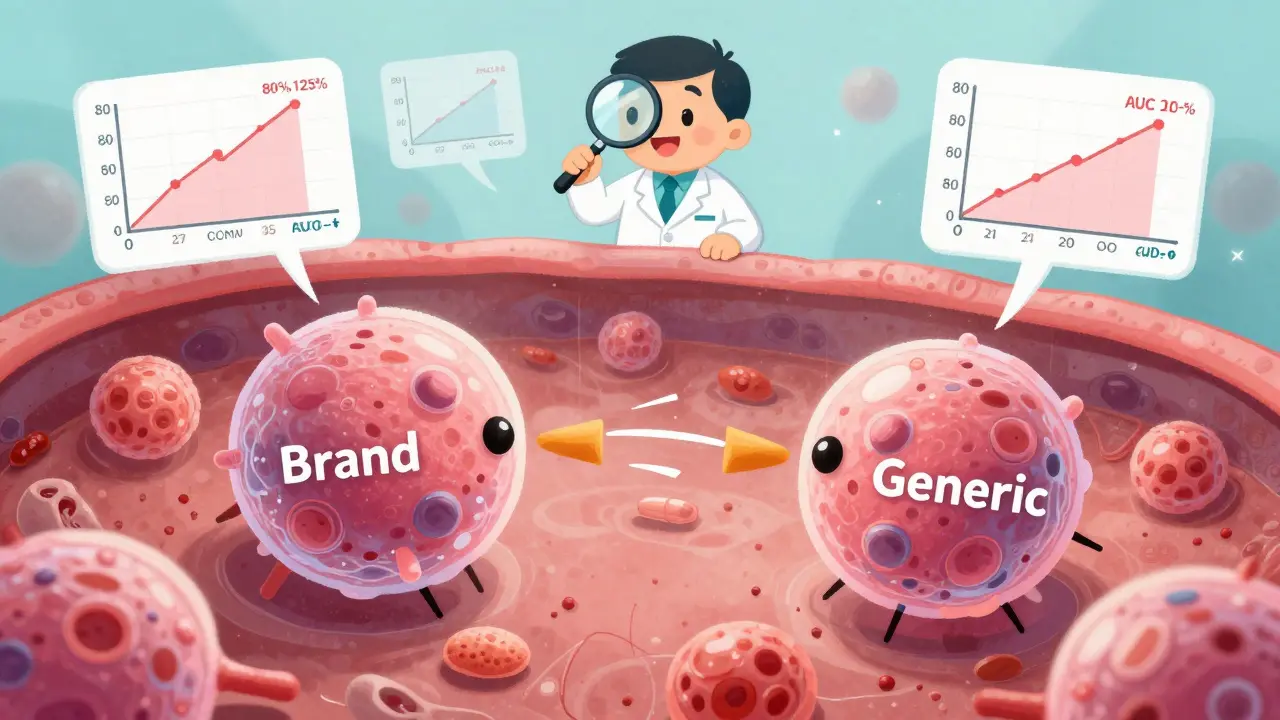
It’s not about matching the color, shape, or taste. It’s about what happens inside your body. The FDA requires that the rate and extent of absorption fall within 80% to 125% of the brand-name drug’s performance. This range isn’t arbitrary - it’s based on decades of pharmacokinetic data showing that variations within this window don’t affect clinical outcomes for most drugs.
How Bioequivalence Is Tested
To prove bioequivalence, manufacturers run controlled studies in healthy volunteers. Typically, 24 to 36 people take both the brand-name drug and the generic, in random order, with a washout period in between. Blood samples are taken over hours to track how the drug moves through the body.
Three key measurements are analyzed:
- Cmax: The highest concentration of the drug in the blood
- AUC0-t: The total drug exposure from time zero to the last measurable point
- AUC0-∞: The total drug exposure extrapolated to infinity
All three must fall within the 80%-125% range. For simple pills, this is straightforward. But for complex products - like extended-release capsules, inhalers, or topical creams - the testing gets harder. For example, a generic version of Ritalin LA (methylphenidate extended-release) must show matching release patterns at specific time intervals: 0-3 hours, 3-7 hours, and 7-12 hours after dosing. If the drug doesn’t release at the right speed, it won’t work the same way.
Strength, Purity, and Stability: The Non-Negotiables
Bioequivalence is just one part. The FDA also demands that generics match the brand-name drug in:
- Active ingredient: Same chemical compound, same amount per dose
- Dosage form: Tablet, capsule, injection, etc.
- Route of administration: Oral, topical, intravenous
- Strength: Exact milligram amount
- Purity: No harmful impurities beyond FDA limits
- Stability: Must remain effective and safe through its labeled shelf life
Manufacturers must prove this through rigorous chemical testing. They can’t just say it’s the same - they have to show data from multiple batches, under different temperatures and humidity levels. The FDA requires stability data covering at least 12 months under accelerated conditions and 24 months under normal storage.
Manufacturing Standards: No Shortcuts
Even if a drug works the same in the body, it won’t get approved if it’s made in a sloppy facility. Every generic drug plant must follow Current Good Manufacturing Practices (cGMP), which are enforced under 21 CFR Parts 210 and 211. These rules cover everything from raw material handling to employee hygiene to equipment cleaning.
The FDA conducts about 1,200 pre-approval inspections each year. If inspectors find major issues - like inconsistent tablet hardness, unclean equipment, or poor record-keeping - the application gets a Complete Response Letter. That means no approval until the problems are fixed and re-inspected.
One example: In 2021, Hetero Labs had its generic version of Jardiance (empagliflozin) rejected because tablet hardness varied too much across production batches. That’s not a small detail - inconsistent hardness affects how fast the tablet dissolves, which can change absorption rates and harm patients.
Complex Generics: Where the System Gets Stuck
Not all generics are created equal - at least in terms of approval difficulty. Simple oral tablets have a high approval rate. But complex products? They’re a different story.
Take the EpiPen. Between 2015 and 2020, the FDA approved only 3 out of 27 generic applications. Why? Because it’s not just a drug - it’s a device. The auto-injector mechanism, needle design, and pressure calibration all matter. A generic that looks the same might not deliver the right dose if the spring is off by a fraction.
Other complex products include inhalers, injectables, and topical creams. In 2021, only 58% of complex generic applications were approved within three review cycles, compared to 76% for simple ones. The FDA’s 2023 draft guidance on complex generics aims to fix this by requiring more detailed data and earlier manufacturer communication.
Narrow Therapeutic Index Drugs: Tighter Rules
Some drugs have a razor-thin margin between being effective and being dangerous. Warfarin, levothyroxine, and lithium fall into this category. For these, the standard 80%-125% bioequivalence range is too wide.
The FDA responded with tighter limits. For levothyroxine sodium generics, the acceptable range is now 95% to 105%. For some other narrow therapeutic index drugs, it’s 90% to 111%. These drugs also require additional clinical monitoring after approval.
Dr. Randall Uppal, writing in the Journal of Generic Medicines, argues these tighter limits are necessary. He points out that for warfarin, a 20% variation in absorption could mean the difference between a clot and a bleed. The FDA agrees - and has acted on it.
Cost, Time, and Real-World Impact
Developing a generic drug costs about $1.3 million on average - a fraction of the $2.6 billion needed for a new brand-name drug. But that doesn’t mean it’s easy. The average time from submission to approval is 32.7 months. For complex generics, it’s nearly 47 months.
Why so long? Because applications are often incomplete. One survey found that 68% of manufacturers struggle most with bioequivalence study design. Another 45% say cGMP compliance during inspections is their biggest hurdle.
Despite the delays, the impact is huge. In 2022, generics made up 90.3% of all prescriptions filled in the U.S. - but only 22.8% of total drug spending. That’s $373 billion saved in one year. Without generics, many patients couldn’t afford their meds.
Why Some Generics Still Get Rejected
Even with clear rules, many applications fail. Common reasons include:
- Insufficient data on stability or dissolution
- Manufacturing inconsistencies across batches
- Missing or poorly designed bioequivalence studies
- Labeling that doesn’t match the reference drug
- Patent or exclusivity blocks
The FDA’s Question-Based Review (QbR) system, introduced in 2005, forces applicants to answer specific questions about Critical Quality Attributes. If you don’t address them, your application stalls.
Successful applicants often use the FDA’s Pre-ANDA program. Over 78% of those who get approved have had at least one pre-submission meeting with the agency. These meetings help manufacturers avoid costly mistakes.
What Patients Should Know
If your doctor prescribes a brand-name drug, and your pharmacy gives you a generic - don’t worry. The FDA has spent 40 years building a system that ensures generics are just as safe and effective. Studies tracking over 15 years of real-world use show that 98.7% of therapeutic categories have no clinically meaningful difference between generics and brand-name drugs.
There are rare exceptions. Some patients report feeling different when switching - but this is often due to inactive ingredients (like fillers or dyes), not the active drug. If you notice changes in how you feel, talk to your doctor. Don’t assume the generic is bad. It’s more likely a sensitivity to something else in the pill.
And if your insurance pushes you to switch? That’s not a trick - it’s how the system works. Generics exist to lower costs without sacrificing safety. The FDA doesn’t approve them lightly. They’re held to the same bar as the originals - sometimes even higher.
What’s Next for Generic Drugs?
The FDA’s 2023 GDUFA III plan sets a goal: approve 50% of complex generic applications within two review cycles by 2027. Right now, it’s only 28%. That’s a big jump - and it’s needed. There are 127 complex brand-name drugs with no generic alternatives, representing $52 billion in annual sales.
Recent wins include the first generic of Humira (adalimumab) in December 2023 and the first generic of Vivitrol (naltrexone extended-release) in August 2023. These approvals matter because they open access to life-saving treatments for chronic conditions like autoimmune disease and opioid addiction.
The system isn’t perfect. Patent thickets still delay entry. Manufacturing in some countries still raises concerns. But the standards themselves? They’re among the most rigorous in the world. And for patients who need affordable, reliable medicine, that’s the whole point.
Alex Smith
January 11, 2026 AT 19:29So let me get this straight - we’re paying $200 for a brand-name pill and $4 for the generic, but they’re chemically identical? And the FDA actually checks this? I mean, I’ve seen my dog eat a whole bag of treats and still look confused, but apparently the FDA has better things to do than nap on the job.
Alfred Schmidt
January 13, 2026 AT 02:53Stop lying to people. The FDA doesn’t care about you. They care about big pharma’s bottom line. I’ve been on generics for 8 years - my blood pressure spikes, my anxiety goes nuts, and my doctor just says ‘it’s all in your head.’ Well, my head isn’t the problem - your system is broken.
Sean Feng
January 13, 2026 AT 06:51Generics work fine. I take them. No drama. Why are you all making this a thing?
Priscilla Kraft
January 13, 2026 AT 13:05Thank you for explaining this so clearly 😊 I’ve been scared to switch from brand to generic for years, but now I feel way more confident. The FDA’s standards really are insane in the best way - like, they’re basically superheroes for your medicine cabinet 🦸♀️💊
Vincent Clarizio
January 15, 2026 AT 01:34Think about it - this isn’t just about pills. This is about the philosophical underpinning of modern capitalism: can we replicate perfection without the myth of originality? The generic drug is the postmodernist’s dream - a copy that doesn’t just imitate, but *achieves* equivalence. It’s Hegel meets pharmacology. The brand-name drug is the Idea; the generic is its material instantiation. And yet, we still cling to the illusion of superiority because we’re afraid to accept that value can be replicated - that meaning can be shared without ownership. We fear the democratization of healing. And that’s why we pay $200 for a pill that could cost $4 - not because of science, but because of our collective spiritual poverty.
Sam Davies
January 16, 2026 AT 12:27Oh wow, the FDA actually does something right? Shocking. Next you’ll tell me the British monarchy still has a functional purpose. I mean, I suppose if you’re the type who believes in regulatory bodies that aren’t just corporate puppets, then sure, this is lovely. But let’s not pretend this isn’t the bare minimum.
Christian Basel
January 17, 2026 AT 15:11Bioequivalence metrics are statistically valid but clinically oversimplified. The 80–125% AUC/Cmax window is a population-level proxy that ignores inter-individual PK variability, especially in polymorphic CYP450 metabolizers. You’re assuming homogeneity in absorption kinetics when the real world is heteroskedastic. That’s not science - it’s a regulatory heuristic dressed up as precision.
Adewumi Gbotemi
January 18, 2026 AT 15:28Back home in Nigeria, we don’t have this kind of system. Some generics are good, some are dangerous. I’m glad the FDA is serious. People’s lives depend on this.
Michael Patterson
January 19, 2026 AT 11:35Anyone who trusts generics is an idiot. I saw a guy on Reddit say his generic Adderall made him feel like a zombie - turns out it was made in a factory with rats running through the warehouse. The FDA? They’re asleep. You think they care? They get paid by the same companies that make the brand names. Wake up.
Matthew Miller
January 19, 2026 AT 14:28So you’re telling me a company can make a pill that’s 80% as effective as the original and call it ‘equivalent’? That’s not equivalence - that’s fraud. And the fact that the FDA allows this proves they’re either incompetent or corrupt. Either way, patients are the ones getting screwed.
Madhav Malhotra
January 20, 2026 AT 06:52I’m from India - we make 40% of the world’s generics. I’ve seen factories where they test batches with lab coats and microscopes. It’s not magic - it’s hard work. The FDA’s standards are tough, but they’re fair. Respect the process.
Priya Patel
January 20, 2026 AT 21:57OMG I just cried a little reading this 😭 I’ve been on levothyroxine for 10 years and I was terrified to switch - now I feel like I can finally breathe. Thank you for writing this like a human who actually cares 💖
Jennifer Littler
January 21, 2026 AT 12:53As someone who works in regulatory affairs, I can confirm: the QbR framework is the only thing keeping complex generics from becoming a regulatory nightmare. The Pre-ANDA meetings? Non-negotiable. Companies that skip them fail. Period. This isn’t bureaucracy - it’s risk mitigation at scale. And yes, it’s expensive. But so is a patient bleeding out because a tablet dissolved too fast.