

When you take a pill, does it matter if you swallowed it on an empty stomach or right after breakfast? The answer isn’t just about stomach upset-it’s about whether the drug actually works the way it’s supposed to. This isn’t just a pharmaceutical issue. It’s also a fitness question: Should you train before breakfast or after? The science behind fasted vs fed state testing reveals how your body’s internal environment changes dramatically depending on whether you’ve eaten, and those changes can make or break outcomes-from how well a medicine works to how much fat you burn during a workout.
What Exactly Is Fasted vs Fed State?
Fasted state means you haven’t eaten for at least 8 to 12 hours. Water, black coffee, and plain tea are usually allowed. Your body is running on stored energy-glycogen in the liver and fat from adipose tissue. Blood sugar is low. Insulin is minimal. Fat breakdown is high. Fed state is the opposite. You’ve eaten a meal-typically a standardized one in research settings-within the last 2 to 4 hours. Your stomach is digesting, your pancreas is releasing insulin, blood sugar is rising, and your body is in storage mode. Fat burning slows. Glycogen use increases. Digestive processes are fully active. These aren’t just labels. They’re two distinct physiological conditions with measurable, repeatable differences. In pharmaceutical testing, these states determine whether a drug gets approved. In exercise science, they determine whether training is optimized for endurance, fat loss, or muscle gain.Why Drug Companies Can’t Ignore Fed State
The FDA and EMA don’t just recommend fed state testing for new drugs-they require it. Why? Because food changes how your body absorbs medicine. It’s not a small effect. For some drugs, food boosts absorption by 200 to 300%. For others, it slashes it by half. Take fenofibrate, a cholesterol drug. When taken with a high-fat meal, its bioavailability jumps dramatically. If tested only in a fasted state, doctors might prescribe a dose that’s too low when patients take it with food. That’s dangerous. On the flip side, griseofulvin-an antifungal-absorbs poorly when taken with food. If you only tested it fed, you’d think it didn’t work. But in a fasted state? It’s effective. That’s why both tests are mandatory. The FDA’s 2002 guidelines spell out exactly what a fed-state meal should look like: 800-1,000 calories, with 500-600 of those from fat. That’s not a snack. That’s a heavy breakfast. And the meal must be consumed within 10% of those exact numbers in every trial. Why? Because even small changes in fat content can alter absorption. Gastric emptying time tells the rest of the story. In a fasted state, the stomach empties in about 14 minutes. In a fed state? It takes over an hour. pH levels drop lower in the stomach after eating-sometimes as low as 1.5-changing how drugs dissolve. Pressure inside the stomach spikes, too. All of this affects how and when a drug enters the bloodstream. A 2019 analysis of 1,200 new drug applications found that 35% of oral medications had clinically significant food effects. That’s why the EMA now requires fed-state testing for any drug where food interaction is unknown. It’s not optional. It’s safety.
Exercise Science: Fasted Training for Fat Loss? Fed for Performance?
In the gym, the debate is just as heated. Should you run on an empty stomach to burn more fat? Or eat first to power through a hard session? Research shows fasted exercise increases free fatty acid availability by 30-50% during moderate workouts. That means your body is pulling more fat from storage. It also upregulates PGC-1α-a gene linked to mitochondrial growth-by 40-50%. That’s a signal your body is adapting to become better at using fat for fuel. But here’s the catch: those benefits don’t always translate to better body composition. A 2021 study in the Journal of the International Society of Sports Nutrition found no difference in fat loss between fasted and fed training groups over six weeks, even though fasted participants burned more fat during the workout itself. Meanwhile, fed-state exercise improves performance. A 2018 meta-analysis of 46 studies found that athletes performed 8.3% better on long endurance sessions when they ate beforehand. But for workouts under 60 minutes? No difference. That’s key. If you’re doing HIIT, sprints, or strength training, you need glycogen. And glycogen comes from food. The American College of Sports Medicine’s 2022 position stand says it plainly: fed-state training is best for competitive athletes. Fasted training may help sedentary people improve insulin sensitivity by 5-7%, but it can reduce high-intensity work capacity by 12-15%. That’s a trade-off. Real-world data backs this up. A 2022 Reddit survey of 1,247 fitness users found 68% felt stronger and more energetic when training fed. But in the r/ketogains community, 42% preferred fasted training for fat loss-even though 31% admitted to feeling dizzy and 22% said their workouts felt weaker. Professional athletes don’t agree either. Ultramarathoner Scott Jurek trains fed to sustain long efforts. CrossFit champ Rich Froning trains fasted to train his body to burn fat. Both are right-for their goals.Why You Can’t Just Pick One
The biggest mistake people make is treating fasted and fed as a binary choice: “Fasted is better” or “Fed is better.” Neither is universally superior. It depends on what you’re trying to achieve. In pharmaceuticals, you need both to know how a drug behaves in real life. People don’t take pills on an empty stomach every time. Some take them with breakfast. Others with dinner. If you only test one condition, you’re not predicting real-world outcomes-you’re guessing. In fitness, the same logic applies. If you’re training for a marathon, fed-state sessions are non-negotiable. If you’re trying to improve metabolic health and you’re not an athlete, fasted training might be a useful tool. But doing it every day? That’s where problems start. The 2022 Medicine & Science in Sports & Exercise study found that genetic differences explain 33% of why some people respond better to fasted training than others. Your PPARGC1A gene variant might make you a natural fat-burner-or it might make you crash without food. You can’t assume your body works like someone else’s.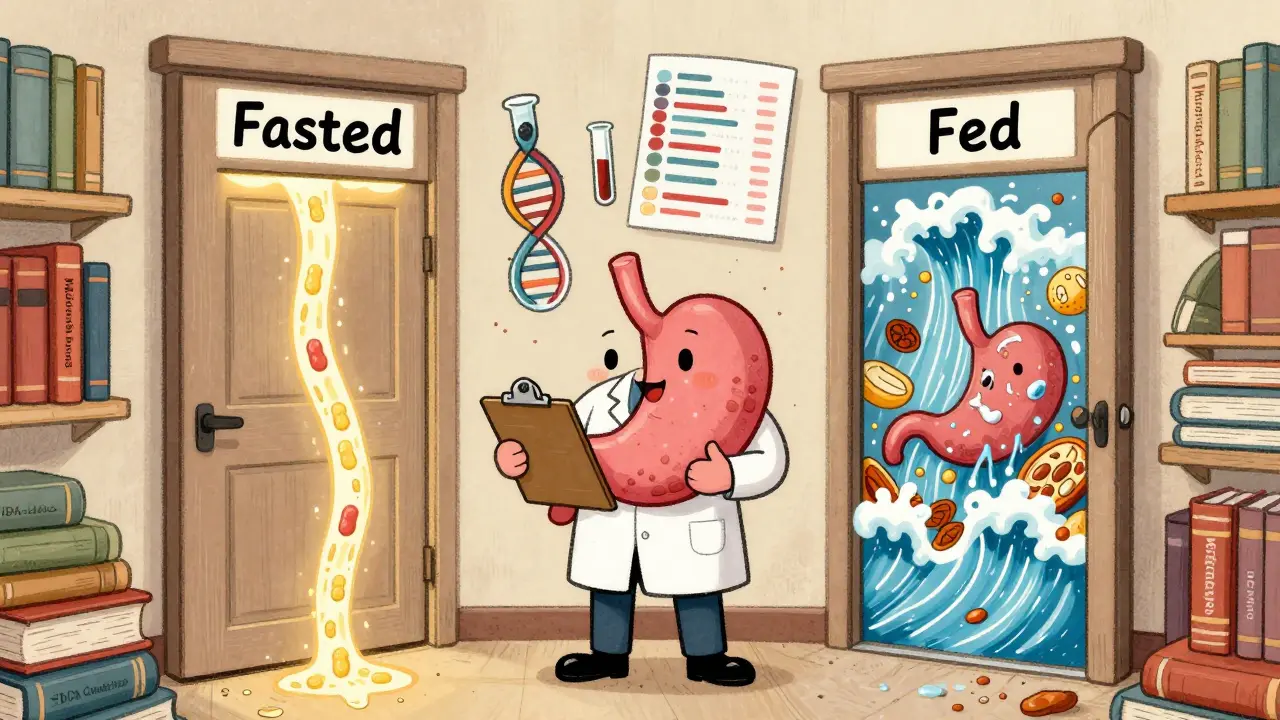
How to Get Accurate Results-Whether You’re Testing a Drug or Your Workout
If you’re designing a study-or just trying to optimize your own routine-standardization is everything. For pharmaceutical trials:- Use the exact FDA meal: 800-1,000 calories, 500-600 from fat
- Control timing: drug given 15 minutes after meal
- Account for ethnicity: Asian populations empty the stomach slower in fed state
- Monitor glucose levels: new EMA guidelines now require continuous glucose monitoring during fed trials
- Fasted: 8-12 hours without food, only water, sleep ≥7 hours, no intense activity the day before
- Fed: 1-4 g/kg of carbohydrates 1-4 hours before training
- Hydration: urine specific gravity below 1.020
- Consistency: test at the same time of day, same week day, same conditions
The Future: Personalized Approaches Are Coming
The one-size-fits-all model is fading. In pharma, the FDA is now requiring fed-state testing across diverse ethnic groups because absorption rates vary. In fitness, companies are starting to test genetic markers to predict whether someone will benefit from fasted training. The global bioequivalence testing market hit $2.7 billion in 2022. The sports nutrition market, fueled by fed-state performance products, is growing at 27% a year. This isn’t a trend. It’s infrastructure. Whether you’re a researcher, a clinician, or someone trying to get in shape, the lesson is the same: context matters. Your body doesn’t operate in a vacuum. What you eat, when you eat it, and how your body responds-it all changes the outcome. Don’t ask whether fasted or fed is better. Ask: What am I trying to measure? And then test both.Why do drug companies test both fasted and fed states?
Because food can dramatically change how much of a drug enters your bloodstream. For some drugs, eating increases absorption by over 200%. For others, it cuts absorption by half. Testing only one state could lead to underdosing or overdosing in real life. The FDA and EMA require both to ensure safe, effective dosing across all eating patterns.
Is fasted exercise better for burning fat?
Yes, during the workout-fasted exercise increases free fatty acid availability by 30-50% and boosts fat-burning genes like PGC-1α. But long-term fat loss depends on total calorie balance, not just what’s burned during exercise. Studies show no difference in body composition after weeks of training, whether fasted or fed. So while fasted training increases fat use during the session, it doesn’t guarantee more fat loss over time.
Should I eat before my morning workout?
It depends on your goal. If you’re doing high-intensity training, strength work, or anything over 60 minutes, eat something first-especially carbs. You’ll perform better and recover faster. If you’re doing light cardio for metabolic health and you feel fine fasted, it’s safe. But if you feel dizzy, weak, or unable to push hard, eating before is smarter. Listen to your body, not just the trend.
What’s the standard fed meal used in drug trials?
The FDA requires a high-fat, high-calorie meal of 800-1,000 calories, with 500-600 calories coming from fat. That’s roughly two bacon cheeseburgers, a large order of fries, and a milkshake. The goal is to mimic a heavy, realistic meal that slows digestion and changes drug absorption. Trials must stick within 10% of these numbers to be valid.
Do genetic differences affect how people respond to fasted vs fed training?
Yes. A 2022 study found that variations in the PPARGC1A gene explain 33% of individual differences in how people respond to fasted versus fed training. Some people naturally burn more fat when fasted. Others crash without food. Genetics play a bigger role than most people realize, which is why personalized nutrition is the future-not one-size-fits-all advice.
Is fed-state testing only important for drugs?
No. It’s also critical in exercise science, nutrition research, and metabolic health studies. Whether you’re measuring endurance, fat oxidation, insulin sensitivity, or hormone response, your nutritional state changes the results. Ignoring fed state means you’re only seeing half the picture. That’s why leading journals now require authors to report whether participants were fasted or fed during testing.
mark shortus
December 20, 2025 AT 01:41THIS IS THE MOST IMPORTANT THING I’VE READ ALL YEAR. I DIDN’T EVEN KNOW FOOD COULD MAKE A DRUG WORK OR NOT WORK. I TOOK MY CHOLESTEROL PILLS WITH A BAGEL EVERY MORNING FOR 5 YEARS. WHAT IF I WASN’T GETTING ANY OF IT?? I’M GOING TO THE DOCTOR TOMORROW. THIS CHANGES EVERYTHING.
AND ALSO-FASTED WORKOUTS? I’VE BEEN DOING THEM FOR 8 MONTHS AND I FEEL LIKE A ZOMBIE. NOW I KNOW WHY. MY BODY IS SCREAMING FOR CARBS AND I’VE BEEN IGNORING IT. I’M EATING BEFORE MY NEXT SESSION. THANK YOU.
PS: I JUST SPENT 20 MINUTES READING THIS TWICE. I’M NOT JOKING. THIS IS A LIFESAVER.
Dikshita Mehta
December 21, 2025 AT 12:45Really well-written breakdown. As someone from India where traditional meals are often high in fats and carbs, it’s fascinating to see how the FDA’s standardized meal doesn’t even reflect global eating patterns. In many households, a ‘fed state’ might be dal-rice with ghee or roti with yogurt-totally different from a bacon cheeseburger. I hope future trials include more diverse dietary backgrounds. Also, the genetic part about PPARGC1A? Spot on. My aunt metabolizes fat like a furnace even when she eats rice for every meal. Genetics > trends.
Kathryn Featherstone
December 22, 2025 AT 11:04As a personal trainer, I’ve seen clients crash hard during fasted HIIT. One guy passed out on the treadmill. Scary. I used to push fasted training because it ‘looked cool’ online. Now I ask: what’s your goal? Fat loss? Then maybe try it once a week. Performance? Always eat. Recovery? Definitely eat. It’s not about being right-it’s about being smart. Your body isn’t a lab rat. It’s yours.
Mark Able
December 22, 2025 AT 19:11Okay but wait-so if I eat a burrito before my squat session, does that mean my body is in ‘fed state’? Or do I need to eat exactly 800 calories with 500 from fat? Because I just ate a Chipotle bowl and now I feel like I’m in a drug trial. Also, why does no one talk about how gross that FDA meal sounds? Who eats that much fat on purpose? That’s not a meal, that’s a medical procedure.
Chris Clark
December 22, 2025 AT 20:09Y’all are overthinking this. I’m a mechanic. I don’t care if your car runs on premium or regular-I care if it starts. Same with your body. If you feel good fasted, stay fasted. If you feel like crap, eat. The science is cool, but real life? It’s about what works for YOU. I’ve been lifting for 15 years. I eat before workouts. I feel strong. My buddy does fasted. He’s a beast too. We both got results. Stop chasing studies. Start listening to your body. And yeah, I spelled ‘you’ wrong. Sue me.
James Stearns
December 23, 2025 AT 01:12It is, without a shadow of a doubt, a profound and unsettling revelation that the pharmaceutical industry-and by extension, the general populace-has been operating under a fundamental epistemological flaw for decades. To assume homogeneity in metabolic response across heterogeneous populations is not merely negligent; it is an affront to the very principles of evidence-based medicine. The FDA’s mandated fed-state protocol is not a suggestion-it is a moral imperative. One must ask: if a drug’s efficacy is contingent upon the ingestion of a high-fat meal, how can we ethically prescribe it without accounting for cultural, socioeconomic, and physiological diversity? The answer, quite simply, is that we cannot. This is not science. This is negligence dressed in white coats.
Nina Stacey
December 23, 2025 AT 07:50I just read this whole thing and I’m crying because I finally understand why I always felt so wiped out after my morning runs even though I lost weight. I thought I was doing everything right but I was just pushing through pain and calling it discipline. Turns out I was just dehydrated and low on glycogen and my body was like ‘yo what the heck’ and shut down. I started eating a banana before my workout last week and I swear I’ve got more energy than I have in years. Also I didn’t even know the FDA had a meal standard. I thought they just said ‘eat something’ and hoped for the best. This is wild. I’m gonna tell my mom. She’s gonna be so proud of me for learning something new.
Carolyn Benson
December 24, 2025 AT 08:50There’s a deeper truth here that no one wants to admit: we’re not optimizing health-we’re optimizing metrics. We measure fat loss, bioavailability, glucose spikes-but we ignore the human experience. What does it feel like to train while dizzy? What does it feel like to swallow a pill with your breakfast and then wonder if it’s working? We’ve turned the body into a data point. The real question isn’t ‘fasted or fed?’-it’s ‘who benefits from this binary?’ Pharma profits from standardized testing. Fitness influencers profit from viral trends. But the person in the middle? They’re just trying to survive. Maybe the answer isn’t more science. Maybe it’s more compassion.
Chris porto
December 25, 2025 AT 13:47It’s funny how we treat food like it’s either good or bad, fasted or fed. But the body doesn’t care about labels. It just wants to keep you alive. Maybe the real takeaway isn’t about timing or meals or genes-it’s about paying attention. If you feel strong after eating, eat. If you feel clear-headed fasting, fast. The science helps us understand why, but it doesn’t tell us what to do. That’s still up to us. And that’s kind of beautiful, in a quiet way.
Aadil Munshi
December 26, 2025 AT 20:43LOL. You all are treating this like it’s rocket science. The truth? Most people don’t even know what ‘bioavailability’ means. And the FDA meal? 800 calories with 500 from fat? That’s just a fancy way of saying ‘eat a McDonald’s Happy Meal and call it science.’ Meanwhile, in India, we’ve been eating dal-chawal before workouts for centuries and no one died. And guess what? We didn’t need a 2022 study to tell us that. The answer is simple: listen to your culture, not your algorithm. Also, I’m pretty sure the guy who wrote this has never eaten a proper dosa. Just saying.
Danielle Stewart
December 28, 2025 AT 03:48Thank you for this. I’ve been telling my clients for years that one-size-fits-all doesn’t work. But they keep scrolling TikTok and believing the ‘fasted cardio burns 3x more fat’ myth. I’m sharing this with my whole group tomorrow. Also, the genetic part? Huge. I have a client with a PPARGC1A variant who can’t gain weight no matter how much she eats. She’s a fat-burning machine. I used to tell her to eat more before workouts. Now I know: she doesn’t need to. She’s built different. This isn’t just science-it’s liberation.