
Medication Dry Eye Risk Calculator
Check Your Medication Risk
Select medications you're currently taking to assess your dry eye risk
Why Your Medications Are Making Your Eyes Feel Like Sandpaper
You’re not imagining it. Your eyes burn when you wake up. They water one minute and feel dry the next. Reading your phone for more than five minutes feels like torture. And if you’re on any regular medication, there’s a good chance it’s the culprit. About 25-30% of all dry eye cases come from drugs - not aging, not screen time, not contact lenses. It’s your pills. And if you’re over 65 and taking five or more medications, that number jumps to 40%.
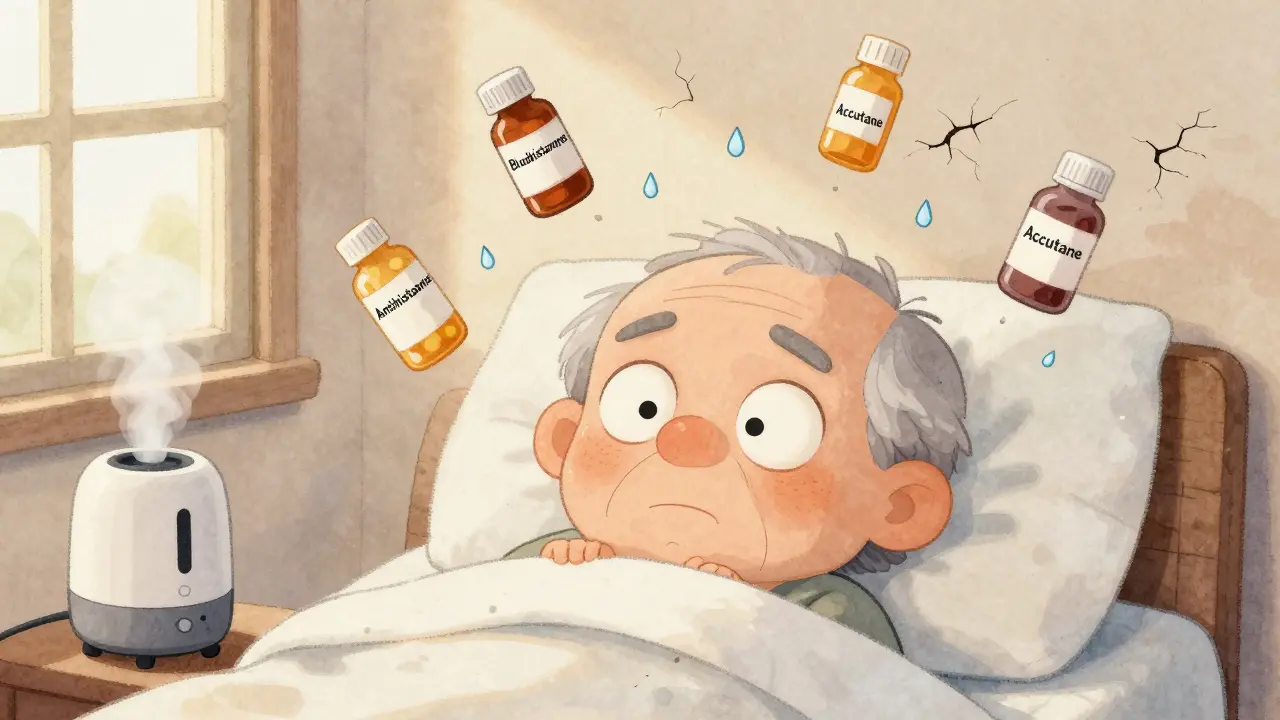
It’s not just old-school drugs like antihistamines or blood pressure pills. Even antidepressants, acne treatments, and glaucoma eye drops can wreck your tear film. The problem? These medications interfere with your body’s ability to make tears or keep them on your eye. Some block nerve signals to your tear glands. Others dry you out from the inside. Some even poison the tiny oil glands along your eyelids that keep tears from evaporating too fast.
Take isotretinoin (Accutane), for example. It’s great for clearing stubborn acne, but it shuts down your meibomian glands - the ones that make the oily layer of your tears. Without that layer, your tears evaporate in seconds. Or consider glaucoma drops with benzalkonium chloride (BAK). Up to 47% of users get burning and dryness from the preservative alone. Switch to a preservative-free version, and that drops to 16%.
What Medications Are Most Likely to Cause Dry Eyes?
Not all drugs affect your eyes the same way. Here’s what to watch for:
- Antihistamines - Benadryl, Claritin, Zyrtec: These stop allergy symptoms by drying up mucus - including your tears.
- Antidepressants - Zoloft, Prozac, amitriptyline: They mess with neurotransmitters that tell your eyes to produce tears.
- Blood pressure meds - Metoprolol, atenolol, hydrochlorothiazide, Lasix: Diuretics flush out fluid, including the moisture your eyes need.
- Glaucoma eye drops - Latanoprost, timolol, Dorzolamide: Especially those with BAK preservative. Even if they save your vision, they can damage your tear film.
- Acne treatments - Isotretinoin (Accutane): A known tear gland killer. Symptoms can last months after stopping.
- Chemotherapy drugs - Methotrexate, cisplatin: These attack fast-growing cells - including those in your tear glands.
- Newer drugs - Immune checkpoint inhibitors, DPP-4 inhibitors, EGFR inhibitors: These cancer and diabetes drugs are increasingly linked to dry eye through direct gland damage.
If you started a new medication and your eyes got worse within a few weeks, it’s not a coincidence. It’s a side effect.
Lubrication That Actually Works - No Preservatives, No Guesswork
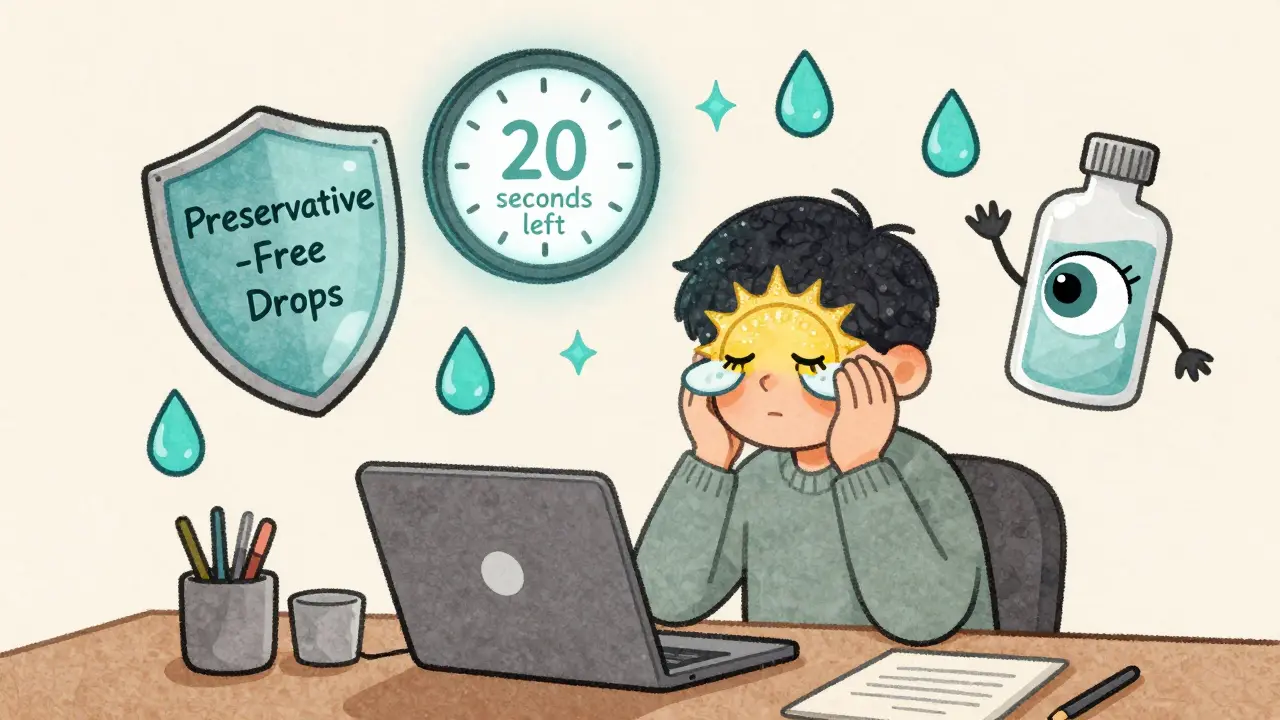
Not all eye drops are created equal. The biggest mistake people make? Using preserved artificial tears too often. Those preservatives - like BAK - are toxic to your eye surface over time. They make dry eye worse.
The fix? Preservative-free artificial tears. Use them 4 to 6 times a day. That’s not overkill - it’s necessary. Brands like Systane Ultra PF, Refresh Optive PF, and TheraTears Lubricant Eye Drops come in single-dose vials. No preservatives. No irritation. Just relief.
Here’s a pro tip if you’re on glaucoma drops: Wait 15 minutes between your prescription drop and your artificial tear. Apply the glaucoma drop first, then wait. Then use your lubricant. This keeps both from washing each other out. Clinical studies show this combo improves symptoms by 78%.
For long-term repair, prescription drops like Restasis (cyclosporine) and Xiidra (lifitegrast) work differently. Restasis slowly boosts your tear production - but it takes 3 to 6 months to see real results. Xiidra reduces inflammation in just weeks. Both are expensive - Restasis averages $550/month without insurance - but many patients get help through manufacturer coupons or patient assistance programs.
If your eyes are really bad, your doctor might suggest punctal plugs. These tiny silicone or collagen plugs block the tear ducts so your natural tears - and your artificial ones - stay on your eye longer. Temporary collagen plugs last 3-6 months and work for 70% of users. Permanent silicone ones can last years.
Lifestyle Fixes That Are Easier Than You Think
Medication changes help. Lubricants help. But your daily habits? They’re the hidden game-changers.
- Use a humidifier. Dry air in your home or office sucks moisture out of your eyes. Keeping humidity between 40-60% cuts tear evaporation by 25%. A simple tabletop humidifier by your bed or desk makes a huge difference.
- Follow the 20-20-20 rule. Every 20 minutes, look at something 20 feet away for 20 seconds. This isn’t just for screen fatigue - it’s for blinking. When you stare at screens, you blink less. Less blinking = drier eyes. This simple habit reduces digital eye strain symptoms by 35% in people on antihistamines or antidepressants.
- Take omega-3s. Fish oil or algae-based supplements with 1,000-2,000 mg of EPA and DHA daily improve tear film stability. Studies show 60% of users feel better within three months. It’s especially helpful if you’re on diuretics or isotretinoin.
- Avoid direct airflow. Don’t sit in front of a fan. Don’t point your car vent at your face. Air moving faster than 0.15 m/s over your eyes increases evaporation by 30%. Adjust your vents downward or use a shield.
- Quit smoking. Smoke doesn’t just hurt your lungs - it dries your eyes. For people on dry-eye-causing meds, smoking makes symptoms 45% worse. Quitting leads to noticeable improvement in just 2-4 weeks.
- Warm compresses + lid massage. Do this twice a day for 10-15 minutes. Heat melts the clogged oil in your eyelid glands. Gently massage your lids afterward to push the oil out. This fixes meibomian gland dysfunction in 65% of cases - especially helpful if you’re on Accutane or similar drugs.
Don’t Stop Your Meds - Talk to Your Doctors
It’s tempting to just quit the pill that’s making your eyes miserable. Don’t. Stopping blood pressure meds or antidepressants cold turkey can be dangerous. You don’t need to suffer - you need a plan.
The best move? Ask your doctor: “Is there an alternative medication with fewer eye side effects?” For example, some antidepressants like bupropion cause less dry eye than SSRIs. Some blood pressure meds like ACE inhibitors are gentler on your tear film than beta-blockers. Glaucoma drops now come in preservative-free versions - your eye doctor can switch you.
One patient on Zoloft told her optometrist her eyes felt like “sandpaper.” She switched to preservative-free tears and started warm compresses. Within two weeks, she could read for more than 20 minutes without burning. That’s not magic - that’s coordination.
Work with both your prescribing doctor and your eye specialist. They need to talk to each other. Your eye doctor can tell your primary care provider which meds are likely causing trouble. Your primary care doctor can explore alternatives without risking your health.
What If Nothing Seems to Work?
Some cases are tough. Isotretinoin can permanently damage oil glands. Chemotherapy can shut down tear production. But even then, there’s hope.
Advanced treatments like iLux thermal pulsation therapy - which uses heat and pressure to unclog blocked glands - helped one patient reduce symptoms by 80%. New FDA-approved drops like Cequa use nanomicellar tech to deliver cyclosporine more effectively. Clinical trials are testing lipid-based emulsions just for Accutane users.
And you’re not alone. Dry eye clinics are now available in 85% of major U.S. cities. They use tools like tear osmolarity tests and meibomian gland imaging to find the exact cause - not just guess.
It’s not about finding one miracle fix. It’s about stacking small wins: preservative-free drops, warm compresses, omega-3s, humidifier, no airflow, 20-20-20 rule. Do them all, and most people see real relief within 2-4 weeks. Full healing? That takes time - especially with prescription drops.
What You Can Do Right Now
- Check the list of medications you’re taking. Which ones are known to cause dry eye?
- Switch to preservative-free artificial tears. Use them 4-6 times a day.
- Start warm compresses and lid massage - twice daily.
- Buy a small humidifier. Put it near your bed or desk.
- Set a timer on your phone for the 20-20-20 rule.
- Call your eye doctor. Ask: “Could my meds be causing this? Can we switch to preservative-free options?”
- Ask your prescribing doctor: “Is there another drug with fewer eye side effects?”
You don’t have to live with burning, gritty eyes. Medications don’t have to win. With the right mix of lubrication, lifestyle tweaks, and smart doctor talks, you can get your comfort back - without giving up your health.
Paul Ong
January 1, 2026 AT 04:50Andy Heinlein
January 1, 2026 AT 07:17Ann Romine
January 2, 2026 AT 17:12Austin Mac-Anabraba
January 4, 2026 AT 03:35gerard najera
January 4, 2026 AT 13:59Stephen Gikuma
January 4, 2026 AT 22:20Bobby Collins
January 5, 2026 AT 11:04Layla Anna
January 6, 2026 AT 10:34Heather Josey
January 6, 2026 AT 14:05Donna Peplinskie
January 7, 2026 AT 12:40Olukayode Oguntulu
January 9, 2026 AT 05:17jaspreet sandhu
January 10, 2026 AT 01:10Alex Warden
January 10, 2026 AT 10:08LIZETH DE PACHECO
January 12, 2026 AT 05:35Lee M
January 12, 2026 AT 11:06