

When it comes to protecting your heart, what you eat matters more than you think. It’s not about cutting out entire food groups or chasing the latest fad. Real, lasting heart health comes from patterns of eating that have been studied for decades - and proven to work. Three of the most reliable? The Mediterranean diet, the DASH diet, and plant-forward eating. Each has its own rules, strengths, and quirks. But they all share one thing: they help your heart live longer and stronger.
What Makes a Diet Truly Heart-Healthy?
A heart-healthy diet doesn’t just lower cholesterol. It tackles the whole picture: blood pressure, inflammation, artery stiffness, and even how your heart muscle functions. The American Heart Association calls these top-tier approaches because they’re backed by solid science - not just one study, but dozens, followed by real people over years. The Mediterranean, DASH, and plant-forward diets all reduce the risk of heart attack, stroke, and early death from heart disease. They’re not quick fixes. They’re lifestyle shifts that work because they’re sustainable.
The Mediterranean Diet: Fat, Fiber, and Flavor
Imagine meals full of olive oil, grilled fish, fresh tomatoes, whole grain bread, and a glass of red wine. That’s the Mediterranean diet in a nutshell. It’s not a strict plan - it’s a way of eating rooted in the old-school habits of Greece, Italy, and Spain. The key? Olive oil as your main fat. Not butter. Not margarine. Extra-virgin olive oil. It’s packed with monounsaturated fats that help lower bad cholesterol without touching the good kind.
This diet piles on vegetables, fruits, beans, nuts, and whole grains. Fish shows up at least twice a week. Poultry is fine. Red meat? Maybe once a month. Sugar and processed foods? Almost gone. A 2023 study of over 2,000 people found that those who stuck closely to this pattern had a much lower chance of dying from heart disease over ten years. Why? It’s not just one thing. It’s the combo: fiber from plants, healthy fats from oil and fish, and antioxidants that fight inflammation. Dr. Ailin Barseghian El-Farra, a cardiologist, says this diet doesn’t just improve numbers - it cuts death rates.
And here’s the best part: people stick with it. Reddit users who tried it for over a year say it feels like a lifestyle, not a punishment. The flavors are rich. The meals are satisfying. You don’t feel deprived. That’s why it’s ranked #1 overall in diet reviews by U.S. News & World Report.
The DASH Diet: Science-Backed Blood Pressure Control
If high blood pressure is your main concern, the DASH diet was made for you. Developed by the National Institutes of Health in the 1990s, DASH stands for Dietary Approaches to Stop Hypertension. And it works. The original trial showed systolic blood pressure dropping by up to 11.4 points - without medication.
Here’s what it looks like: 6-8 servings of grains (mostly whole), 4-5 servings of veggies, 4-5 servings of fruit, 2-3 servings of low-fat dairy, and lean protein like chicken, fish, or beans. Nuts and seeds? Five servings a week. Sodium? Strictly capped at 1,500 to 2,300 mg a day. That’s less than half of what most Americans eat. The average American consumes over 3,400 mg daily. Cutting that in half is hard. But it’s doable.
One big advantage? You see results fast. A 2022 study found that 29% of hypertensive patients on DASH were able to reduce their blood pressure meds within six months. Users on Reddit say their BP dropped from 150/95 to 130/85 in just six weeks. But the trade-off? The rules are tight. Counting servings. Avoiding canned soups, deli meats, and salty snacks. It’s precise. That’s why adherence is low - only 18% of Americans follow it closely. Still, for those who stick with it, the payoff is measurable.
There’s also a smarter version: the OmniHeart variation. Replace some carbs with healthy fats (like olive oil or avocado) or with extra protein. That tweak boosted results even more. Blood pressure dropped another 4 points. And people stuck with it longer.
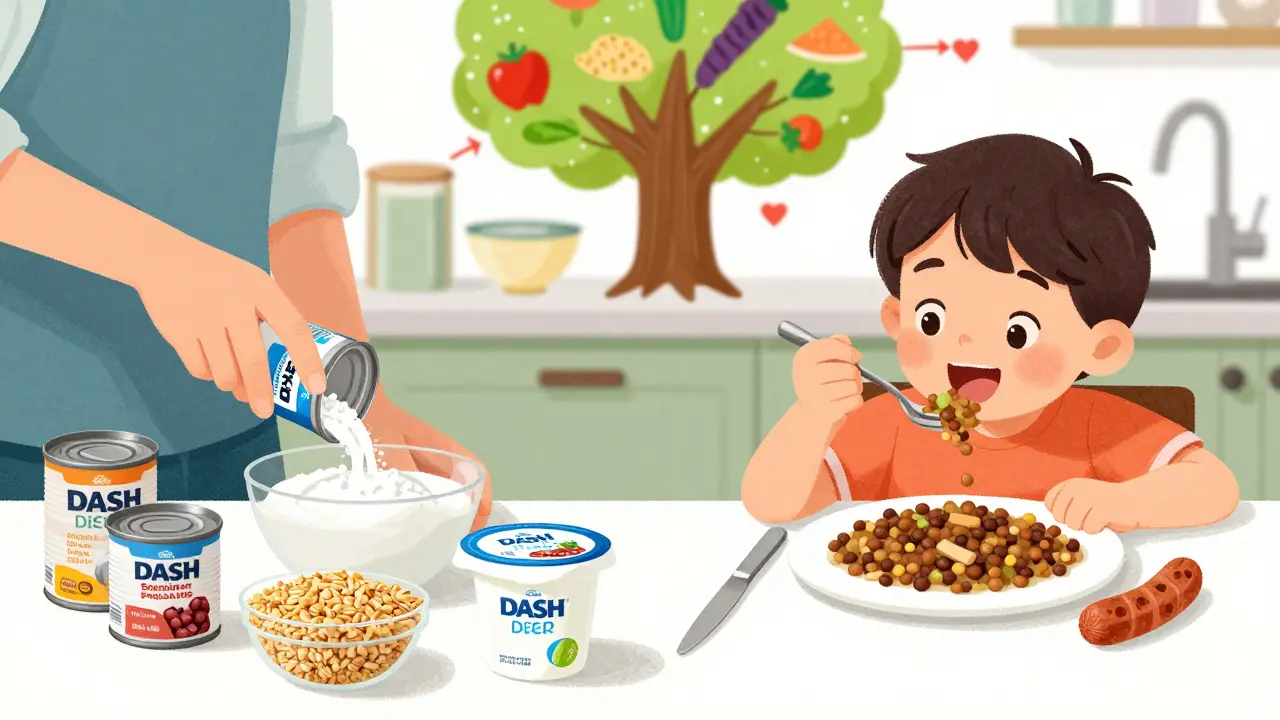
Plant-Forward Eating: Flexibility Without Sacrifice
Plant-forward doesn’t mean vegan. It means plants come first. Meat isn’t banned - it’s just not the star. Think: a big salad with grilled chicken on top. Or lentil stew with a side of sausage. The focus is on vegetables, fruits, whole grains, beans, nuts, and seeds. Animal products? They’re accents, not anchors.
This approach is the fastest-growing trend. A 2024 Nielsen survey found that 42% of Americans now eat mostly plant-based meals at least three days a week. Why? It’s flexible. You don’t have to quit bacon cold turkey. Just eat less of it. More beans. More veggies. More whole grains. Research from the PURE study showed a 23% drop in heart disease deaths among people who ate mostly plant-based proteins.
It works because it hits the same targets as the other two diets: lower saturated fat, more fiber, less processed junk. A 2023 study found that even small shifts - like swapping one meat-based meal a day for beans or tofu - improved cholesterol and blood pressure. The American Heart Association now lists plant-forward eating as a Tier 1 option, alongside Mediterranean and DASH. And it’s gaining traction because it fits real life. You can eat it at a restaurant. You can cook it at home. You can adapt it for your culture, your budget, your taste.
How Do They Compare?
| Feature | Mediterranean Diet | DASH Diet | Plant-Forward Eating |
|---|---|---|---|
| Primary Goal | Reduce overall heart disease risk and mortality | Lower high blood pressure | Improve heart health through plant-rich eating |
| Fat Source | Extra-virgin olive oil (35-40% of calories) | Low-fat dairy, lean meats, limited added fats | Olive oil, nuts, seeds, avocados |
| Sodium Limit | No strict limit (typically 2,000-3,000 mg) | 1,500-2,300 mg daily | No strict limit (but naturally lower) |
| Protein Focus | Fish, poultry, legumes; red meat rare | Lean meats, poultry, fish, low-fat dairy | Beans, lentils, tofu, nuts; animal proteins optional |
| Alcohol | 1-2 glasses red wine daily (optional) | No specific recommendation | No specific recommendation |
| Adherence Rate | High (28% of U.S. adults follow) | Low (18% follow closely) | Rising fast (42% eat mostly plant-based 3+ days/week) |
| Best For | Long-term sustainability, taste, reducing death risk | Fast blood pressure drop, medication reduction | Flexibility, cultural adaptation, cost savings |
Which One Should You Choose?
There’s no single winner. The best diet is the one you can stick with. If you love flavor and don’t want to count servings, go Mediterranean. If your blood pressure is high and you want quick results, try DASH - but start with the 2,300 mg sodium goal before cutting to 1,500. If you’re unsure, start plant-forward. Add one more veggie to your plate. Swap out one meat meal a week. See how you feel.
Here’s the twist: the smartest move might be to combine them. Researchers call it “Medi-DASH.” It’s the best of both: olive oil, fish, and veggies from the Mediterranean, with DASH’s sodium limits and dairy focus. A 12-week trial showed this combo dropped blood pressure by 12.4 points and LDL cholesterol by nearly 19 mg/dL. That’s better than either diet alone.
And now, new science is pointing to something even more powerful: personalization. Duke University’s 2024 study found that genetic testing can predict who responds better to Mediterranean vs. DASH. One person might drop blood pressure dramatically on DASH. Another might see better cholesterol results on Mediterranean. Your genes might hold the key.

Getting Started Without Overwhelm
You don’t need to overhaul your kitchen overnight. Start small:
- Swap butter for olive oil when cooking or drizzling on bread.
- Make one meatless dinner a week - try lentils, chickpeas, or black beans.
- Choose whole grain bread, pasta, and rice instead of white.
- Snack on nuts or fruit instead of chips or cookies.
- Read labels. Avoid foods with more than 200 mg of sodium per serving.
- Drink water instead of sugary drinks.
Resources are free and easy to use. The National Heart, Lung, and Blood Institute offers downloadable DASH meal plans. The Oldways Preservation Trust has Mediterranean recipe collections. The American Heart Association’s “No-Fad Diet” toolkit lets you build a plan based on your preferences. Over 80% of users said it helped them get started.
What’s Holding People Back?
Cost. Accessibility. Habit. A 2024 USDA analysis found these heart-healthy diets cost about $1.50 more per day than the average American diet. That adds up - especially for families on tight budgets. But long-term, they save money: fewer hospital visits, less medication, fewer heart attacks.
And then there’s the social side. A 2024 Veganuary survey found 78% of people struggled with dining out or family gatherings. That’s normal. You don’t have to go full vegan. Just bring your own dish. Ask for extra veggies. Choose grilled over fried. You’re not asking for a special menu - you’re asking for a better option.
And wine? The Mediterranean diet includes it. But if you don’t drink, skip it. No one needs alcohol for heart health. The real stars are the plants, the oil, the fish, and the whole grains.
Real Results, Real Life
People who stick with these diets report more energy, better sleep, and fewer cravings. A Cleveland Clinic survey found 68% of consistent followers felt more energized. That’s not magic. It’s blood sugar stability. Better circulation. Less inflammation.
And it’s not just about numbers. One man in Denver, 58, started eating like this after his cholesterol hit 240. He swapped out processed snacks for almonds. Made lentil soup instead of canned chili. Started walking after dinner. In six months, his LDL dropped 35 points. His doctor said he didn’t need statins anymore.
That’s what these diets do. They don’t promise miracles. They give you tools. Tools that have been tested, refined, and proven over time. Your heart doesn’t need perfection. It just needs consistency. And these diets? They’re built for that.
Can I combine the Mediterranean and DASH diets?
Yes, and many experts recommend it. Combining the two - called "Medi-DASH" - means eating more vegetables, whole grains, olive oil, and fish (from Mediterranean) while keeping sodium under 2,300 mg and limiting saturated fat (from DASH). A 12-week study showed this combo lowered blood pressure more than either diet alone and cut LDL cholesterol by nearly 19 mg/dL. It’s flexible, flavorful, and highly effective.
Do I have to give up meat completely?
No. None of these diets require you to go fully plant-based. The Mediterranean diet allows fish and poultry regularly and red meat rarely. DASH includes lean meats and low-fat dairy. Plant-forward means plants come first, but meat can still be part of the meal - just not the main focus. The goal is to reduce, not eliminate.
Is the DASH diet too strict for everyday life?
It can be, especially with the 1,500 mg sodium target. Most Americans eat over 3,400 mg daily. Start with 2,300 mg - that’s still half the average intake. Read labels, avoid processed foods, cook at home, and use herbs instead of salt. You don’t have to hit the lowest number right away. Progress matters more than perfection.
What if I can’t afford fresh produce?
Frozen and canned vegetables and fruits (without added salt or sugar) work just as well. Beans, oats, brown rice, and lentils are cheap, shelf-stable, and packed with fiber. You don’t need organic or exotic ingredients. Focus on whole, minimally processed foods - even if they’re on sale or in bulk. A bag of dried beans costs less than a fast-food meal.
Do these diets work for people with diabetes or kidney disease?
Yes - but adjustments may be needed. For diabetes, the high-fiber, low-sugar focus helps control blood sugar. For kidney disease, DASH’s sodium limits help, but protein and potassium intake may need monitoring. Always talk to your doctor or a registered dietitian before making major changes, especially if you have other health conditions.
Why is olive oil so important in the Mediterranean diet?
Extra-virgin olive oil is rich in monounsaturated fats and antioxidants like polyphenols. These reduce inflammation, lower LDL (bad) cholesterol, and improve artery function. Unlike seed oils or butter, it doesn’t raise blood pressure or promote plaque buildup. Use it for cooking, drizzling on salads, or dipping bread. Aim for at least 1-4 tablespoons daily.
Can I still eat cheese and yogurt?
Yes - but choose low-fat or fat-free versions. The Mediterranean and DASH diets include dairy, but limit saturated fat. Greek yogurt, cottage cheese, and small amounts of feta or mozzarella are fine. Avoid processed cheese, cream cheese, and full-fat sour cream. Two to three servings per day are typical.
How long does it take to see results?
Blood pressure can drop in as little as two weeks on DASH. Cholesterol improvements often show up in 4-8 weeks. Energy levels and reduced cravings may be felt within days. But long-term protection - like preventing heart attacks - takes years of consistent eating. Think of it like brushing your teeth: daily habits build lifelong health.
Heart disease doesn’t happen overnight. And neither does heart health. These diets aren’t about restriction - they’re about abundance. More color on your plate. More flavor in your meals. More life in your days. You don’t need to be perfect. Just consistent. And that’s something anyone can do.
Lakisha Sarbah
February 8, 2026 AT 04:39Just started swapping butter for olive oil last week and my energy’s already better. No more afternoon crashes. Small changes really do add up.
Also made lentil soup tonight - tasted better than I expected. Who knew beans could be this tasty?
Ariel Edmisten
February 9, 2026 AT 22:01Same. I did the one meatless night thing. Chickpea curry. Loved it. No drama. No deprivation. Just good food.
Ashley Hutchins
February 10, 2026 AT 05:57Why are people still eating cheese like it's 2005? Full fat dairy is just butter with extra steps. If you really care about your heart you cut it all. No exceptions. Stop pretending you're healthy while sipping your Greek yogurt like it's a spa drink.
And don't even get me started on wine - alcohol is poison no matter how fancy you make it sound
Savannah Edwards
February 12, 2026 AT 01:28Okay but let’s be real - the Mediterranean diet works because it’s not a diet. It’s a way of life that includes laughter at the table, slow meals with family, and olive oil drizzled on everything like it’s liquid gold.
My grandma from Sicily never measured anything. She just cooked with love and what was in season. We ate grilled sardines, tomatoes with basil, and bread dipped in oil. No one had heart disease. Not one person. Not even the uncle who smoked three packs a day.
Modern science just caught up to what our ancestors knew: real food, prepared with care, eaten slowly - that’s the magic. Not counting grams of sodium or tracking servings. It’s about rhythm. Connection. Joy.
And yeah, maybe the wine helps. Not because it’s ‘heart healthy’ but because it turns dinner into a moment. Not a chore.
I’ve tried DASH. I followed the spreadsheet. I cried over low-sodium broth. I missed flavor. I missed life.
Plant-forward? I get it. But if you’re not enjoying your food, you won’t stick with it. And if you don’t stick with it, the heart doesn’t care how ‘right’ you were on paper.
AMIT JINDAL
February 13, 2026 AT 20:04Lmao I live in Mumbai and we’ve been doing plant-forward for centuries. Roti, dal, sabzi, chutney - no meat needed. Why are Americans only now ‘discovering’ this? 🤦♂️
Also, olive oil? We use mustard oil. It’s cheaper, tastier, and has more omega-3s. Stop acting like Europe invented healthy eating 😂
And don’t get me started on ‘low-fat dairy’ - whole milk yogurt with cardamom is my daily ritual. My BP is perfect. My cholesterol? Low. My doctor? Proud.
Niel Amstrong Stein
February 14, 2026 AT 05:55Real talk - I didn’t change my diet. I changed my mindset.
Instead of ‘what can’t I eat’ I started asking ‘what can I add?’
Added spinach to my smoothie. Added walnuts to my oatmeal. Added a walk after dinner.
Didn’t feel deprived. Felt like I was upgrading my life.
And yeah, I still eat bacon sometimes. But now it’s a treat. Not a habit.
Heart health isn’t about perfection. It’s about paying attention.
❤️
Joey Gianvincenzi
February 15, 2026 AT 15:10While I appreciate the sentiment of this article, it is fundamentally flawed in its omission of the systemic socioeconomic barriers that prevent equitable access to these dietary paradigms. The assumption that individuals possess the leisure, financial resources, and nutritional literacy to implement such protocols is not only naïve but ethically irresponsible. One cannot ‘just swap butter for olive oil’ when the nearest grocery store is 40 miles away and the local food desert offers only processed carbohydrates and high-fructose corn syrup. This is not a personal failure - it is a public health crisis. The American Heart Association must shift its messaging from individual compliance to structural reform.
Amit Jain
February 16, 2026 AT 17:08Oh here we go again with the ‘plant-forward’ nonsense. You know what actually lowers heart disease? Not smoking. Not sitting on your ass. Not eating kale. Exercise. Move your body. That’s it.
People think if they eat a quinoa salad they can binge on Netflix and eat pizza on weekends and call themselves ‘healthy.’
WRONG.
My uncle ate bacon every day, smoked, drank whiskey, and ran marathons. He’s 82 and still hikes. You think his heart cares about your olive oil?
Stop overcomplicating it. Move. Stop lying to yourself.
Ritu Singh
February 17, 2026 AT 04:06As someone raised in a traditional Indian household where meals centered around legumes, seasonal vegetables, and minimal oil, I find this discussion both validating and concerning.
Validating because our ancestral diets align with the Mediterranean and plant-forward models - yet concerning because Western discourse treats this as a ‘new trend’ rather than a long-standing wisdom.
Our elders didn’t need NIH studies to know that dal and brown rice were medicine. They knew because they lived it.
Today, in urban India, we’re losing this. Children eat nuggets and soda. Grandparents are diagnosed with hypertension. We’ve imported the worst of Western diets and discarded the best of our own.
It’s not about copying a diet. It’s about reclaiming cultural food sovereignty.
And yes - we used mustard oil, turmeric, and ghee. Not olive oil. But the principle? Same. Whole foods. Mindful preparation. Community eating.
Let’s stop acting like science ‘discovered’ this. Let’s honor the knowledge that already existed.
Catherine Wybourne
February 18, 2026 AT 21:01So… you’re telling me that eating like my Italian nonna - who lived to 98, never took a pill, and still made pasta from scratch - was just ‘lucky’?
And now we have to pay $12 for a bottle of ‘extra virgin’ oil because science says it’s ‘optimal’?
She used whatever oil was cheapest and added a splash of wine if she felt like it.
She didn’t have a spreadsheet. She had love.
Maybe the real secret isn’t in the food…
It’s in the way we eat it.
Just saying. 😘
Eric Knobelspiesse
February 20, 2026 AT 08:24Okay but what if your body just doesn’t respond to any of this? I tried everything. Mediterranean, DASH, plant-forward - I even did a 30-day vegan challenge. My LDL went up. My BP stayed the same. My doctor said ‘maybe it’s genetics.’
So now I eat what I want. And I run 5 miles a day.
Maybe the real issue isn’t diet. Maybe it’s that we’ve turned food into a moral test.
And now we’re all just stressed out about our avocado toast.
Stress kills hearts faster than saturated fat.
Just saying.
Niel Amstrong Stein
February 22, 2026 AT 08:16Bro I read your comment about exercise and I’m nodding. But here’s the thing - people who move don’t usually need to be told to eat better. They just do.
It’s the ones sitting on the couch scrolling TikTok while eating chips who need the food advice.
And they’re not gonna start running. But they might try swapping chips for nuts.
Small wins matter.
Also - your uncle sounds awesome. 👊