
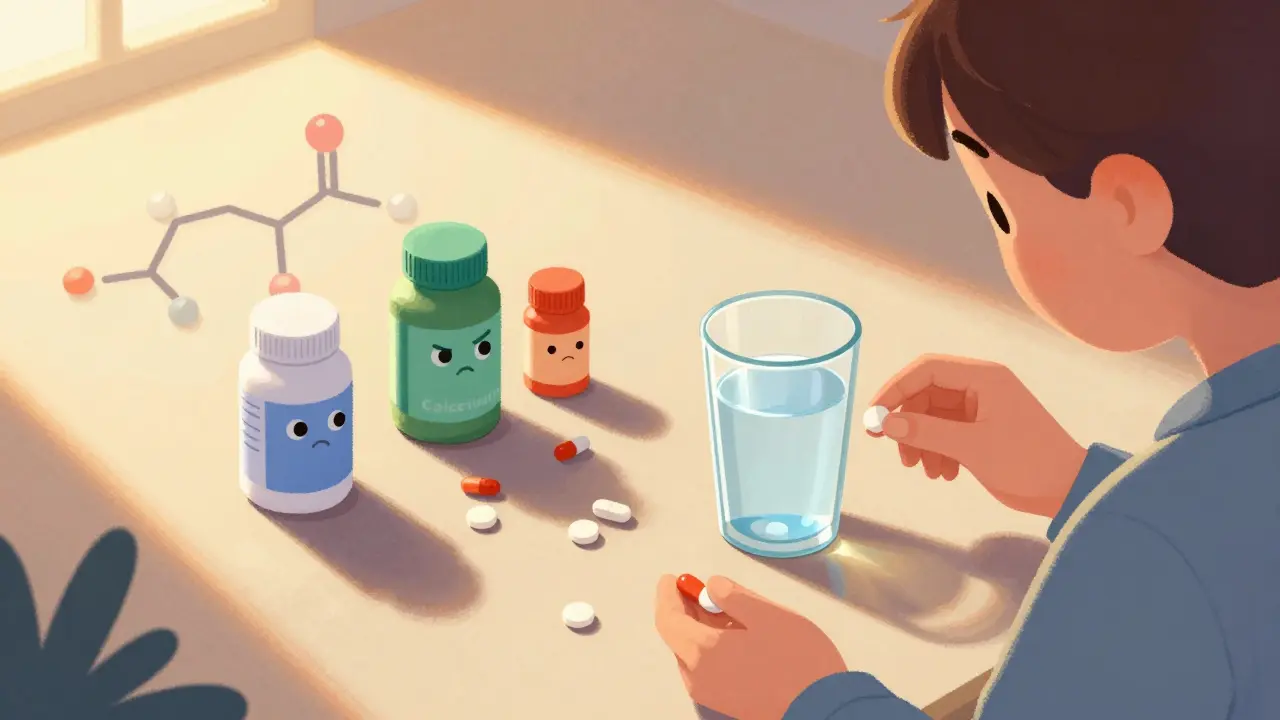
When you’re taking levothyroxine for hypothyroidism, your body depends on consistent, predictable absorption of the medication to keep your thyroid hormone levels stable. But what you eat, drink, or take as a supplement can quietly sabotage that balance - especially if you’re also taking calcium or iron. These two common supplements don’t just pass through your system unnoticed. They actively bind to your thyroid medication in your gut, turning it into an insoluble lump your body can’t absorb. The result? Your TSH levels creep up, your symptoms return, and your doctor might think you need a higher dose - when all you really need is better timing.
Why Calcium and Iron Mess With Thyroid Medicine
Levothyroxine, the synthetic version of the thyroid hormone T4, is absorbed in the upper part of your small intestine. But calcium and iron are minerals that carry a positive charge. When they meet levothyroxine in your stomach or intestines, they form tight chemical bonds - like two magnets snapping together. This creates a complex that your body can’t break down or absorb. Think of it like mixing milk with vinegar: the protein curdles and becomes useless. Same thing here. The medication is still there, but your body can’t use it.
Studies show the drop in absorption is real and measurable. A 2000 study in the Journal of Clinical Endocrinology & Metabolism found that when 1,200 mg of calcium carbonate was taken at the same time as levothyroxine, absorption dropped by 22% to 36%. Another study in 2008 showed that just 325 mg of ferrous sulfate (a common iron supplement) cut absorption by 21%. These aren’t small numbers. They’re enough to push your TSH into the hypothyroid range - meaning you’ll start feeling tired, cold, and sluggish again, even if you’re taking your pill every day.
What the Guidelines Actually Say
The American Thyroid Association, the American Association of Clinical Endocrinologists, and the Mayo Clinic all agree: calcium and iron must be separated from levothyroxine by several hours. But there’s no single rule - and that’s where confusion sets in.
- Calcium supplements: Most experts recommend waiting at least four hours after taking levothyroxine before taking calcium. The Mayo Clinic’s 2023 guidelines are clear on this. Even the European Thyroid Association, which is slightly more lenient, says two to three hours is the minimum.
- Iron supplements: The data here is a little less uniform. The American Association of Clinical Endocrinologists says two hours is enough. Others, like Thyroid UK, recommend four hours. The reason? Iron is even more aggressive at binding to levothyroxine. One case report in the Journal of Thyroid Research showed a woman needed a 50% dose increase because her iron supplement was blocking absorption - even though she took it three hours after her thyroid pill.
Here’s the catch: if you take calcium or iron in the morning right after your thyroid pill, you’re not just interfering with one dose. You’re throwing off your whole day. Your body needs consistent hormone levels. Even a 20% drop in absorption can cause your TSH to rise over time, leading to unnecessary lab tests, dose changes, and frustration.
It’s Not Just Pills - Fortified Foods Count Too
Many people don’t realize that calcium isn’t just in pills. It’s in orange juice, almond milk, soy milk, and even some cereals. An 8-ounce glass of calcium-fortified orange juice contains about 350 mg of calcium - nearly a third of the daily recommended intake. If you drink that with your levothyroxine, you’re already risking reduced absorption.
Same goes for iron. Iron-fortified breakfast cereals, energy bars, and even some baby formulas can contain enough iron to interfere. One 2023 patient survey found that 61% of people taking levothyroxine didn’t realize fortified foods could be a problem. If you take your thyroid pill at 6 a.m. and have cereal at 7 a.m., you’re still in danger.

Who’s at Highest Risk?
Not everyone has the same level of risk. Three groups are especially vulnerable:
- Pregnant women: Iron needs jump during pregnancy. Many start supplements without realizing how they affect thyroid meds. A case study in Thyroid showed a pregnant woman with TSH at 8.2 mU/L - well above normal - even though she took iron six hours after her thyroid pill.
- Postmenopausal women: Bone health often leads to calcium supplementation. But if they’re also on thyroid medication, the timing conflict is unavoidable unless they restructure their routine.
- Women with heavy periods or anemia: Iron deficiency is common. But if they’re taking iron without spacing it from their thyroid pill, they’re essentially undoing their treatment.
And it’s not just women. Men over 65 who take calcium for bone density or iron for low hemoglobin are also at risk. The interaction doesn’t care about gender - it only cares about timing.
What About Other Supplements and Foods?
Calcium and iron aren’t the only troublemakers. Soy products, walnuts, coffee, grapefruit juice, fiber-rich meals, and even biotin can all interfere - though in different ways.
- Soy: A 2018 study showed soy can reduce levothyroxine absorption by 18-30%. That’s why many doctors advise avoiding soy milk or tofu within a few hours of taking your pill.
- Walnuts: One study found eating walnuts with your thyroid medication cut absorption by 24%.
- Coffee and tea: Tannins in coffee and black tea can block absorption. Wait at least 60 minutes after taking your pill before drinking either.
- Biotin: This popular supplement for hair and nails can mess with lab tests. At doses over 5 mg/day, it can make your TSH look falsely low - leading doctors to think you’re overmedicated when you’re not.
- High-fiber foods: More than 30 grams of fiber within one hour of taking levothyroxine can raise TSH by 15-25%.
The pattern? Anything that changes the chemistry in your gut - especially minerals, proteins, or compounds that bind to drugs - is a potential problem.
How to Actually Get This Right
Here’s what works in real life, based on patient experiences and clinical data:
- Take levothyroxine on an empty stomach with a full glass of water, first thing in the morning. Wait at least 30-60 minutes before eating or drinking anything else.
- Take calcium supplements at bedtime, at least four hours after your thyroid pill. If you take it with dinner, wait until after 10 p.m. to take calcium.
- Take iron supplements at least four hours after your thyroid pill. For many, this means taking iron at lunchtime or early afternoon - never with breakfast.
- Check labels. If your orange juice says “calcium-fortified,” skip it until after your four-hour window. Same with cereals, protein bars, and plant-based milks.
- Use a pill organizer with separate compartments for thyroid meds, calcium, and iron. Label them clearly. Set phone alarms for each dose.
One Reddit user, u/HypoMama, shared how switching her thyroid pill from morning to bedtime solved her problems. She took iron at breakfast and levothyroxine at 11 p.m. - no more TSH spikes. It’s not ideal for everyone, but it worked. And if you’re on multiple medications, talk to your pharmacist. They can help you map out a safe schedule.

What If You’ve Already Been Taking Them Together?
If you’ve been taking calcium or iron with your thyroid pill for months - don’t panic. But do act.
- Get your TSH and free T4 tested. A rise in TSH above 5 mU/L is a red flag.
- Stop taking calcium or iron for at least six weeks. Then retest. If your levels improve, the interaction was the cause.
- Reintroduce the supplement with proper spacing. Retest after four weeks.
A 2022 study found that 4.4% of patients taking calcium with levothyroxine developed TSH levels above 5 mU/L within a year. That’s over 600,000 people in the U.S. alone - all potentially misdiagnosed because their labs were skewed by a simple timing error.
The Future: Better Formulations?
There’s hope on the horizon. New liquid and enteric-coated forms of levothyroxine are being tested to bypass the stomach entirely. One liquid formulation showed only an 8% drop in absorption when taken with calcium - compared to 32% for standard tablets. But here’s the catch: these new versions cost about $350 a month. Generic levothyroxine? Around $15. For now, timing is still your best tool.
Bottom Line
You don’t need to stop calcium or iron. You just need to space them out. Your thyroid medication works best when it’s alone - no minerals, no soy, no coffee, no fiber bombs. If you’re taking levothyroxine, treat it like insulin: precise, consistent, and protected from interference. The science is clear. The guidelines are solid. The solution is simple: time your pills right. Your body will thank you.
Can I take calcium and iron together with my thyroid medication if I space them apart?
No. Even if you take calcium and iron separately from your thyroid pill, you still need to space them from each other. Taking iron and calcium together can reduce iron absorption, and both can still interfere with levothyroxine if taken too close. The safest approach is to take thyroid medication first, then wait four hours before taking either supplement - and if you’re taking both calcium and iron, space them at least two hours apart from each other.
What if I forget and take my calcium with my thyroid pill?
One mistake won’t ruin your treatment, but it can cause a small dip in absorption. Don’t double your next dose. Instead, just go back to your regular schedule. If this happens often, adjust your routine - move your calcium to bedtime or switch to a different time of day. Consistency matters more than perfection.
Can I take my thyroid medication at night instead of in the morning?
Yes - and for many people, it’s actually better. Taking levothyroxine at bedtime, at least three to four hours after your last meal, improves absorption and makes it easier to avoid interactions with food, supplements, and coffee. Studies show nighttime dosing is just as effective as morning dosing. Talk to your doctor about switching if morning timing is too hard.
Do all forms of calcium interfere the same way?
Calcium carbonate - the most common form in supplements - is the biggest offender because it’s highly alkaline and binds tightly to levothyroxine. Calcium citrate is less likely to interfere, but it still can. The safest approach is to assume all calcium supplements interfere and space them at least four hours apart. Don’t rely on “gentler” forms unless your doctor confirms it’s safe.
Should I stop taking iron if I have hypothyroidism?
No. Iron is essential, especially if you’re anemic. But you must take it at the right time. Take iron at least four hours after your thyroid pill - ideally at lunch or early afternoon. If you’re taking iron for postpartum anemia or heavy periods, work with your doctor to schedule it safely. The goal isn’t to avoid iron - it’s to avoid the interaction.