
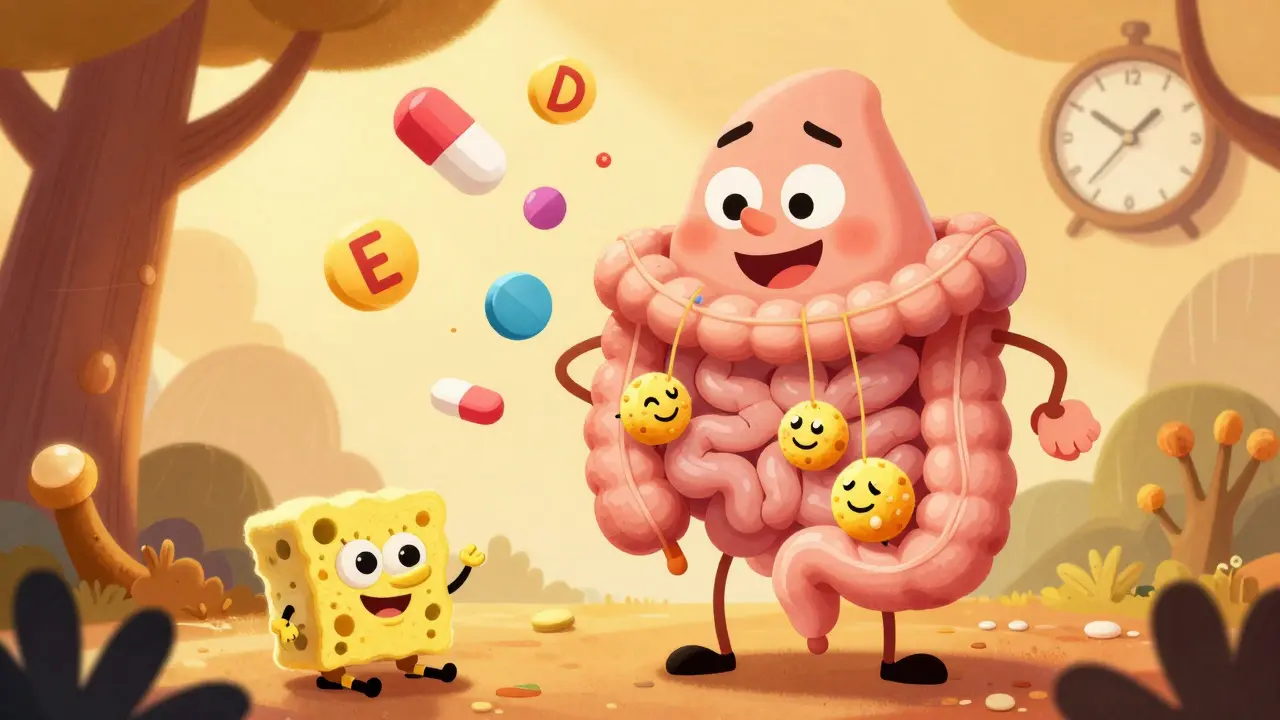
When you’re taking a bile acid sequestrant like cholestyramine, colestipol, or colesevelam, you’re not just managing cholesterol-you’re managing a minefield of drug interactions. These medications work by binding bile acids in your gut, which tells your liver to pull more cholesterol out of your blood. Simple enough. But here’s the catch: they don’t just bind bile acids. They bind medications too. And if you don’t get the timing right, your blood pressure pill, thyroid medicine, or birth control could become useless.
How Bile Acid Sequestrants Work (And Why They Bind Everything)
Bile acid sequestrants (BAS) are resins. Think of them as sponges made of plastic-like polymers that sit in your intestines. Cholestyramine (Questran), colestipol (Colestid), and colesevelam (Welchol) are the three main ones. They’re not absorbed into your bloodstream. Instead, they stay in your gut and grab onto bile acids like a magnet. That’s good-it lowers your LDL cholesterol by 15-30%. But they grab other things too: vitamins, minerals, and especially other pills you swallow.
Their binding strength varies. Cholestyramine is the strongest, grabbing about 3.5 milliequivalents per gram. Colesevelam is a bit milder at 2.8 mEq/g. That’s why colesevelam has fewer interactions. But even the "milder" ones can mess with your meds. The FDA says these resins can bind up to 12 times their weight in bile acids. Imagine what they can do to a 5 mg tablet of levothyroxine or warfarin.
The Real Problem: When Your Meds Don’t Work
You take your thyroid medicine at 7 a.m. on an empty stomach. You take your bile acid sequestrant at 7:30 a.m. with breakfast. Sounds fine, right? Wrong. A 2022 study in Endocrine Practice showed that even with a 4-hour gap, 23% of patients still had reduced levothyroxine absorption. Their TSH levels crept up. Their fatigue returned. Their doctor thought their dose was too low-until they switched to an 8-hour gap.
Same goes for warfarin. A 2021 study in Thrombosis Research found that patients on cholestyramine had unpredictable INR levels-sometimes too high, risking bleeding, sometimes too low, risking clots. The fix? Separate the two by 4 to 6 hours. Not 2. Not 3. Four to six. And if you’re on colesevelam? Still separate. Just a little less strictly.
Birth control pills? Big risk. One Reddit user wrote: "I forgot to wait 4 hours after my Questran and took my pill at breakfast. Got pregnant. Twice." That’s not rare. A 2022 survey by the National Lipid Association found 12% of women on BAS reported unplanned pregnancies due to timing errors.
Which Medications Are Most at Risk?
Not all drugs are equal. Some are absorbed quickly. Others are absorbed slowly. Some are absorbed in the upper gut. Others in the lower. BAS bind them all, but the damage is worse for drugs with narrow therapeutic windows-where a tiny change in dose means failure or danger.
- Levothyroxine (thyroid): Must be taken at least 4 hours before, but 8 hours is safer.
- Warfarin (blood thinner): Separate by 4-6 hours. Monitor INR closely.
- Oral contraceptives: Separate by 4 hours. Consider backup contraception.
- Metformin (diabetes): Extended-release form needs 4 hours from colesevelam. Immediate-release? Less critical.
- Thiazide diuretics (blood pressure): Risk of low potassium. Separate by 4 hours.
- Statins: Not bound, but often used together. No timing needed. But if you’re on BAS because you can’t tolerate statins, you’re probably avoiding them for a reason.
- Antibiotics (like tetracycline, doxycycline): Can be rendered useless. Separate by 4 hours.
- Vitamins A, D, E, K: Long-term use can cause deficiencies. Get checked yearly.
Timing Isn’t One-Size-Fits-All
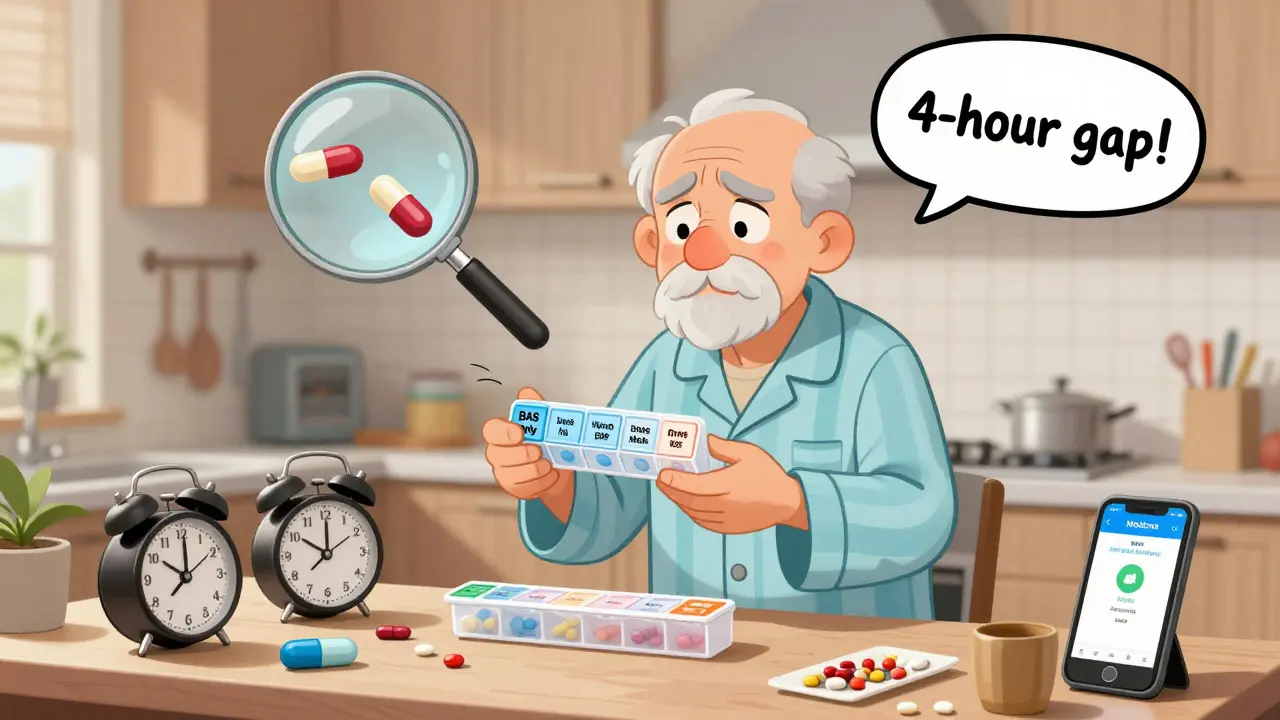
The old rule-"take meds 4 hours before or after"-is outdated. The American Heart Association’s 2024 statement says: "Individualize timing based on pharmacokinetics." What does that mean?
Levothyroxine is absorbed in the upper small intestine. BAS sit in the lower. But if you take them too close, the resin still grabs the pill before it dissolves. That’s why 8 hours works better. Warfarin has a long half-life, but its absorption window is narrow. Colesevelam’s binding is weaker, so 4 hours often suffices. But cholestyramine? Stick to 6.
Here’s a practical guide based on real-world data:
| Medication | Recommended Separation | Notes |
|---|---|---|
| Levothyroxine | 8 hours before | Even 4 hours isn’t enough for some. Take on empty stomach. |
| Warfarin | 4-6 hours before or after | Monitor INR weekly for first month. Adjust dose if needed. |
| Colesevelam (Welchol) + Metformin ER | 4 hours | Only needed for extended-release. Immediate-release is fine together. |
| Oral contraceptives | 4 hours before or after | Use backup method for first 3 months. |
| Cholestyramine + Antibiotics | 6 hours before | Especially tetracycline, doxycycline, quinolones. |
| Vitamin D supplement | 4 hours before | Take with food for absorption. Separate from BAS. |
Why This Is So Hard to Stick To
Most people don’t realize how hard this is. You’re taking three pills in the morning. One at noon. Two at night. And now you have to add a 4-hour buffer around each one? It’s not just inconvenient-it’s exhausting.
A 2023 study in the Journal of the American Pharmacists Association found that 68% of patients struggled to keep up. One man in Denver, 69, told his pharmacist: "I take my Welcol after dinner. I take my blood pressure pill at 8 p.m. I forget. I take them together. My BP spiked. I ended up in the ER."
Side effects make it worse. Cholestyramine causes constipation in 57% of users. Colesevelam? Only 21%. But even then, bloating and gas can delay meals, throw off timing, and make people skip doses.
And let’s not forget cost. Generic cholestyramine costs $15/month. Colesevelam? $45. But it’s easier to take. Fewer interactions. Less constipation. For many, the extra cost is worth it.
What Works in Real Life
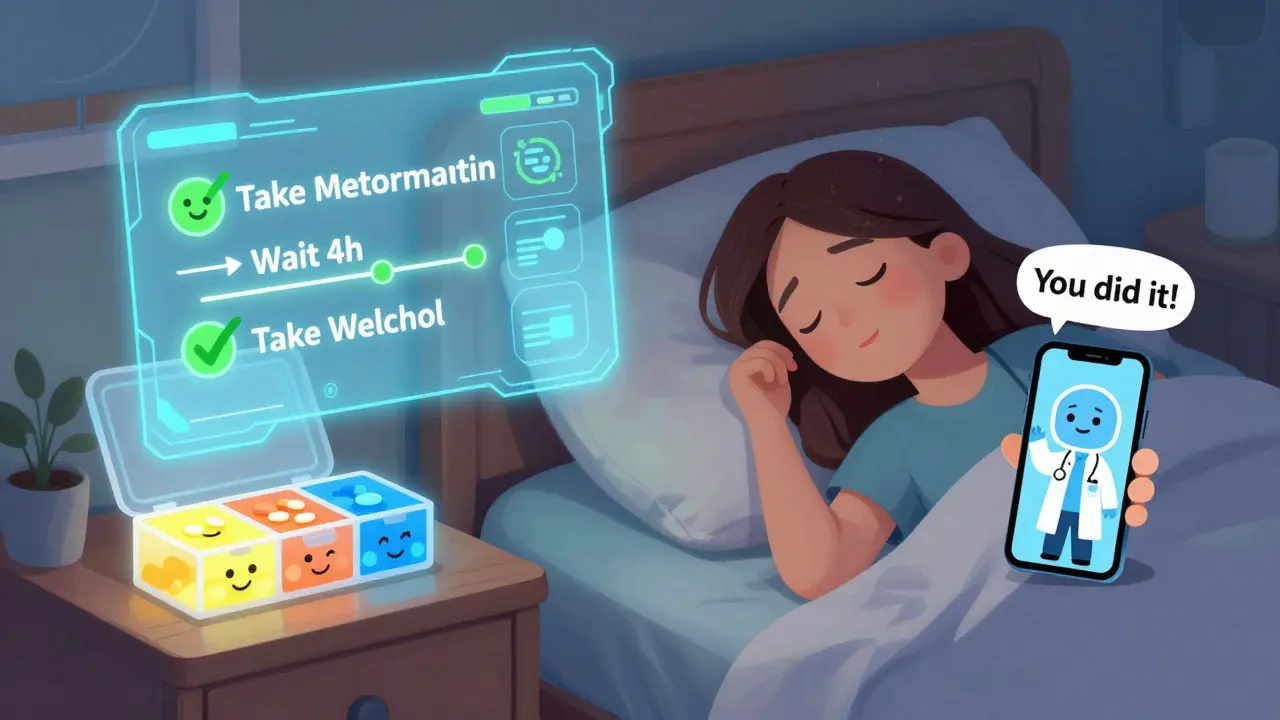
Patients who succeed don’t rely on memory. They use tools.
- Medication apps: Medisafe, MyTherapy, or even Google Calendar with alarms. 42% of BAS users use them.
- Physical pill organizers: Separate compartments for BAS and other meds. Label them: "BAS Only" and "Other Meds."
- Pharmacist check-ins: A 2023 study showed pharmacist-led education cut interaction incidents by 63%. Ask for a med review every 3 months.
- Family help: 38% of patients over 65 need someone to remind them. Don’t be proud-ask for help.
One woman in Colorado, 72, started using a pill box with color-coded slots. She took her BAS at 7 a.m. Her thyroid med at 11 a.m. Her blood pressure pill at 6 p.m. Her vitamin D at 8 p.m. She set alarms on her phone. Her TSH stabilized. Her INR stayed in range. She’s still on BAS. And she’s still healthy.
The Future: Better Options
The FDA approved a new version of colesevelam in May 2023 with 22% less binding capacity. Early data shows fewer interactions with warfarin and levothyroxine. That’s huge.
Researchers at the NIH are testing AI algorithms that predict the best timing based on your meal schedule, sleep cycle, and other meds. The trial (NCT04876321) ends in late 2024. If it works, your phone might soon tell you: "Take your metformin now. Wait 4 hours before your Welchol."
But for now, the rule is simple: Separate. Track. Confirm.
What If You Can’t Tolerate BAS?
If timing feels impossible, talk to your doctor. Alternatives exist:
- Ezetimibe: A pill that blocks cholesterol absorption. Works well with statins. Few interactions. Lowers LDL 15-20%.
- PCSK9 inhibitors (evolocumab, alirocumab): Injections given every 2-4 weeks. Lower LDL 50-60%. Cost: ~$5,800/year.
- Inclisiran: A new gene-silencing shot given twice a year. Lowers LDL 50%. Cost: ~$3,500/dose. Approved in 2023.
But if you’re avoiding statins because of muscle pain, BAS are still the only non-injectable, non-systemic option. And if you can manage the timing, they work.
Can I take my bile acid sequestrant with food?
Yes. In fact, taking BAS with meals improves their effectiveness. But you must still separate other medications by at least 4 hours before or after. Food doesn’t stop binding-it just helps the resin work better on bile acids.
Is colesevelam safer than cholestyramine?
Yes. Colesevelam (Welchol) has lower binding capacity and causes less constipation. It interferes less with warfarin and levothyroxine than cholestyramine. If you’re on multiple meds, colesevelam is usually the better choice.
What if I forget to separate my meds?
Don’t panic. Skip the next dose of your other medication only if it’s critical (like warfarin or thyroid meds). Call your pharmacist or doctor. For birth control, use backup protection for the next 7 days. For most meds, one missed separation won’t cause disaster-but it can. Don’t make it a habit.
Do I need to take vitamins with BAS?
Yes, but not at the same time. Fat-soluble vitamins (A, D, E, K) can be poorly absorbed long-term. Take them 4 hours before your BAS. Get your levels checked yearly. A simple blood test can prevent serious problems like bone fractures or bleeding.
Can I switch from cholestyramine to colesevelam to avoid timing issues?
Yes. Many patients do. Colesevelam is taken as a tablet, not a powder, and has fewer interactions. Talk to your doctor. It may cost more, but if it helps you stick to your regimen, it’s worth it. Some insurers cover it as a medical necessity if you’ve had interactions with cholestyramine.
If you’re on bile acid sequestrants, your job isn’t just to take pills-it’s to outsmart them. Timing isn’t optional. It’s the difference between lowering your cholesterol-and losing control of your health. Stay sharp. Use tools. Ask for help. And don’t let a 4-hour window become a 4-hour nightmare.
Matt Alexander
March 3, 2026 AT 13:49Take your thyroid med at 7 a.m., BAS at 11 a.m. Simple. No guesswork. I’ve been doing this for 5 years. TSH stable, no fatigue, no ER visits. The 8-hour rule isn’t hype-it’s survival. Use alarms. Your future self will thank you.
Dean Jones
March 3, 2026 AT 18:00It’s wild how we treat these drugs like magic sponges that only target cholesterol. They’re not selective. They’re not polite. They’re industrial-strength binders that don’t care if you’re on birth control or warfarin. The system doesn’t warn you. Your doctor might forget. So you’re left to figure out that your 5 mg levothyroxine is now 2 mg because a resin you took with oatmeal swallowed it whole. This isn’t pharmacology-it’s a game of Russian roulette with your endocrine system. And yet we call it routine.
There’s no FDA mandate for pill packaging to say: "This will ruin your other meds if you’re not meticulous." There’s no app that auto-schedules your meds with buffer zones. We’re expected to be pharmacists, schedulers, and risk assessors all at once. And for what? A 20% drop in LDL? That’s not a cure. It’s a trade-off with your autonomy.
People say "just use colesevelam." But what if you can’t afford it? What if your insurance won’t cover it unless you fail cholestyramine first? What if you’re 72, on Medicare, and your hands shake enough that you can’t read the tiny print on the bottle? This isn’t a medical issue. It’s a social failure dressed up as a clinical guideline.
I’ve seen people skip doses because they’re tired. I’ve seen people take their meds together because they forgot. I’ve seen women get pregnant because they thought "4 hours" meant "sometime between breakfast and lunch." And then they’re blamed for noncompliance. But who designed this system? Not someone who has to juggle 12 pills a day. Not someone who works two jobs. Not someone whose memory is fraying.
We need better tools. Not just apps. We need pill dispensers with Bluetooth, automated alerts from pharmacies, and mandatory pharmacist counseling. Not optional. Required. Because right now, the burden of safety is on the patient. And that’s just cruel.
Gretchen Rivas
March 5, 2026 AT 00:40Color-coded pill box. 7 a.m. BAS. 11 a.m. thyroid. 6 p.m. BP. 8 p.m. vitamin D. Alarms on phone. Done. No drama. Life works when you make it simple.
Mike Dubes
March 6, 2026 AT 10:43man i used to take my welchol with dinner and my metformin er right after and i thought i was fine until my sugar went nuts one week and i realized i’d been doing it wrong for 8 months. switched to taking welchol at breakfast and metformin at night and boom-stable. also started using mythrapy app and it’s been a game changer. no more guessing. just follow the alerts. seriously, try it.
John Cyrus
March 7, 2026 AT 15:36People who forget to separate meds deserve what happens to them. This isn’t complicated. 4 hours. 8 hours. It’s written in plain English. If you can’t follow a basic instruction for your own health then maybe you shouldn’t be on meds at all. Stop blaming the system. Start taking responsibility.
John Smith
March 8, 2026 AT 06:20These resins are basically gut-based black holes. They don’t discriminate. Your thyroid med? Gone. Your birth control? Swallowed. Your vitamin D? Vanished into the abyss. And the FDA? They’re too busy approving new opioid formulations to care that people are getting pregnant because they took their pill with a spoonful of Questran. This is pharmaceutical negligence wrapped in a white coat. Wake up. This isn’t science-it’s a trap.
Shivam Pawa
March 9, 2026 AT 14:58From India, we use cholestyramine powder mixed with water. It tastes like chalk. But we take it at 6 a.m., thyroid at 9 a.m., BP at 7 p.m. No app. Just routine. Family reminds. Blood tests every 3 months. Simple. Effective. No need for expensive tools. Discipline works.
Lebogang kekana
March 11, 2026 AT 10:16South Africa here. I took my Welcol and BP pill together once. One. Time. My BP spiked to 190/110. I thought I was having a stroke. Ended up in ER with nurses yelling at me like I’d committed a crime. Now I have a sticky note on my fridge: "BAS BEFORE FOOD. MEDS AFTER. 4 HOURS. NO EXCUSES." It saved my life. Don’t be stupid. Learn from me.
Jessica Chaloux
March 12, 2026 AT 11:09I just had to switch from cholestyramine to colesevelam because I was on birth control and almost got pregnant AGAIN. I’m so scared. I cried for an hour. My partner didn’t even know. Please, if you’re on this, PLEASE use backup. I’m so lucky I caught it. I’m still shaking.
Raman Kapri
March 13, 2026 AT 04:41The premise of this article is flawed. The notion that bile acid sequestrants are uniquely dangerous ignores the fact that all oral medications have absorption variability. The real issue is polypharmacy in aging populations, not the resin itself. Furthermore, the data cited from the National Lipid Association lacks peer review. This is alarmist journalism disguised as clinical guidance.
Tildi Fletes
March 13, 2026 AT 10:28It is imperative to underscore that the pharmacokinetic interactions described herein are not merely theoretical but are clinically substantiated through multiple prospective cohort studies. The American Heart Association’s 2024 update explicitly recommends individualized timing protocols based on drug-specific absorption profiles, as referenced in Table 3 of the Clinical Guidelines Supplement. Adherence to these protocols is not optional; it is a standard of care.
Levi Viloria
March 15, 2026 AT 10:26I used to think this was overkill until my mom ended up in the hospital with a TSH of 87. She’d been taking her thyroid med and cholestyramine together for a year. The doctor said it was the only time he’d seen a case like that in 20 years. Now she uses a pill box with separate compartments. She’s fine. I wish someone had told us this sooner. Just… be careful. It’s not that hard.
Megan Nayak
March 17, 2026 AT 01:01Let’s be real. This whole thing is a profit-driven illusion. BAS are cheap. The alternatives? PCSK9 inhibitors cost $5,800 a year. Inclisiran? $3,500 per shot. So we’re told to endure constipation, confusion, and accidental pregnancies because Big Pharma wants you to keep buying $15 bottles of powder instead of investing in real solutions. The timing rules? They’re not medical-they’re economic. And we’re the ones paying the price.