
Antihistamine Driving Safety Checker
Select your antihistamine to check if it's safe to drive after taking it.
Why Your Allergy Medicine Could Be Putting You at Risk Behind the Wheel
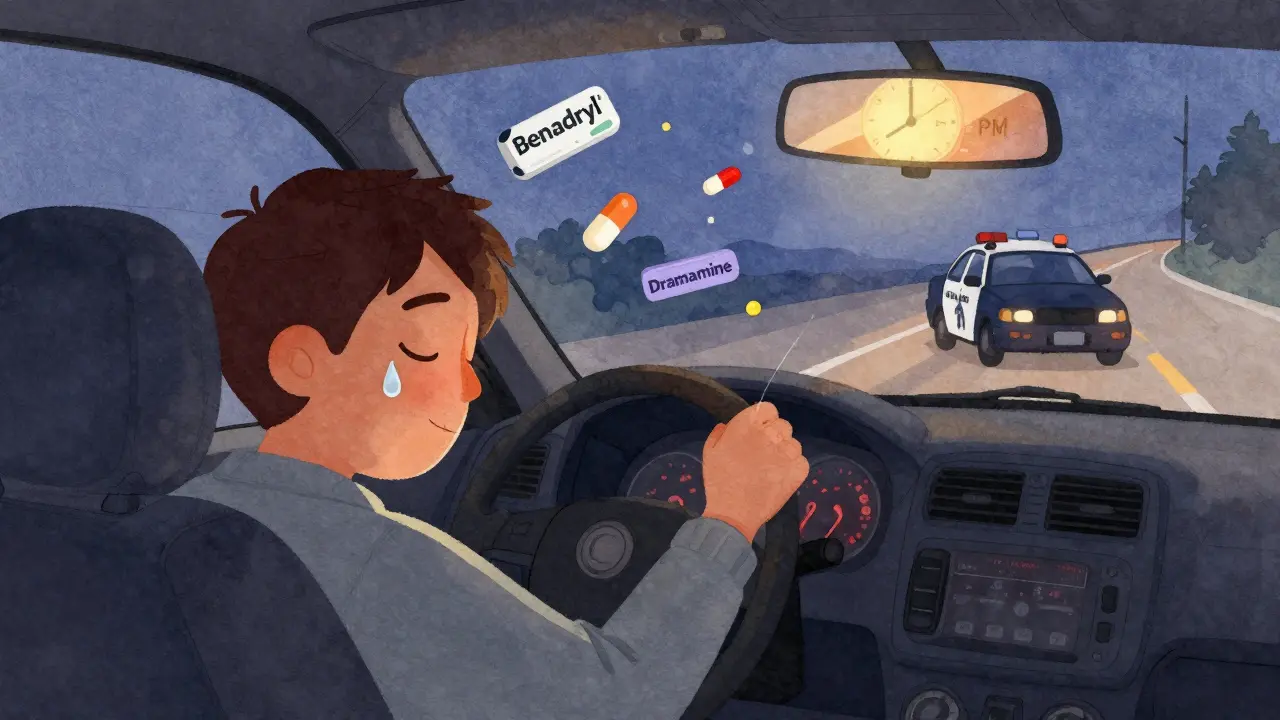
You take an antihistamine to stop the sneezing, the itchy eyes, the runny nose. It works. You feel better. But what you don’t feel-until it’s too late-is how much that pill is slowing you down behind the wheel. Every year, thousands of drivers in the U.S. get behind the wheel after taking over-the-counter allergy meds, unaware they’re driving as impaired as someone with a blood alcohol level of 0.05%. And the worst part? Many of them think they’re fine because they don’t feel sleepy.
The truth is, not all antihistamines are created equal. Some are safe to take before driving. Others aren’t just risky-they’re legally dangerous. In 22 European countries, it’s illegal to drive within 8 to 12 hours of taking certain first-generation antihistamines. In the U.S., while there’s no nationwide ban, police can charge you with DUI if they prove your driving was impaired by medication. And if you’re in a crash? Your antihistamine could end up in the toxicology report, turning what you thought was an accident into a legal nightmare.
How Antihistamines Work-and Why Some Make You Drunk Behind the Wheel
Antihistamines block histamine, the chemical your body releases during an allergic reaction. But here’s the catch: older antihistamines don’t just block histamine in your nose and throat. They cross the blood-brain barrier and mess with your central nervous system. That’s why you get drowsy.
First-generation antihistamines-like diphenhydramine (Benadryl), chlorpheniramine, and clemastine-are the worst offenders. They were developed in the 1940s and 50s, long before anyone fully understood how they affected brain function. These drugs are still sold over the counter, often in multi-symptom cold and flu products, and many people assume they’re harmless because they’re cheap and easy to buy.
But research shows they’re anything but. In controlled driving tests, drivers taking diphenhydramine showed 30-50% more lane deviation than those taking a placebo. That’s equivalent to driving with a blood alcohol concentration (BAC) of 0.05% to 0.08%-the legal limit in most U.S. states. And if you drink alcohol while taking one? Impairment jumps by 200-300%. One study found drivers who combined alcohol and Benadryl performed worse than those with a BAC of 0.10%.
The Generations of Antihistamines: Which Ones Are Safe to Drive After?
Not all antihistamines are the same. They’re grouped into three generations based on how they interact with your brain.
- First-generation: Diphenhydramine (Benadryl), chlorpheniramine, dexchlorpheniramine, clemastine, hydroxyzine. These are the most sedating. Avoid them before driving.
- Second-generation: Cetirizine (Zyrtec), loratadine (Claritin), fexofenadine (Allegra), levocetirizine (Xyzal). These were designed to be less sedating, but they’re not all equal.
- Third-generation: Fexofenadine and levocetirizine. These are the current gold standard for drivers.
Here’s the breakdown:
Cetirizine (Zyrtec) is often labeled “non-drowsy,” but that’s misleading. Studies show 15-20% of people still experience noticeable impairment at the standard 10mg dose. In one trial, drivers on cetirizine showed slower reaction times and reduced attention during complex traffic situations. If you’re sensitive, it’s not worth the risk.
Loratadine (Claritin) is much better. Most studies show minimal to no impairment at the standard 10mg dose. But even this isn’t foolproof-some people still feel foggy, especially if they’re older, taking other medications, or have liver issues.
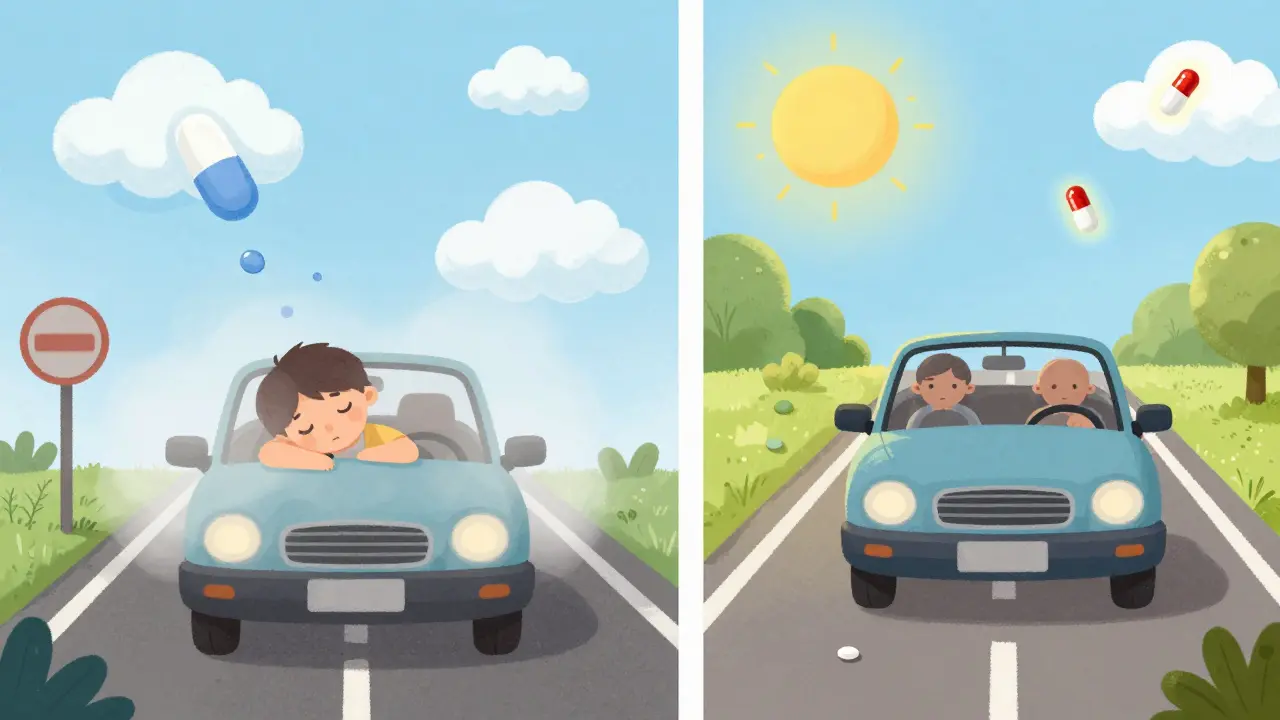
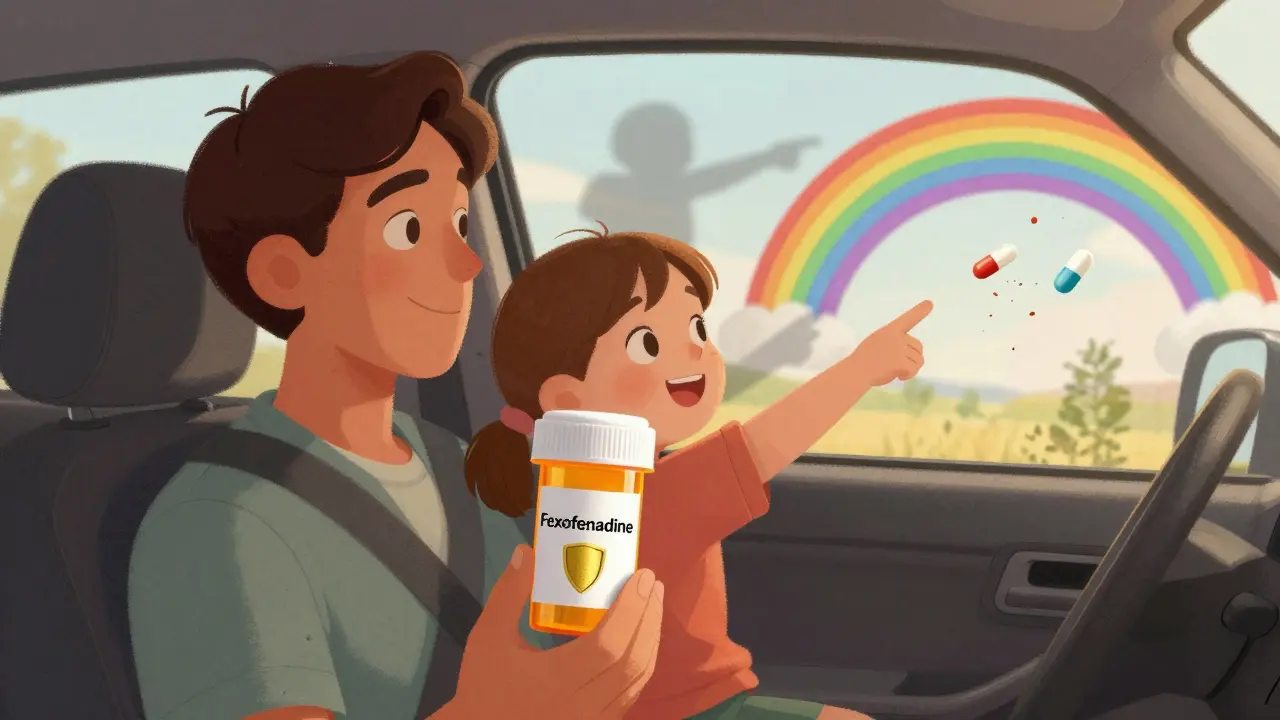
Fexofenadine (Allegra) and levocetirizine (Xyzal) are the safest. In 16 double-blind, placebo-controlled driving studies, neither caused statistically significant impairment-even after repeated daily doses. They barely enter the brain. You can take them in the morning and drive safely that afternoon. No guesswork. No risk.
What the Data Says: Real-World Risks You Can’t Ignore
It’s not just theory. Real people are getting into crashes because of antihistamines.
A 2006 study of accident victims found antihistamines in 0.6% of biological samples. That might sound small, but it’s a conservative number-many people don’t report medication use, and testing isn’t always done. In a Reddit thread with over 140 comments from allergy sufferers, 63% admitted to feeling drowsy or slowed down after taking Benadryl while driving. Twelve percent said they had near-miss accidents because of it.
One user wrote: “Took Benadryl before a road trip and had to pull over three times because I kept nodding off-never doing that again.”
On the flip side, a Drugs.com survey of 1,245 people found 82% reported no impact on driving after taking fexofenadine. Only 18% said they felt slightly slower during heavy traffic or complex maneuvers-nothing dangerous, just minor.
And here’s the kicker: 70% of people who take sedating antihistamines can’t accurately tell how impaired they are. You might feel fine. But your brain is still lagging. Your reaction time is slower. Your focus is thinner. You’re not drunk-you’re medicated. And that’s just as dangerous.
Legal Consequences: You Can Get Charged with DUI for Taking Benadryl
In the U.S., there’s no law that says “it’s illegal to drive after taking antihistamines.” But that doesn’t mean you’re safe.
Police can arrest you for DUI if they prove your driving was impaired by any substance-including prescription or over-the-counter drugs. Prosecutors don’t need to prove you were drunk. They just need to show the medication affected your ability to drive safely. And if you’re in a crash? Your antihistamine use becomes evidence.
In 2022, the NHTSA reported that 3.5 million traffic violations involved drivers under the influence of impairing medications. Antihistamines made up 15-18% of those cases. That’s tens of thousands of drivers annually who got pulled over or cited for driving while impaired by allergy meds.
In Europe, the rules are stricter. Countries like Germany, France, and Sweden classify certain first-generation antihistamines as controlled substances for drivers. You can be fined, lose your license, or even face criminal charges if you’re caught driving after taking them.
And insurance? If you’re in an accident and it’s found you took a sedating antihistamine, your claim could be denied. Most policies exclude coverage for accidents caused by impaired driving-even if the impairment came from a legal medication.
What You Should Do: A Simple Plan to Stay Safe
You don’t have to suffer through allergies to stay safe on the road. Here’s what to do:
- Switch to fexofenadine (Allegra) or levocetirizine (Xyzal). These are the only antihistamines proven safe for drivers. They’re more expensive-$35 a month vs. $4 for Benadryl-but your safety is worth it.
- Never take first-generation antihistamines before driving. That includes Benadryl, Dramamine, and most nighttime cold medicines. Check the active ingredients.
- Wait 48 hours after starting any new antihistamine. Even “non-drowsy” ones can affect you differently than others. Test them at home first. Try reading, walking, or using a driving simulator app before getting behind the wheel.
- Avoid alcohol and other sedatives. Combining antihistamines with alcohol, sleep aids, or even some painkillers can turn mild drowsiness into dangerous impairment.
- Don’t rely on how you feel. Feeling alert doesn’t mean you’re safe. Your brain’s reaction time can still be slowed without you noticing.
If you’re already taking a sedating antihistamine, talk to your doctor. Ask for a switch to fexofenadine or levocetirizine. Most insurance plans cover them. And if cost is an issue, ask about generic versions-they’re often cheaper than brand names.
Why “Non-Drowsy” Doesn’t Mean Safe
Labeling is misleading. “Non-drowsy” on a Zyrtec bottle sounds reassuring. But it’s not a guarantee. The FDA allows that label if the drug causes less drowsiness than diphenhydramine-not if it causes zero impairment.
Dr. F. Estelle R. Simons, a leading allergy expert, put it plainly: “Clinical tolerance to the sedating effects of these drugs has been reported anecdotally, but it has not consistently been found objectively.” Translation: Just because you’ve taken it for weeks doesn’t mean your body got used to it. You’re still impaired.
And here’s another trap: many people think if they only take one pill, it’s fine. But even a single dose of cetirizine can impair driving for up to 12 hours. And since these drugs are often taken at night for allergy relief, people don’t realize they’re still feeling the effects the next morning.
What’s Changing: The Future of Allergy Medication and Driving
The good news? The medical community is waking up. In 2023, the American College of Allergy, Asthma & Immunology reported that 78% of doctors now prescribe fexofenadine or levocetirizine as first-line treatment for patients who drive.
The FDA and EMA now require all antihistamine labels to include clear warnings based on generation and risk level. New nasal sprays like levocabastine, approved in 2021, show no driving impairment in trials. And seven new peripherally-acting antihistamines are in late-stage testing-drugs that block histamine only in the nose and throat, with zero brain effects.
Insurance companies are also taking notice. The Insurance Institute for Highway Safety estimates that if more people switched to safer antihistamines, medication-related crashes could drop by 40-50% over the next decade.
But change won’t happen unless drivers know the truth. You can’t rely on ads or store shelves to tell you what’s safe. You need to read the label, know the active ingredient, and choose wisely.
Final Thought: Your Life Is Worth More Than a $4 Bottle
It’s easy to reach for the cheapest antihistamine. But if you drive, your safety isn’t about saving a few dollars. It’s about protecting yourself, your passengers, and everyone else on the road.
Benadryl might be cheap. But a DUI, a crash, or a life-altering injury? Those costs are infinite.
Switch to fexofenadine or levocetirizine. Test new meds at home. Never mix them with alcohol. And if you’re ever unsure-don’t drive. Wait. Sleep it off. It’s not weakness. It’s wisdom.
Cam Jane
January 6, 2026 AT 10:21And yes, it costs more-but so does a DUI.
Melanie Clark
January 7, 2026 AT 02:21Harshit Kansal
January 8, 2026 AT 23:10Brian Anaz
January 9, 2026 AT 11:13Kiran Plaha
January 10, 2026 AT 06:39Matt Beck
January 11, 2026 AT 22:45Wake up. You're not special. The chemistry doesn't care.
Kelly Beck
January 12, 2026 AT 01:26And if you need someone to cheer you on-I’m here.
Ryan Barr
January 13, 2026 AT 12:43Isaac Jules
January 15, 2026 AT 12:20Lily Lilyy
January 15, 2026 AT 19:01Susan Arlene
January 17, 2026 AT 00:40Joann Absi
January 17, 2026 AT 21:43Leonard Shit
January 18, 2026 AT 21:59Gabrielle Panchev
January 20, 2026 AT 09:26