
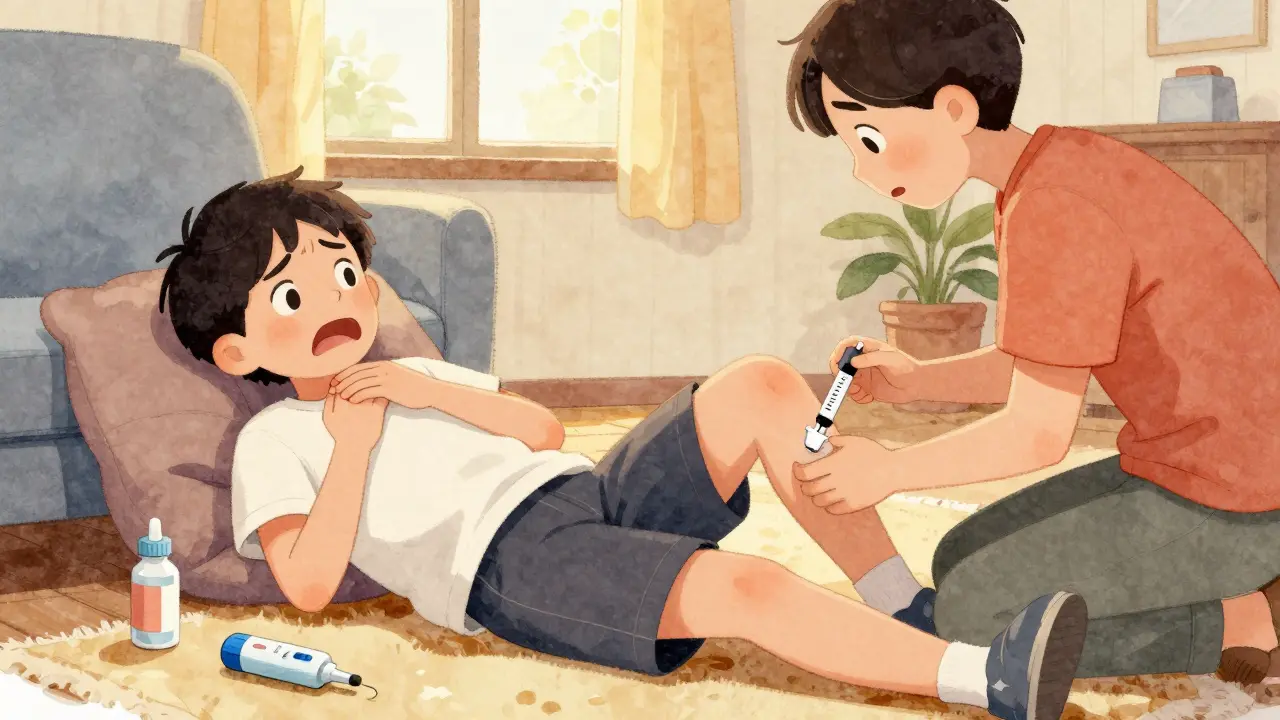
When a medication triggers anaphylaxis, seconds matter. This isn’t a slow-burning reaction-it’s a full-system collapse waiting to happen. One minute you’re fine, the next you’re gasping for air, your throat is closing, and your blood pressure is crashing. And the worst part? Many people wait too long to act. In hospitals, the average time from symptom start to epinephrine is over eight minutes. That’s too late. The window to save a life is five minutes or less.
What Anaphylaxis from Medication Actually Looks Like
Anaphylaxis from drugs doesn’t always start with a rash or hives. In fact, up to 20% of cases show no skin symptoms at all. That’s why so many people miss it. The real danger signs are in your airway, breathing, and circulation-the ABCs.- Difficulty breathing, wheezing, or a persistent cough
- Swelling of the tongue, throat, or lips
- Tightness in the throat, hoarse voice, or trouble talking
- Dizziness, fainting, or sudden collapse
- Pale, clammy skin-especially in children
- Rapid heartbeat or feeling like your heart is pounding
The One Thing That Saves Lives: Epinephrine
Epinephrine is the only treatment that stops anaphylaxis from killing you. Antihistamines like Benadryl? They help with itching, but they do nothing for your airway or blood pressure. Steroids? They might reduce swelling later, but they won’t stop you from going into shock right now. Epinephrine works in 1 to 5 minutes. It opens your airways, tightens your blood vessels to raise your pressure, and calms your overactive immune system. But it only lasts 10 to 20 minutes. That’s why you need to call for help immediately-even if you feel better after the shot. For adults and kids over 30 kg, use a 0.3 mg auto-injector. For children 15-30 kg, use 0.15 mg. Inject into the outer thigh, through clothing if needed. Hold it in place for 10 seconds. Don’t massage the area. Don’t hesitate. If you’re unsure, give it anyway. Studies show that hesitation causes 35% of preventable deaths.Positioning: Don’t Let Them Stand Up
Lay the person flat on their back. Immediately. No exceptions. Standing, sitting up, or even walking-even if they feel fine-can trigger sudden cardiovascular collapse. About 15-20% of deaths happen because someone was allowed to stand after symptoms started. If they’re having trouble breathing, let them sit up with legs stretched out. If they’re unconscious, roll them onto their left side (recovery position). Pregnant women should always lie on their left side to avoid pressure on major blood vessels. For small children, hold them flat-don’t hold them upright.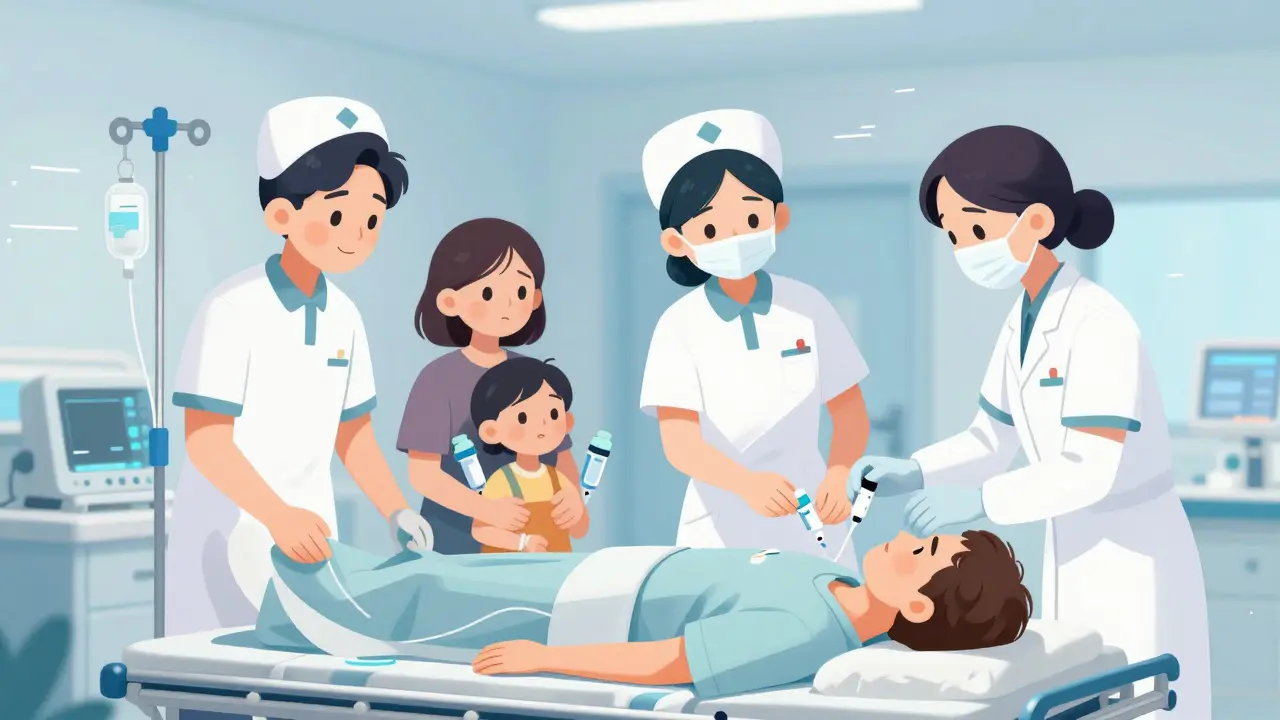
What to Do After the First Shot
If symptoms don’t improve after 5 minutes, give a second dose of epinephrine. Same spot. Same dose. Repeat every 5-10 minutes if needed. Don’t wait for EMS to arrive. Don’t wait for a doctor. If you have another auto-injector, use it. Call 999 (UK) or your local emergency number right away-even if you gave epinephrine. You need to go to the hospital. Why? Because 1 in 5 people have a second wave of symptoms hours later, called a biphasic reaction. That’s why you must be monitored for at least 4 hours. For medication-induced cases, some experts now recommend 6-8 hours because the risk is higher than with food allergies.Why People Delay-And How to Beat It
In hospitals, 65% of anaphylaxis cases get epinephrine too late. Why? Fear. Nurses worry about side effects like high blood pressure or a racing heart. But here’s the truth: out of 35,000 epinephrine doses given for anaphylaxis between 2015 and 2020, only 0.03% caused serious heart problems. The risk of not giving it? Death. Outside hospitals, 68% of people with known allergies carry an auto-injector. But only 41% feel confident using it. Common mistakes? Not holding the device long enough (37% of errors), injecting into fat instead of muscle (18%), or not piercing through clothing (23%). Practice with a trainer pen. Know how it works. Teach your family.Special Cases: Beta-Blockers and Obesity
If you’re on beta-blockers-for high blood pressure, heart issues, or anxiety-epinephrine might not work as well. These drugs block the effects of adrenaline. In these cases, you might need 2-3 times the normal dose. And if you’re obese (BMI over 30), standard doses may not reach your bloodstream fast enough. New research suggests higher doses based on body mass index could improve outcomes. If you’re in this group, talk to your doctor about your emergency plan.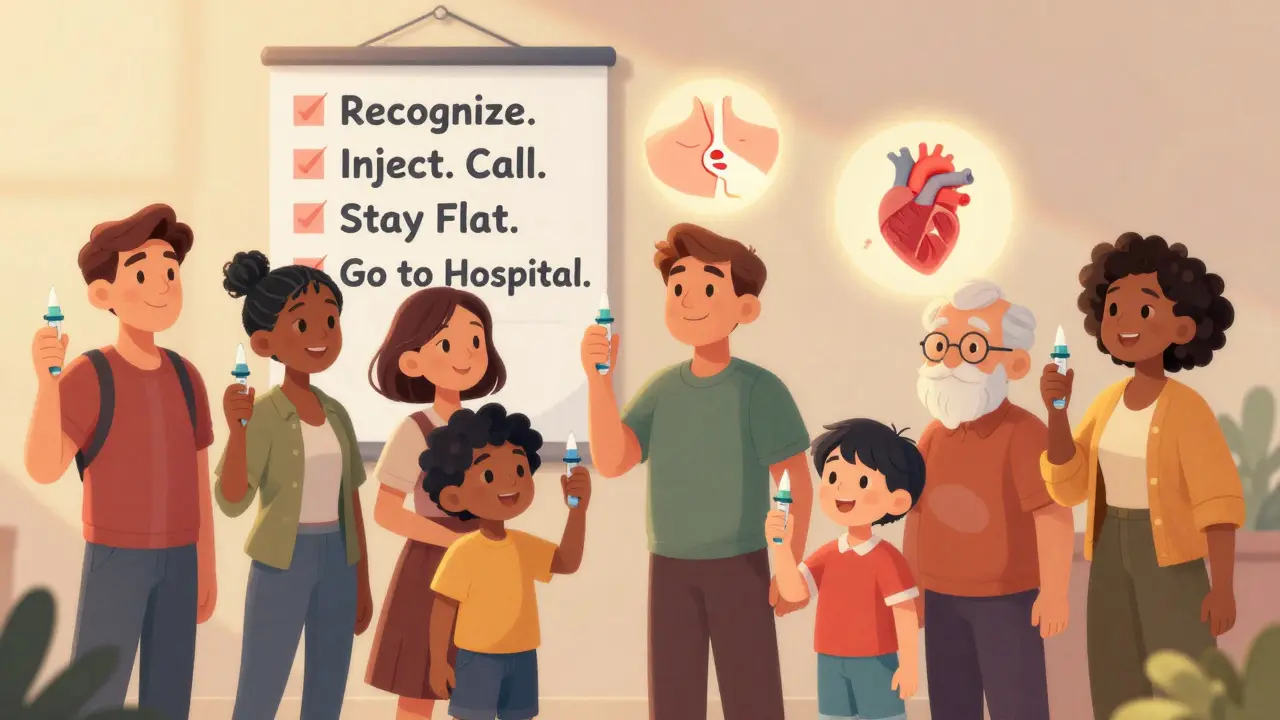
What Hospitals Will Do Next
Once you’re in the ER, they’ll start IV fluids-usually 1-2 liters of saline-to help stabilize your blood pressure. Oxygen will be given if your levels are low. They may give more epinephrine through an IV drip if you’re still crashing. This is only done by trained teams in controlled settings. They’ll monitor your heart, oxygen, and blood pressure for hours. You won’t be sent home after one dose. Even if you feel fine, you need to be watched. You’ll likely get a prescription for two epinephrine auto-injectors and a referral to an allergy specialist. They’ll help you figure out what caused it and how to avoid it again.What to Carry and What to Avoid
Always carry two epinephrine auto-injectors. One might not be enough. Keep them at room temperature. Don’t leave them in your car or in direct sunlight. Check the expiration date every 6 months. Replace them if the liquid looks cloudy or discolored. Avoid NSAIDs if you’ve had a reaction to them-even if it was years ago. Cross-reactivity is real. If you’re allergic to penicillin, ask your doctor about alternatives before any surgery. Tell every healthcare provider-dentists, pharmacists, ER staff-about your history. Write it on a medical ID bracelet if you can.The Bottom Line
Anaphylaxis from medication is rare, but deadly when ignored. The rules are simple: recognize the signs fast, give epinephrine fast, call for help fast, stay flat, and go to the hospital. No exceptions. No delays. No guessing. Your life depends on acting before you’re sure. If you’re unsure-give the shot. If you’re scared-give the shot. If you’re alone-call 999 and give the shot. Every second counts.Can antihistamines stop anaphylaxis?
No. Antihistamines like Benadryl only help with mild skin symptoms like itching or hives. They do nothing for breathing problems, low blood pressure, or airway swelling. Relying on them alone during anaphylaxis can be fatal. Epinephrine is the only treatment that reverses life-threatening symptoms.
Why is epinephrine given in the thigh?
The outer thigh has rich blood flow, which lets epinephrine enter the bloodstream quickly. It’s also easy to access through clothing and less likely to be missed compared to other sites. Injecting into the arm, stomach, or buttocks slows absorption and reduces effectiveness.
What if I’m not sure it’s anaphylaxis?
If you’re unsure, give the epinephrine anyway. The risk of giving it when it’s not needed is extremely low. The risk of not giving it when it is needed? Death. Studies show hesitation causes nearly one-third of preventable deaths. The saying is clear: If in doubt, give adrenaline.
Can I reuse an epinephrine auto-injector?
No. Auto-injectors are single-use devices. Once the needle is deployed, the device is spent-even if not all the medicine was delivered. Always carry two. Replace expired ones immediately. Some newer models have voice guidance to help during stress.
Why do I need to go to the hospital after using epinephrine?
Even if you feel better, up to 20% of people have a second wave of symptoms hours later-called a biphasic reaction. This can happen 1 to 72 hours after the first episode. Hospital observation for at least 4 hours (6-8 for medication-triggered cases) is standard to catch and treat this early. Discharging too soon has led to preventable deaths.
Are there new epinephrine devices I should know about?
Yes. The FDA approved the Auvi-Q 4.0 in 2023, the first auto-injector with voice guidance. It tells you when to inject and how long to hold it. In trials, it improved correct use from 63% to 89% among untrained users. If you or a loved one struggles with anxiety during reactions, this device can make a life-saving difference.
Patrick Merrell
January 27, 2026 AT 18:20People still don’t get it. Epinephrine isn’t a suggestion-it’s a lifeline. I’ve seen someone die because a nurse waited for ‘confirmation.’ There’s no confirmation. If the signs are there, you act. No second guesses. No paperwork. No ‘let me check the protocol.’ You inject. You call 999. You save a life. Period.
And if you’re one of those people who says ‘I’ll just take Benadryl first’-you’re not helping. You’re delaying the inevitable. Stop romanticizing slow responses. Anaphylaxis doesn’t wait for your hesitation.
Ryan W
January 29, 2026 AT 15:15Let’s cut through the noise. The 8-minute median time to epinephrine in hospitals is a systemic failure, not a clinical one. We’re talking about a drug that’s been around since 1901 being treated like a last-resort option. The real issue? Liability culture. Nurses fear side effects-hypertension, tachycardia-so they wait for ‘clearer signs.’ But the data’s clear: 0.03% adverse events vs. 100% mortality if untreated. This isn’t medicine. It’s risk-averse cowardice dressed up as protocol.
And don’t get me started on BMI dosing. If you’re obese and on beta-blockers, your auto-injector is a toy. We need weight-based protocols. Standardized. Now. Not ‘talk to your doctor.’ That’s a death sentence wrapped in bureaucracy.
Rakesh Kakkad
January 30, 2026 AT 21:55As a medical professional from India, I must emphasize the urgency of this message. In rural clinics, epinephrine is often unavailable or stored improperly-exposed to heat, expired, or locked away due to fear of misuse. We have trained nurses who have never held an auto-injector. The gap between knowledge and access is not just a gap-it is a chasm.
It is not enough to say ‘carry two.’ Many cannot afford even one. We need government-funded distribution programs. Community training. Public awareness campaigns in local languages. This is not a Western problem-it is a global emergency. Lives are lost daily because we assume education alone will save them. It will not. Action will.
Simran Kaur
February 1, 2026 AT 00:14I lost my brother to this. He had a mild reaction to ibuprofen five years ago-just a rash. He thought it was nothing. Then last year, he took a painkiller after a back injury. No rash. No warning. Just… collapse. We were at home. I panicked. I called 911. I grabbed the EpiPen. I didn’t know how to use it. I fumbled. I cried. He was gone before the ambulance arrived.
I carry two now. I taught my mom, my dad, my sister. I even showed my coworkers. I don’t care if it’s awkward. I don’t care if people think I’m overreacting. I’d rather be the weirdo who saved someone than the one who watched them die because they didn’t know how.
If you’re reading this-please, please, please-learn. Practice. Carry two. Teach someone. Don’t wait until it’s too late.
Angie Thompson
February 1, 2026 AT 20:55OMG I JUST REALIZED I’VE BEEN KEEPING MY EPI PEN IN MY CAR FOR A YEAR 😱 I thought it was fine because it wasn’t expired but like… HOT CAR = BAD. I just grabbed a new one and put it in my purse with a little note that says ‘IF I’M PASSING OUT, STAB ME IN THE THIGH.’
Also, I showed my partner how to use it. He thought I was joking. I didn’t laugh. He’s now the official EpiPen Enforcer. We even bought a trainer pen and did a mock emergency while watching Netflix. Yes, we’re weird. But we’re alive. 💪❤️
Skye Kooyman
February 2, 2026 AT 23:50SWAPNIL SIDAM
February 4, 2026 AT 03:57My mother is diabetic and on beta-blockers. She was terrified of epinephrine until I showed her the data. Now she carries two. She says she doesn’t want to be a burden. But I tell her-this isn’t about burden. It’s about being alive. We practiced with the trainer pen last Sunday. She held it for ten seconds. Didn’t flinch. I cried.
Thank you for writing this. It’s not just information. It’s a gift.
Geoff Miskinis
February 5, 2026 AT 11:36Let’s be brutally honest: most of this is common sense. But the fact that we need a 2,000-word guide to tell people to inject epinephrine into the thigh instead of their palm suggests a society that has outsourced basic survival skills to institutions.
And the ‘voice-guided auto-injector’? A Band-Aid on a hemorrhage. The real problem isn’t device design-it’s cultural ignorance. We’ve turned medical emergencies into spectator events. People wait for someone else to act. That’s not a failure of medicine. It’s a failure of character.
Also, ‘biphasic reactions’ are not ‘new.’ They’ve been documented since the 1950s. Why are we acting like this is groundbreaking? The science isn’t new. The complacency is.
Sally Dalton
February 7, 2026 AT 02:09Just wanted to say thank you for this. I’m a nurse and I’ve seen too many people delay because they thought it was ‘just a panic attack’ or ‘maybe it’s allergies.’ I’ve also seen nurses hesitate because they’re scared of giving too much. This post? It’s the kind of thing I wish I could hand out to every new hire.
And to the person who said they’re scared to use it-I get it. I was too. But I practiced on an orange. Then on a banana. Then on my own thigh (with the trainer). It’s not scary once you know how it works. You’re not hurting anyone. You’re saving them.
Also, I just bought two EpiPens. One for my bag. One for my car. And I told my kids: ‘If I’m not breathing, you do it. No waiting.’