
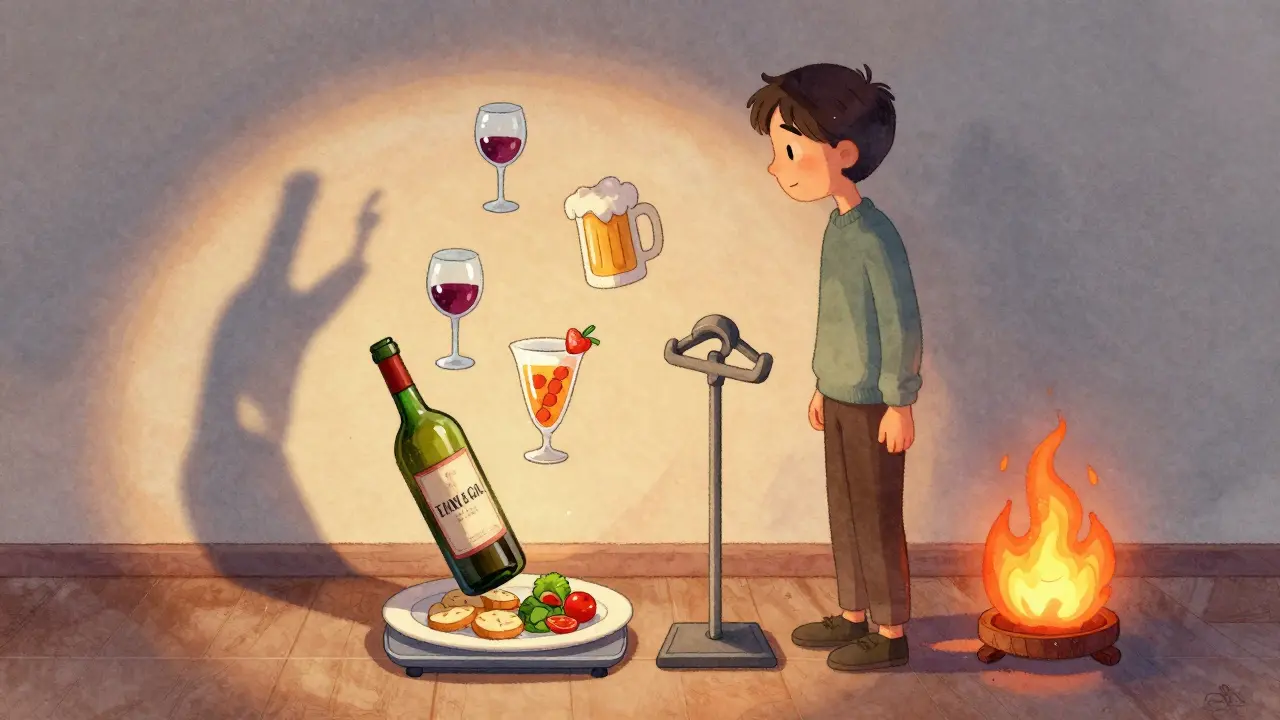
Let’s be honest: if you’re trying to lose weight, alcohol is one of the sneakiest obstacles you’ll face. It’s not sugar. It’s not fried food. It doesn’t come with a label that says "high calorie." But it’s silently sabotaging your progress - and most people have no idea how much.
Alcohol Isn’t Just Empty Calories - It’s Metabolic Sabotage
Alcohol has 7 calories per gram. That’s almost twice as much as protein or carbs, and only a little less than fat. A standard 5-ounce glass of wine? Around 125 calories. A 12-ounce beer? About 150. Sounds harmless, right? Until you realize you’re drinking those calories on top of your regular meals.
But here’s the real problem: your body doesn’t treat alcohol like food. It treats it like poison. When you drink, your liver stops burning fat. Instead, it focuses all its energy on breaking down ethanol. That pause in fat metabolism lasts about 1 to 2 hours per drink. During that time, any fat you eat - from your dinner, your snack, even the butter on your toast - gets stored instead of burned.
Research from the American Journal of Clinical Nutrition found that when alcohol is in your system, your body stores 30-40% more dietary fat than usual. That’s not a small bump. That’s a major shift in how your body handles energy. And it’s happening every time you drink.
Why You Eat More After Drinking
Ever notice how after a few drinks, you suddenly crave pizza, chips, or that greasy kebab? You’re not weak - your biology is working against you.
Alcohol lowers your inhibitions, yes. But it also directly affects your brain’s hunger signals. Studies from the Cleveland Clinic show people consume 20% more food after drinking alcohol compared to when they drink non-alcoholic beverages - even when they’re told to eat the same amount.
One reason? Alcohol suppresses leptin, the hormone that tells you you’re full. At the same time, it boosts ghrelin, the hormone that makes you hungry. The result? You feel hungrier, less in control, and more likely to reach for high-calorie, low-nutrient foods.
And it’s not just dinner. UC San Diego’s 2022 study found alcohol increases late-night snacking by 45%. That midnight snack? It’s not a choice - it’s a biological response.
Not All Drinks Are Created Equal
Not every alcoholic drink is equally damaging. The difference between a vodka soda and a piña colada isn’t just taste - it’s hundreds of calories.
- 1.5 oz of 80-proof vodka: 100 calories
- Same vodka with club soda and lime: still 100 calories
- Same vodka with tonic water and sugar: 180-200 calories
- 1.5 oz of rum with coconut cream and pineapple juice (piña colada): 400-500 calories
- Some cocktails: over 700 calories - more than a cheeseburger
When you mix alcohol with sugary sodas, syrups, or fruit juices, you’re adding sugar on top of alcohol’s metabolic chaos. That’s a double hit: extra calories plus a blood sugar spike that drives cravings later.
Stick to simple mixes: vodka or gin with soda water and a squeeze of citrus. Skip the pre-made cocktails, sweet wines, and beer floats. If you’re counting calories, your drink should be as clean as your meal.

Alcohol Can Erase Your Daily Calorie Deficit
Most weight loss plans aim for a 500-calorie daily deficit. That’s manageable. But if you drink two beers and a glass of wine in an evening, you’ve already added 400-500 calories - and that’s before the late-night snack.
A 2021 study tracking 12,500 adults found that people who cut their alcohol intake from heavy to moderate lost an average of 3.7 pounds in 12 months - without changing anything else about their diet. That’s not magic. That’s just removing a major source of hidden calories.
And it’s not just about quantity. The HSE Ireland’s 2023 analysis found that for people aged 25-45 who drink regularly, alcohol makes up 10-12% of their daily calories. That’s like eating a full meal’s worth of calories just from drinks. No wonder weight loss stalls.
Strategies That Actually Work
You don’t have to quit alcohol cold turkey to lose weight. But you do need a plan.
- Set alcohol-free days. Aim for 3-4 days a week with zero alcohol. This isn’t about restriction - it’s about resetting your metabolism. Clinical data shows this cuts weekly calorie intake by 750-1,200 for moderate drinkers.
- Pre-load with protein. Eat 20-30 grams of protein before drinking. Chicken, eggs, Greek yogurt - anything high in protein. Research shows this reduces post-drinking food intake by 18%.
- Measure your pours. A standard glass of wine is 5 ounces. Most people pour 7-8 ounces at home. That’s 35-50 extra calories per glass. Use a measuring cup once to see how much you’re actually pouring.
- Track your drinks. People underestimate cocktail calories by 47%, according to UC San Diego’s tracking data. Use an app. Write it down. Treat alcohol like food - because your body does.
- Choose lower-calorie options. Dry white wine, light beer, or spirits with soda water are your best bets. Avoid dessert wines, sweet cocktails, and sugary mixers.

Why Some People Lose Weight and Others Don’t
Not everyone responds the same way to alcohol. Some people can have a glass of wine with dinner and still lose weight. Others cut out alcohol overnight and see results within days.
Why? Genetics. Metabolism. Hormones. A 2022 study in Nutrients identified three distinct metabolic responses to alcohol. Some people burn alcohol quickly and store less fat. Others process it slowly, leading to more fat storage and stronger hunger signals.
That’s why blanket advice like “just stop drinking” doesn’t work for everyone. But here’s the truth: even if you’re in the group that handles alcohol better, you’re still getting the appetite boost. You’re still interrupting fat burning. You’re still adding empty calories.
Weight loss isn’t about perfection. It’s about consistency. And alcohol, no matter your metabolism, is a consistent barrier.
What the Experts Say
Dr. Leslie Heinberg from the Cleveland Clinic puts it plainly: “For people trying to lose weight, cutting out empty calories is a good place to start.”
The Dietary Guidelines for Americans 2020-2025 say moderate drinking (one drink a day for women, two for men) can fit into a healthy diet - but only if calories are accounted for. That’s the key phrase: accounted for.
Most people don’t account for it. They think, “I skipped dessert today, so I can have wine.” But they forget the wine is 125 calories, the snack after is 300, and the fat storage spike adds another 100-200 calories worth of stored energy.
It’s not about guilt. It’s about awareness.
The Bigger Picture
Alcohol isn’t the only reason you’re not losing weight. But it’s one of the most avoidable ones. Unlike processed snacks or sugary cereals, alcohol has no nutritional benefit. No fiber. No vitamins. No protein. Just calories and disruption.
When you remove it, you’re not just cutting calories. You’re giving your body back its ability to burn fat. You’re reducing cravings. You’re improving sleep. You’re lowering inflammation. All of that helps weight loss - even if you don’t change a single meal.
The market is changing, too. Searches for “low calorie alcoholic drinks” have gone up 65% since 2019. The global market for low-alcohol beverages is expected to hit $19.2 billion by 2027. People are waking up.
You don’t need to become a teetotaler. But if you’ve been stuck on a weight loss plateau, alcohol might be the missing piece. Try cutting it out for 30 days. Track your food. Track your energy. See what changes.
It’s not about giving up. It’s about choosing what really matters.
Does alcohol make you gain belly fat?
Yes. When you drink alcohol, your body prioritizes breaking it down, which slows fat burning. The excess calories from alcohol and the food you eat while drinking are more likely to be stored as fat - especially around your abdomen. This is why heavy drinkers often develop what’s called a "beer belly," even if they’re not eating a lot of junk food.
Can you lose weight while drinking alcohol?
Yes, but it’s harder. You can lose weight while drinking if you stay within your daily calorie limit and choose low-calorie options like vodka with soda water. But alcohol interferes with fat burning and increases hunger, so progress will be slower. Most people see faster results when they reduce or eliminate alcohol.
Is wine better than beer for weight loss?
Generally, yes. A 5-ounce glass of dry white wine has about 120 calories, while a pint of lager has 180-200. Wine also tends to be consumed more slowly, which may help reduce overall intake. But if you’re drinking multiple glasses of wine or adding sugar, it can quickly become worse than beer. Portion size and mixers matter more than the type of alcohol.
How many calories are in a shot of vodka?
A 1.5-ounce shot of 80-proof vodka contains 100 calories. It has no sugar, no carbs, and no fat. When mixed with soda water and lime, it stays at 100 calories. Add tonic water, juice, or syrup, and you’re adding 100-200 extra calories.
Will cutting out alcohol help me lose weight?
For most people, yes - and often faster than expected. Cutting out alcohol removes hidden calories, reduces appetite, and lets your body burn fat normally again. In one study, people who stopped drinking lost 3.2% more body fat over 12 weeks than those who cut other calories but kept drinking. The biggest changes often come in the first few weeks.
What should I drink instead of alcohol?
Sparkling water with lime, herbal tea, low-sugar kombucha, or a mocktail made with fresh fruit and soda water. These drinks give you the ritual of a drink without the calories or metabolic disruption. Many people find they enjoy the crispness and refreshment even more once they stop relying on alcohol for relaxation.
How long does it take to see weight loss after quitting alcohol?
Many people see changes within 1-2 weeks. You might lose 1-3 pounds quickly from reduced water retention and lower calorie intake. Fat loss follows over the next few weeks as your metabolism returns to normal. The biggest drop often happens when you combine alcohol reduction with better sleep and less late-night snacking.
Is it better to cut alcohol completely or just drink less?
For fastest results, cutting out alcohol completely for 30 days gives you the clearest picture of its impact. After that, you can decide if you want to reintroduce it in moderation. For many, 2-3 alcohol-free days a week is enough to keep progress steady without feeling deprived. The key is consistency - not perfection.
Fabio Raphael
December 26, 2025 AT 03:05I used to think cutting out beer was the big win, but switching from sweet cocktails to vodka soda? Game changer. I lost 4 lbs in 2 weeks without changing my diet at all. Turns out my weekend margaritas were basically liquid dessert.
Also, the protein pre-load tip? I started eating an egg or two before going out. No more 2 a.m. taco runs. My brain finally stopped screaming for grease.
Nikki Brown
December 27, 2025 AT 06:41If you’re drinking alcohol and expecting to lose weight, you’re not trying-you’re deluding yourself. This isn’t a ‘strategy.’ It’s basic biology. You wouldn’t pour gasoline on your car and expect it to run better. Why treat your body like a trash can?
And if you need ‘low-calorie’ cocktails, you’re not drinking-you’re bingeing with a side of denial.
roger dalomba
December 28, 2025 AT 12:56Wow. A 700-calorie cocktail. I didn’t know I was ordering a cheeseburger with a side of regret.
Also, ‘dry white wine’? Sounds like a wine that’s mad at you.
Rajni Jain
December 29, 2025 AT 13:51OMG yes!! I started doing alcohol-free Wednesdays and honestly? My skin cleared up, I slept better, and I stopped craving junk food at night.
Also, measuring my wine pour? I was pouring like a bartender who’s been at it since 8am. Whoops 😅
Try it. You’ll be shocked how much energy you get back.
Natasha Sandra
December 29, 2025 AT 19:06SO TRUE!! I cut out wine for 30 days and lost 5 lbs. Not because I ate less, but because I stopped snacking after 9pm. My brain was like, ‘Hey, we’re not drunk anymore, so why are we eating chips??’ 😂
Also, sparkling water with lime is my new BFF. So fancy, so zero guilt. 💧✨
Erwin Asilom
December 31, 2025 AT 03:40The metabolic interference effect is well-documented. Ethanol metabolism prioritizes acetaldehyde clearance, which inhibits fatty acid oxidation via NADH accumulation and malonyl-CoA suppression. This is why even moderate intake impedes fat loss.
Protein pre-loading increases satiety via GLP-1 and PYY release, reducing subsequent caloric intake. Evidence-based, not anecdotal.
Sumler Luu
January 1, 2026 AT 17:19I get it-alcohol messes with your goals. But I also think we need to be careful not to shame people for enjoying a drink now and then.
It’s not all-or-nothing. Maybe the real issue isn’t the drink-it’s the habit around it. The wind-down. The ritual. The comfort.
Find a replacement that feels like a treat, not a punishment.
sakshi nagpal
January 2, 2026 AT 04:12As someone from India, where alcohol consumption is often stigmatized but still present in urban circles, I find this article refreshingly balanced.
It’s not about moralizing-it’s about awareness. I’ve seen friends lose weight simply by switching from rum-cola to gin-soda. No drama. No deprivation. Just smarter choices.
Also, the 3-4 alcohol-free days? Brilliant. It’s not a diet. It’s a reset.
Sandeep Jain
January 3, 2026 AT 08:59bro i just stopped drinking beer for a month and my pants fit like they did in college 😭
also i didnt even try hard. just stopped. weird how simple stuff works huh
Brittany Fuhs
January 3, 2026 AT 22:48Of course alcohol stalls weight loss. We’re not talking about ‘calories’-we’re talking about cultural decay. America turns everything into a snack, even booze.
Real men don’t drink cocktails. Real men drink whiskey neat and lift weights. That’s discipline.
Also, if you’re measuring your wine, you’re not drinking-you’re doing a lab experiment.
Sophia Daniels
January 3, 2026 AT 23:46Let’s be real-alcohol is the silent relationship killer of weight loss. It’s not the beer. It’s the 3 a.m. pizza after the third glass. It’s the ‘I deserve this’ lie you tell yourself while staring at the fridge like a zombie.
I lost 11 lbs in 6 weeks after ditching wine. Not because I ate kale. Because I stopped feeding my brain’s craving addiction.
And yeah, my social life got weird for a bit. But my reflection? That’s the real party.
Peter sullen
January 4, 2026 AT 12:54According to the 2021 longitudinal cohort study published in the Journal of Nutritional Metabolism, a reduction in ethanol intake from ≥14 standard drinks/week to ≤7 standard drinks/week yielded a statistically significant (p<0.01) decrease in visceral adipose tissue volume, independent of caloric restriction.
Furthermore, the hepatic ethanol clearance rate varies by CYP2E1 polymorphism, which may account for inter-individual variability in fat storage efficiency post-consumption.
Therefore, it is empirically substantiated that alcohol moderation is a critical, non-negotiable variable in sustainable weight management protocols.
Steven Destiny
January 5, 2026 AT 13:55Stop overthinking this. Cut it out. Period. No ‘strategies.’ No ‘low-calorie’ lies. You want results? Stop drinking. Full stop.
I did it. Lost 18 lbs in 3 months. Didn’t count a single calorie. Just stopped. Your body doesn’t care about your ‘ritual.’ It just wants to burn fat.
Stop being soft.
Amy Lesleighter (Wales)
January 6, 2026 AT 10:04Alcohol isn’t evil. It’s just… not helpful. Like trying to run a marathon with a backpack full of rocks.
Some people can handle it. Some can’t. But everyone gets hungrier after drinking. Everyone’s fat-burning pauses. That’s not magic. That’s just biology.
Try 30 days. Not to punish yourself. Just to see what your body does without it. You might be surprised.
Becky Baker
January 7, 2026 AT 21:47Y’all are overcomplicating this. I quit drinking. Lost weight. Done. No stats. No science. Just didn’t drink. My body thanked me. End of story.