
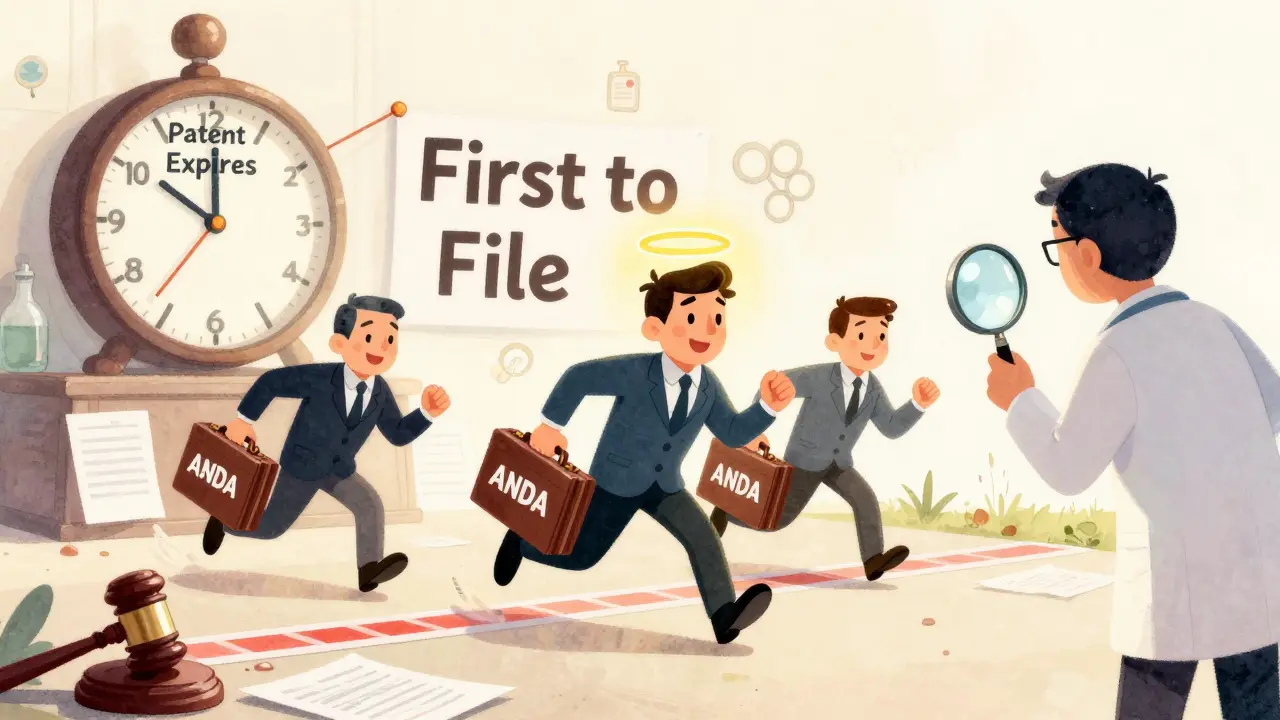
When a brand-name drug’s patent expires, you’d expect generic versions to flood the market quickly-lowering prices and giving patients more choices. But that’s not always what happens. Sometimes, even after a patent ends, the first generic version stays alone on the shelf for months-or even years-while others wait. The reason? A little-known rule called 180-day exclusivity.
What Is 180-Day Exclusivity?
It’s not a reward for being first to market. It’s a legal incentive built into the Hatch-Waxman Act of 1984 to get generic drug companies to challenge weak or overreaching patents. If a generic manufacturer files an Abbreviated New Drug Application (ANDA) with a Paragraph IV certification-meaning they claim the brand’s patent is invalid or not infringed-they can qualify for 180 days of market exclusivity. During that time, the FDA can’t approve any other generic versions of the same drug, even if they’re ready. This isn’t about protecting innovation. It’s about risk. Challenging a patent means going to court. It costs millions. And if you lose, you’re out of luck. So the 180-day window is the prize: the chance to be the only generic seller during a critical window when demand is highest and brand-name prices are still high.How Does It Actually Start?
The clock doesn’t start when the FDA approves the drug. It doesn’t even start when the patent expires. It starts on one of two dates:- The day the first generic company actually starts selling the drug
- The day a court rules the patent is invalid or not infringed
Why Does This Happen?
There’s a financial incentive to stall. If you’re the first applicant and you control the only generic version, you can set the price. No competition means you can charge close to the brand-name price-sometimes 80-90% of the original cost-instead of the 10-20% you’d see after multiple generics enter. Some companies have been known to delay launch for over a year just to maximize profits. And it’s not just greed. Sometimes, it’s legal strategy. A company might wait to launch until after a patent appeal is resolved, or until a settlement with the brand company is finalized. In some cases, brand and generic companies have struck deals where the generic agrees to delay entry in exchange for a cut of the profits. These are called “pay-for-delay” agreements, and they’re controversial-but still legal in many forms.
Who Gets the Exclusivity?
It’s not enough to just file an ANDA. You have to be the first to file a substantially complete application with a valid Paragraph IV certification. The FDA has strict rules about what “substantially complete” means. Missing a form? A typo in the chemistry data? That could disqualify you-even if you filed on the same day as someone else. If two companies file on the same day, the FDA uses internal rules to pick the winner. Sometimes it’s based on the order of receipt. Other times, it’s based on who submitted the most complete package first. This has led to lawsuits, petitions, and months of back-and-forth between companies trying to claim the prize. And here’s the kicker: only one company gets it. Even if five companies file valid Paragraph IV certifications on the same day, only one gets the 180-day window. The others go back to the waiting room. That’s why generic manufacturers often race to file-even if they’re not fully ready. The stakes are too high to wait.What Happens If You Lose the Exclusivity?
The 180-day exclusivity isn’t guaranteed. The Medicare Modernization Act of 2003 added forfeiture rules. You can lose it if:- You don’t market the drug within 75 days of FDA approval
- You withdraw your application
- You fail to get approval within 30 months of filing
- You enter into a settlement that delays your launch
How Is This Different From Other Exclusivities?
The FDA gives out several kinds of exclusivity:- 5-year new chemical entity: For brand-name drugs with a completely new active ingredient. No generics allowed for five years.
- 3-year new clinical investigation: For new uses or formulations of existing drugs. Blocks generics for three years.
- Pediatric exclusivity: Adds six months to existing patents if the company studies the drug in children.

What’s Being Done About It?
Critics say the system is broken. The 180-day exclusivity was meant to speed up generics. Instead, it’s become a tool to delay competition. In March 2022, the FDA proposed a major change: the exclusivity period should only last 180 days from the date of first commercial marketing. Right now, it can stretch for years. Under the new rule, if a company waits three years to launch, the clock only starts when they finally sell the drug-and then it runs for 180 days. After that, everyone else can enter. The proposal also suggests a 270-day exclusivity window if the first applicant launches more than five years before the patent expires. And if multiple companies qualify as “first applicants,” only one gets the first 90 days. The rest get approval on day 91. That’s a big shift. It moves away from the “winner-takes-all” model toward a more balanced system. But change moves slowly. The FDA can’t rewrite the law on its own. Congress has to approve any changes to the Hatch-Waxman Act. Until then, the current system stays in place-and so does the delay.What Does This Mean for Patients?
For patients, this isn’t just legal jargon. It’s about access and cost. A drug that could be $10 a pill as a generic might stay at $150 because only one version is on the market. That’s hundreds of dollars a month. For people on fixed incomes, chronic conditions, or without good insurance, that’s a life-altering difference. It also affects hospitals, pharmacies, and state Medicaid programs. When generics don’t enter, budgets get stretched. Drug shortages become more likely. And innovation slows because there’s less pressure to improve formulations or delivery methods. The 180-day exclusivity rule was designed to help patients. But in practice, it often does the opposite. The system rewards legal maneuvering over speed. It rewards delay over competition.What’s Next?
Generic manufacturers are watching closely. Some are pushing for reform. Others are doubling down on the current system, filing early, litigating hard, and waiting for the right moment to launch. The next few years will decide whether the 180-day exclusivity stays as it is-or evolves into something fairer. For now, the message is clear: if you want a generic drug to be affordable, don’t just wait for the patent to expire. Watch who files the first Paragraph IV challenge. And if they don’t launch quickly? You might be waiting longer than you think.Can multiple generic companies share the 180-day exclusivity?
No. Only the first company to file a substantially complete ANDA with a Paragraph IV certification qualifies. Even if multiple companies file on the same day, the FDA has rules to pick one winner. The rest are locked out until the exclusivity period ends-or is forfeited.
What happens if the first generic company never launches the drug?
If the first applicant never starts selling the drug, the 180-day exclusivity doesn’t expire. Other generic companies can’t get approval unless the first applicant forfeits the exclusivity-by withdrawing their application, failing to get approval within 30 months, or entering a pay-for-delay deal. In practice, this can block competition for years, even after the patent expires.
Is 180-day exclusivity the same as patent extension?
No. Patent extensions add time to the original patent term under the Hatch-Waxman Act-usually up to five extra years. The 180-day exclusivity is a separate incentive for generic companies to challenge patents. It doesn’t extend the brand’s patent. It delays other generics from entering the market after the patent ends.
How does the FDA decide who is the "first applicant"?
The FDA looks at the date and completeness of the ANDA submission. The first company to submit a substantially complete application with a valid Paragraph IV certification is typically awarded first-applicant status. Even minor errors-like missing signatures or incomplete bioequivalence data-can disqualify an applicant, even if they filed first.
Why don’t more generic companies challenge patents?
It’s expensive and risky. Legal fees for a patent challenge can exceed $5 million. If you lose, you can’t sell the drug at all. Even if you win, you might face delays from appeals. Many smaller companies can’t afford the gamble. Only those with deep pockets or strong legal teams take the risk.
Johanna Baxter
January 10, 2026 AT 07:45This system is a joke. One company gets to hold the entire market hostage for months just because they filed first? Patients are suffering while lawyers get rich. Someone needs to burn this whole thing down.
tali murah
January 10, 2026 AT 20:45Let’s be clear: this isn’t a market failure-it’s a regulatory capture masterpiece. The FDA, under pressure from Big Pharma, turned a tool meant to increase access into a profit-maximizing cartel mechanism. The 180-day window isn’t an incentive-it’s a loophole with a velvet rope.
And don’t get me started on ‘pay-for-delay’ agreements. That’s not competition. That’s collusion dressed up as litigation.
The 2022 FDA proposal? Too little, too late. They’re still letting the first filer dictate the timeline. If you don’t launch within 30 days of approval, you should forfeit automatically. No exceptions. No ‘negotiations.’
Meanwhile, patients are rationing insulin because some lawyer in Delaware decided to ‘wait for the right moment.’ The moment? When the brand’s patent expired and they could charge $149 instead of $14.
This isn’t capitalism. It’s feudalism with a pharmacy license.
Diana Stoyanova
January 11, 2026 AT 11:18Okay but imagine if this was applied to anything else-like, say, you’re the first person to open a taco stand after a city bans all street food for a year, and then you just… sit there for 18 months with your cart parked, not selling anything, while everyone else waits outside. People are starving. The smell of carnitas is in the air. And you’re just… chilling. Waiting for ‘the right time.’
That’s what’s happening here. The drug is ready. The science is done. The FDA says it’s safe. But the company? They’re playing chess with people’s lives.
And the worst part? We’re supposed to be impressed that they ‘took the risk’? Bro, the risk was built into the system. They knew the payout. They calculated it. It’s not bravery. It’s greed with a law degree.
Also-why does only ONE company get to win? Why not split it? Like, top 3 get 60 days each? That’d still incentivize filing, but stop the monopoly. Why is this so hard to fix?
Someone needs to start a TikTok campaign: #UnlockTheGeneric. I’ll make the memes.
Gregory Clayton
January 12, 2026 AT 15:12Why are we even letting foreign companies play in this game? America invented the modern pharmaceutical industry. Now we’re letting some startup in Ohio delay a drug launch for two years while a bunch of overseas generics sit and wait? This isn’t innovation. It’s national betrayal.
And don’t give me that ‘it’s legal’ crap. If it hurts American patients, it should be illegal. We need a law that says: if you’re a U.S. company and you delay launch beyond 90 days after approval, you forfeit the exclusivity-and the FDA gives it to the next American applicant. No exceptions.
Stop outsourcing our healthcare to corporate lawyers.
Ashley Kronenwetter
January 13, 2026 AT 23:42While the intent of the 180-day exclusivity provision was to encourage patent challenges, its implementation has created unintended consequences that undermine public health objectives. The current regulatory framework permits strategic delays that are neither transparent nor accountable.
There is a clear need for statutory reform to define a fixed commencement window for exclusivity, tied directly to FDA approval rather than commercial marketing. This would prevent indefinite postponement and ensure timely market entry for competing generics.
Moreover, the lack of public reporting on launch timelines by first applicants constitutes a transparency deficit that erodes trust in the regulatory process.
Micheal Murdoch
January 14, 2026 AT 04:37Look, I get why this rule exists. Challenging a patent is expensive. You’re risking millions. The 180 days? It’s supposed to be the reward for taking that leap.
But here’s the thing-when the reward becomes a weapon, the system breaks. And right now, it’s broken.
What if we flipped it? Instead of giving one company 180 days of monopoly, we give the first five applicants 36 days each. That still rewards early filers, but it stops the hold-up. More competition faster. Prices drop quicker. Patients win.
And if a company doesn’t launch within 60 days of approval? Automatic forfeiture. No drama. No waiting. Just get it out there.
This isn’t about punishing the brave. It’s about stopping the greedy from hiding behind bravery.
Lindsey Wellmann
January 14, 2026 AT 16:33WHY IS NO ONE TALKING ABOUT THIS?? 😭
Imagine you’re diabetic and your insulin costs $150 because ONE company is ‘waiting for the right moment’ to launch their generic. Meanwhile, they’ve had FDA approval for 3 years. THREE YEARS. 😤
They’re not ‘innovating.’ They’re just… sitting. On. Your. Life. Savings. 💸
#UnlockTheGeneric #GenericDrugsAreNotALuxury
Jacob Paterson
January 15, 2026 AT 23:47Of course this happens. The entire pharma industry is a rigged casino. The FDA? Just the bouncer letting the rich guys in the back room. The 180-day rule? It’s not a law. It’s a corporate loophole with a fancy name.
And don’t pretend these companies are ‘risking it all.’ They’ve got teams of lawyers who’ve done this a hundred times. They know exactly when to delay. They’ve got spreadsheets for it.
Meanwhile, grandma’s on a waiting list for her blood pressure med because ‘the market isn’t ready.’
Fix this. Or I’m starting a petition to sue the FDA for emotional distress.
Kiruthiga Udayakumar
January 16, 2026 AT 10:52India makes 80% of the world’s generic drugs. We know how to make them cheap. We know how to make them fast. But here in the US, you’ve got companies sitting on approvals like they’re holding a diamond. This isn’t capitalism. This is extortion with a white coat.
Why can’t the FDA just approve multiple generics at once? Why does one company get to be the gatekeeper? It’s insane.
My cousin died because she couldn’t afford her med. This isn’t policy. This is murder by bureaucracy.
Patty Walters
January 17, 2026 AT 04:16okay so i read this whole thing and honestly i had no idea this was even a thing. like… i just assumed once the patent expired, generics just showed up. but no. some company sits on it for 2 years? and the fda just lets them??
so if i file an anda but miss a signature, i lose forever? but if i file with a typo and win the lottery, i get to charge 150 bucks for a drug that should cost 10??
someone pls fix this. i’m scared to take my meds now.
Phil Kemling
January 17, 2026 AT 09:39It’s a paradox of incentive. The system rewards the very behavior it was designed to discourage-delay. The moment you tie exclusivity to commercial launch rather than approval, you create a perverse incentive to wait. Why rush when waiting multiplies profit?
This isn’t just about drugs. It’s about how we design systems that assume rational actors. But humans aren’t rational. They’re greedy, strategic, and patient. And when you give them a legal way to profit from delay, they’ll exploit it to the max.
Maybe the answer isn’t more rules. Maybe it’s fewer incentives. Remove the exclusivity entirely. Let the market decide. Let competition drive price down faster. Let the first filer win not by holding back, but by moving fast.
That’s real innovation.
Jenci Spradlin
January 17, 2026 AT 21:33so like… if a company files first but never launches, does the exclusivity just… live forever? like a zombie patent? 😳
someone needs to make a tracker website. ‘Generic Drug Delay Watch’-showing how long each company is sitting on their approval. public shaming might actually work here.
also, why is the fda so slow to update this? they’ve had 40 years to fix this. 40. years.
Elisha Muwanga
January 19, 2026 AT 06:23Another example of government overreach disguised as consumer protection. The Hatch-Waxman Act was supposed to balance innovation and access. Instead, it created a bureaucratic nightmare that benefits lawyers and big pharma.
The real problem? The FDA has too much power. Let the market decide. If a generic company wants to wait to launch, fine. But don’t block others from entering. That’s not regulation. That’s censorship of competition.
Free markets work. This system doesn’t.
Maggie Noe
January 20, 2026 AT 06:29It’s wild how something so technical can have such human consequences. One signature. One typo. One delay. And someone can’t afford their medication.
I used to think the system was broken because of corruption. Now I think it’s broken because we treat healthcare like a spreadsheet instead of a lifeline.
What if we made every FDA official who approves a drug with a delayed launch have to sign a letter to the patient who suffered because of it?
Would they still wait?
Jerian Lewis
January 21, 2026 AT 21:29I’ve worked in pharma compliance for 12 years. This isn’t a scandal-it’s standard operating procedure. The 180-day exclusivity is a legal artifact that’s been weaponized. Companies don’t challenge patents to help patients. They challenge them to win the lottery.
The FDA’s 2018 letter on buprenorphine? That was a quiet revolution. But nobody talks about it because the media doesn’t cover regulatory letters. Only lawsuits make headlines.
Change will come when a patient dies because their insulin was delayed. Then we’ll have hearings. Then we’ll have outrage. Then we’ll have… nothing.
Micheal Murdoch
January 22, 2026 AT 11:40Just read the comment above from 6678. He’s right. This isn’t a glitch. It’s the design.
And that’s why the FDA’s proposal is so important. If we tie exclusivity to the date of first commercial marketing, we remove the incentive to delay. If you wait five years? Your 180 days start in year five. Everyone else can enter right after.
It’s not perfect. But it’s the first step that actually moves the needle.
Let’s not wait for a tragedy to fix this. Let’s fix it before someone else dies.